
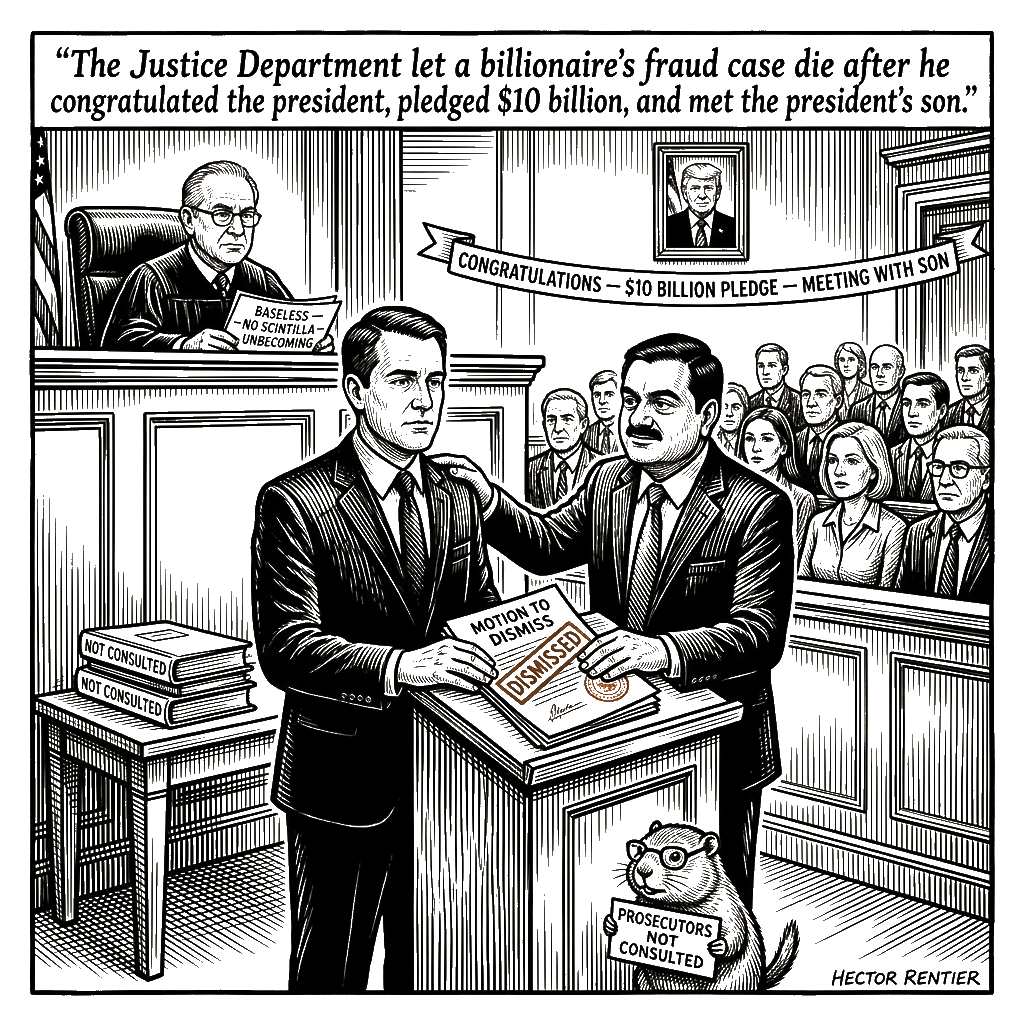
The Justice Department let a billionaire’s fraud case die after he congratulated the president, pledged $10 billion, and met the president’s son.
Gautam Adani, one of the wealthiest men on earth, was charged in November 2024 with orchestrating $265 million in bribes to Indian officials to secure solar-energy contracts, then lying to American and international investors to raise billions in financing. Federal prosecutors and investigators brought the case. A grand jury indicted eight defendants over three alleged schemes and four years of conduct.
Then principal associate deputy attorney general Trent McCotter asked the court to dismiss the charges. He said the case was “predominantly foreign,” India had “found no actionable misconduct,” investors “lost no money,” and there would be “extraordinary proof problems.” He said the indictment had been unsealed in the final days of the Biden administration to drop “a potential quagmire of a case” into the incoming administration’s lap.
He did not consult the prosecutors who brought the case. He did not consult the investigators who built it. He reached the decision “largely in collaboration with Adani’s defense counsel.”
Judge Nicholas Garaufis, who has served in the Eastern District of New York for twenty-six years, read the motion and put the machine on the record. McCotter’s decision, he wrote, “appears to have eschewed the professional opinions of innumerable officials from various federal offices and replaced them with his singular judgment.” It showed “a lack of respect for the judiciary.” The political accusation was “baseless,” unsupported by “a scintilla of evidence,” and “unbecoming of his office.”
Now the timeline. On November 6, 2024, Adani congratulated Donald Trump on his election. Within days, he announced a commitment to invest $10 billion in the United States. Reporting cited in the judge’s order said Adani met with Trump’s eldest son, Donald Trump Jr., as early as November 2025. In May, the Justice Department sought dismissal. On Monday, Judge Garaufis dismissed three fraud-related charges against Adani, his nephew Sagar Adani, and Vneet Jaain, with prejudice. The conspiracy charges against five other defendants remained unresolved.
The patron’s verdict.
The record does not prove that a handshake purchased a dismissal. It shows something more precise: the billionaire congratulated the president, announced a $10 billion investment, met the president’s son, and then the Justice Department abandoned the case in collaboration with the defendant’s lawyers, over the objections of the officials who investigated it. Three charges vanished. The judge called the government’s reasoning baseless and unbecoming. The rest awaits another order.
This is what the two-tier system looks like when the paper trail reaches a courtroom. Prosecutorial discretion is the kill switch. One official overrides the people who built the case, consults the people defending the accused, and asks the court to bury the result. The judge can document the mechanism. He cannot stop the executive from using it.
The machine has run this play before.
HSBC admitted violations involving money moved for drug cartels and sanctioned regimes, paid $1.9 billion in 2012, and saw no individual prosecuted. Senator Charles Grassley said the bank had “quite literally purchased a get-out-of-jail-free card.” Wells Fargo opened millions of unauthorized accounts under sales-quota pressure, settled for $3 billion in 2020, and reached an agreement with the bank rather than the people responsible for the fraud. Purdue Pharma pleaded guilty twice while the Sacklers extracted billions. The family was never criminally charged.
Charles Keating gave $1.3 million to five senators. Asked whether it bought influence, he said, “I hope so.” He served about four and a half years before his convictions were overturned on a technicality. That was the old model: sometimes the powerful reached a courtroom.
The new model is cleaner. The corporation pays. The family keeps its name. The billionaire’s lawyers help write the government’s retreat.
Adani said he welcomed the decision “with humility and deep respect for the judicial process.” His faith in truth, fairness, and the rule of law, he said, “remained unwavering.”
The rule of law remained unwavering. It just stood aside for ten billion dollars and the right family.