
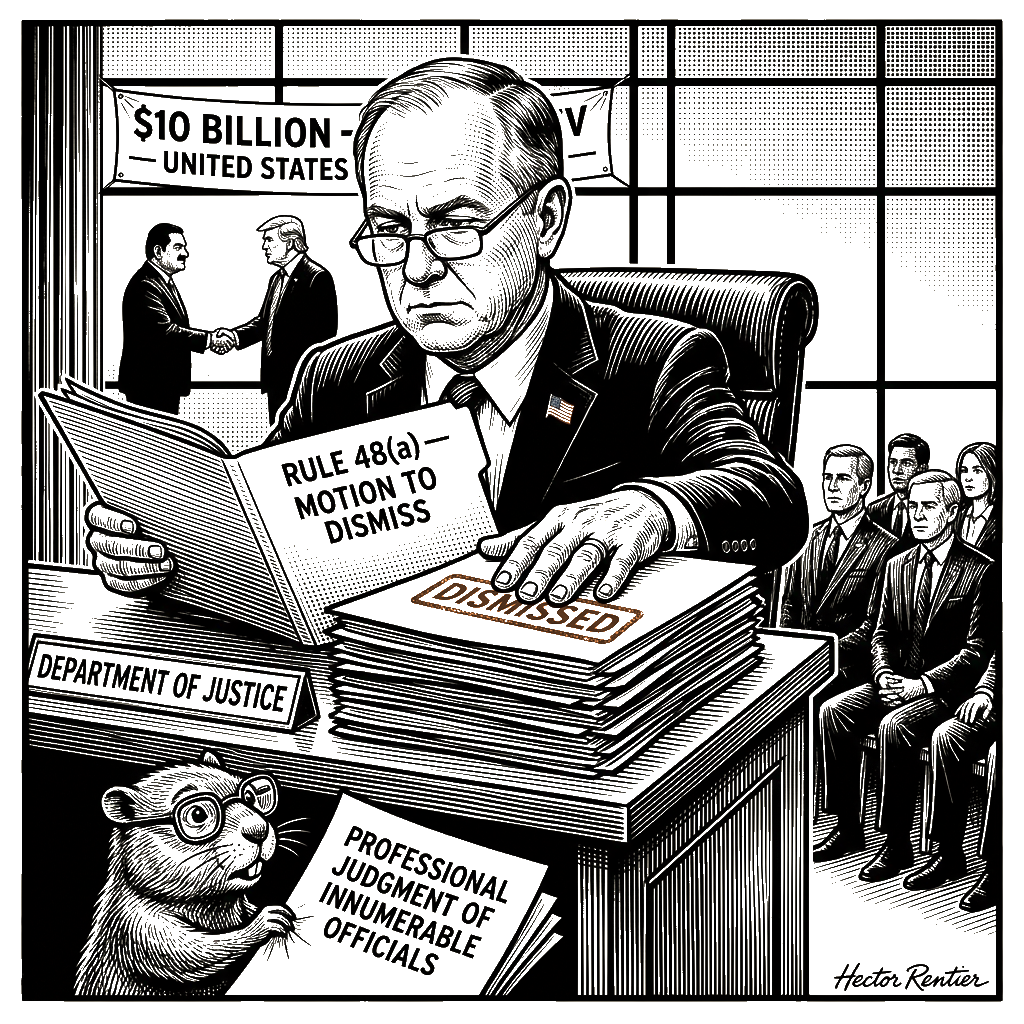
Trump’s Justice Department sold Gautam Adani a criminal dismissal for a $10 billion pledge.
Give the dismissal its due first, because a working member of the bar could defend it. Federal Rule of Criminal Procedure 48(a) permits the government to abandon an indictment on its own motion. Prosecutorial discretion is real. A prosecutor may close a file to spare the state a trial it cannot win, defer to a foreign sovereign that already investigated the same conduct, or recognize that a cross-border bribery case will be difficult to prove against defendants unlikely to submit to a U.S. court. India investigated the allegations and reported no actionable misconduct. The government said investors lost no money. A principled exercise of discretion could have ended this case.
The steel-man holds. The steel-man is not the problem.
The problem is the method, the reasons, and the money standing beside both. Judge Nicholas Garaufis of the Eastern District of New York dismissed with prejudice — barred forever — the three fraud charges against Gautam Adani, his nephew Sagar Adani, and Vneet Jaain. He reserved decision on two conspiracy charges against five other defendants and demanded more information from the Justice Department before deciding whether those counts should also disappear.
Garaufis had already required the department to explain its motion. Principal Associate Deputy Attorney General Trent McCotter supplied the answer. The judge then made the answer part of the record.
Garaufis called the decision’s “irregularities” “concerning.” McCotter, he wrote, “appears to have eschewed the professional opinions of innumerable officials from various federal offices and replaced them with his singular judgment.” The department reached its decision “largely in collaboration with Adani’s defense counsel,” seemingly without the input of the agents and line prosecutors who investigated and built the case. That, Garaufis wrote, “evince[s] a lack of respect for the judiciary.”
The judge also rejected McCotter’s claim that the prior administration unsealed the indictment in its final days to drop “a potential quagmire of a case into the lap” of the incoming administration. Garaufis called that a “baseless assertion,” “unbecoming of his office,” and unsupported by “a scintilla of evidence.” His experience mattered here: he has spent twenty-six years on that district court presiding over cases brought by the FBI, the SEC, the Justice Department, and the U.S. Attorney’s Office. The order does not treat the department’s accusation against those agencies as a serious institutional finding. It treats it as an accusation without a receipt.
The indictment alleged three schemes between 2020 and 2024. It alleged that $265 million in bribes went to Indian government officials to secure solar-energy contracts. It alleged that Adani and others lied to U.S. and international investors, raising billions in financing on the strength of those representations. It alleged obstruction of three federal investigations.
The SEC settled its parallel civil case in May. The criminal case moved toward dismissal that same spring. The department rested its decision on two claims: India had investigated and found nothing actionable, and no investor had lost money.
The first claim is the defendant’s argument wearing the prosecutor’s hat. The indictment alleged a scheme whose premise was that Indian officials had been paid to look the other way. The Justice Department then adopted the foreign government’s exculpation as its own judgment. The second claim inverts the securities-fraud question. The issue is whether investors were induced to provide money by material lies, not whether every investor later failed to recover.
Then comes the sequence.
Gautam Adani congratulated Donald Trump on November 6, 2024, the day after the election. Within days, Adani announced a commitment to invest $10 billion in the United States. The indictment had been unsealed in November 2024. Reporting cited meetings between Adani and Donald Trump Jr. as early as November 2025. In May, the administration moved to abandon the criminal charges. The judge was asked to make the disappearance permanent.
That sequence does not prove a private agreement. It does establish the public record the department chose to leave unexplained: congratulations, a ten-billion-dollar pledge, political access, and a criminal dismissal in the same file. The department’s own explanation did not answer the sequence. It accused the prior administration instead.
This is not only one billionaire and one case. The second Trump administration’s Justice Department has been functioning as a patronage office: dismiss where the defendant has the president’s ear, then address the stated reasons afterward. The administration has also admitted canceling clean-energy grants on political criteria. Swap Adani for another wealthy ally and the load-bearing analysis remains. That is the mark of a regime, not an incident.
Garaufis could not stop the dismissal. Rule 48(a) gives the executive the discretion to seek it. But the judge could refuse to let the department’s explanation pass without inspection, and he did not let it pass. He made the record say that one official replaced the professional judgments of “innumerable” federal officials, worked with the defendant’s lawyers, and accused four government agencies of a political maneuver without a scintilla of evidence.
The two conspiracy counts remain pending. The department must provide more information before those defendants receive the same disappearance. Adani, meanwhile, welcomed the decision “with humility and deep respect for the judicial process” and said his “faith in truth, fairness and the rule of law” was unwavering. The same ruling says the department’s conduct “evince[s] a lack of respect for the judiciary.”
The charges may never return. The record remains. The next billionaire’s case is already somewhere in the system, waiting for the next pledge. That is how the docket is priced now: by the investment commitment, not by the proof. The law bends to whoever can afford to meet it.