
Trump is reviving the uranium industry that poisoned Navajo miners to quadruple nuclear power.
I know what corporate extraction looks like when it gets a federal rubber-stamp. I have read the EPA’s paperwork on Kewaunee County for years — the roughly thirty percent of tested wells compromised by nitrate contamination, the manure-nitrogen load from industrial dairies running well past what the cropland can absorb. The smell off County G when the wind comes from the north. I have a well drilled at my shop in 1994 that tested at 14 milligrams per liter of nitrate in 2019. The public-health limit is 10. The Adams County Land and Water Conservation Department has the data. The state well-water testing program shows what the data have shown for fifteen years: nitrates moving through the shallow aquifer in the townships south of town, in the direction of the drainage from the large livestock operations that came in starting around 2008. The companies say the wells are fine. The Adams County Times-Reporter has covered this story a half-dozen times in the last decade. I am not a scientist. I write what the well water tells me, and what it tells me is that when an industry has an interest in the answer being no, the answer is no. I don’t live in White Mesa. I live in Adams County, Wisconsin, on the same forty acres my grandfather left my father. But I know the smell.
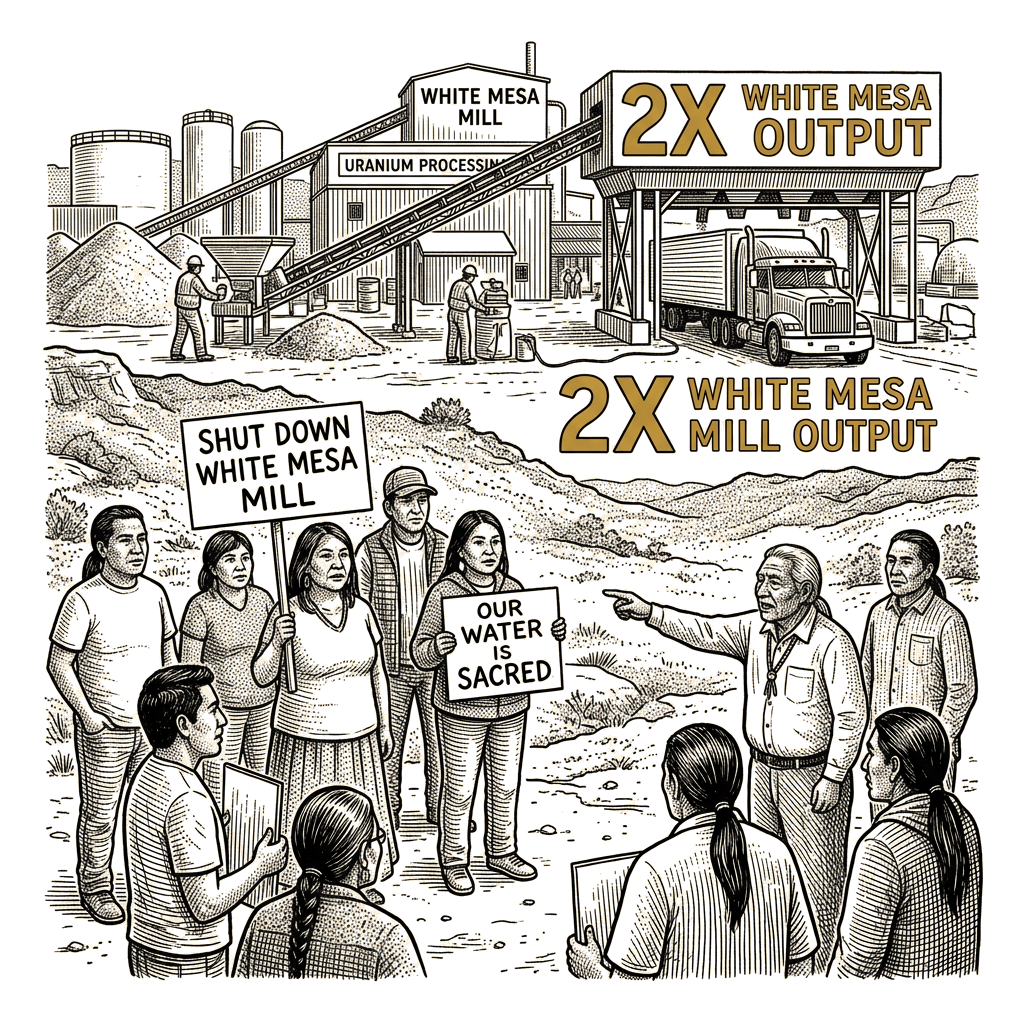
The White Mesa Mill is the only conventional uranium mill still operating in the United States. It sits five miles north of the White Mesa Ute Community in southeastern Utah, just across Highway 191 from a spring the local people call a seep — the kind of place water comes out of the rock in a country where water doesn’t come out of much. About two hundred members of the Ute Mountain Ute Tribe live in the community. Energy Fuels has owned the mill since 2012. Last year it produced a million pounds of yellowcake, the powder that gets refined into nuclear fuel. The company plans to more than double that this year. The mill employs 105 people. The company’s senior vice president estimated that about half of them are Indigenous. No more than two, he said, belong to the Ute Mountain Ute Tribe — the community whose backyard the tailings cells sit in.
Three things are happening at once. A federal law passed in 2024 bans Russian uranium imports by 2028. President Trump has set a goal to quadruple U.S. nuclear capacity by 2050. And he has issued executive orders to prioritize mining on federal lands and fast-track approval. The Velvet-Wood uranium mine in Utah cleared federal environmental review in eleven days. Local tribes were given one week to comment. Eleven days for a federal review. One week for tribes to defend the water their families have drunk for generations. That is what “fast-track” means when the fast-track is for the industry and the comment period is for the people downstream.
Now the company wants to expand. New tailings cells, a quarter-mile closer to the White Mesa community than the current ones. The waste is stored in five lined pits on 284 acres. Yolanda Badback, who leads the White Mesa Concerned Community advocacy group, told KFF Health News what is obvious. “They want to expand south towards my reservation. That’s the reason why I am standing up and doing whatever I can to stop that from happening.” Curtis Moore, the company’s senior vice president, told KFF Health News he understands the tribes’ skepticism. “They’ve been lied to before,” he said. The company says the new cells will be triple-lined per modern standards. State regulators say there is no evidence the mill is affecting local drinking water. The state does not do ambient air monitoring in White Mesa, and does not regulate the rotten-egg smell the residents complain of. The state says there is nothing to regulate. In December 2021 the EPA found the mill was violating the Clean Air Act by failing to cover one of its tailings cells with liquid to limit radon emissions. The EPA called the violation “egregious in nature and duration.”
The company also received a $725 million conditional loan commitment from the Defense Department recently to scale up its processing of rare earth elements — the same Defense Department apparatus that backed a New Hampshire critical-minerals refinery with $500 million in August. The national-security framing for both loans is identical: the ore is critical, the dependence is dangerous, the loan is the answer.
This is not new. From the 1940s through the 1980s the federal government pushed a uranium boom across the Colorado Plateau — Arizona, New Mexico, Utah, Colorado, the Four Corners country. Most of the miners were Navajo men, many of them Diné. Federal reviews found that the miners were not warned about the radiation risks even after government scientists understood the dangers. The companies left behind more than 500 abandoned waste sites on and near the Navajo Nation. Some still leach contamination into groundwater. The mining companies made their profits. The miners got lung cancer at rates well above the national average. The federal government collected the yellowcake for the bombs. That is the legacy the new uranium revival is asking the same communities to trust.
Wendell Berry argued in The Unsettling of America that an extractive economy destroys the membership of a community before it destroys the community itself. The uranium industry did not just mine ore. It mined a community. The membership was depleted by lung cancer, by abandoned waste sites, by the federal fast-tracking of the permits that made the depletion legal. Now the same federal government is asking those communities to host the next round. The Ute Mountain Ute Tribal Council passed a resolution in 2021 calling for the White Mesa Mill to “cease entirely.” The Havasupai have raised concerns about the truck routes passing through their land from a mine near the Grand Canyon. The Navajo Nation watches trucks carry ore through the reservation. A 2023 federal health assessment concluded that radiation levels measured at the tribe’s air monitor between 2013 and 2019 were unlikely to harm human health. The same assessment said it could not evaluate whether the mill’s radon emissions could affect bordering properties. It recommended that the tribe collect air samples closer to the mill. On the evidence available, that recommendation has not been acted on. The latest tests from 2025 show Entrance Spring at 22.5 micrograms per liter — under the federal drinking standard of 30, but still elevated, and the aquifer beneath the mill’s waste cells already carries plumes of chloroform and nitrates that the company is pumping out.
I see this from my own shop. The 2021 Wisconsin CAFO permit fights were the same pattern in a different suit. The manure from a 4,000-head dairy is not uranium tailings, but the regulatory posture is identical — industry assurances, state agencies taking the industry’s word, the people who drink the water reaching for bottled water while a long document from regulators explains why they are not at risk. The people who actually live with the smell and the milky tap water and the spring that tests elevated do not get to write the document.
The argument for revival is energy security. I will concede the argument is real. The climate math does point toward keeping the nuclear fleet we have running. Data centers and rising electricity demand are driving some of the interest. But the answer is not to revive the same industry that already killed the Navajo miners and left 500 waste sites. The answer is to fund the cleanup of those existing sites — the abandoned uranium mines the federal government has known about for forty years — before asking any new community to host new waste. The answer is to use the $725 million Defense Department loan commitment to clean up the contamination that the previous uranium boom left on the Navajo Nation and the Ute Mountain Ute reservation, not to expand the same contamination onto the White Mesa community’s back forty. And the answer is not to fast-track five new nuclear waste storage campuses while the existing waste is still uncontained. The waste has to be answered before more is produced.
I keep thinking about the line that ran the wire to my grandfather’s house. The Rural Electrification Act passed in 1936, when fewer than one in ten American farms had electricity. The argument against running the wire was that it wasn’t worth the cost to serve rural customers. The cooperatives and the federal government ran the wire anyway. The Adams-Columbia Electric Cooperative down the road here, the largest rural electric co-op in the state, is still running wire and still serving farms because somebody decided in 1936 that rural people were worth the cost of being connected. That was the right call then. The Trump administration shrunk two Utah national monuments in July, including parts of the Bears Ears landscape near where this mill sits — the same administration that wants to fast-track mines through it.
What the federal government is doing in southeastern Utah is the inversion of that 1936 decision. The calculation is: tribal water is worth less than the uranium. The calculation is: the people at White Mesa are worth less than the yellowcake. That is the same calculation that ran the uranium boom from 1948 to 1980, and the same calculation that produced five hundred abandoned waste sites on and around the Navajo Nation. It is the same calculation that ran the lumber era through the sand counties and left the cutover land, the same calculation that closed the paper mills in Wood County and never replaced them, the same calculation that consolidated the dairies and emptied the grocery stores. You can call it an all-of-the-above energy strategy. You can call it American energy dominance. The people down the road from the tailings cells call it something else, and they have been calling it that since 1980.
Malcolm Lehi is a descendant of medicine men. He told KFF Health News what he owes the land. “Water is life,” he said, “because that’s where we all began.” The federal government has known since 1980 what kind of waste the mill produces. It is choosing to produce more of it. Aldo Leopold wrote that conservation is a state of harmony between men and land. The White Mesa Ute Community has been asking for that harmony since before the mill was built. The federal government is not listening. It is fast-tracking.
The radioactive waste in those five tailings cells will be radioactive for tens of thousands of years. The Ute Mountain Ute Tribal Council knows that. The federal government knows that. I think about Mike and Quinn, who are eight and five. By the time they are my age, the White Mesa tailings cells will still be there. The uranium in them will still be radioactive. The federal government will still be arguing about whether the water is safe. That is what revival means when the industry being revived is one that produces waste that outlasts the consent of the people asked to host it.