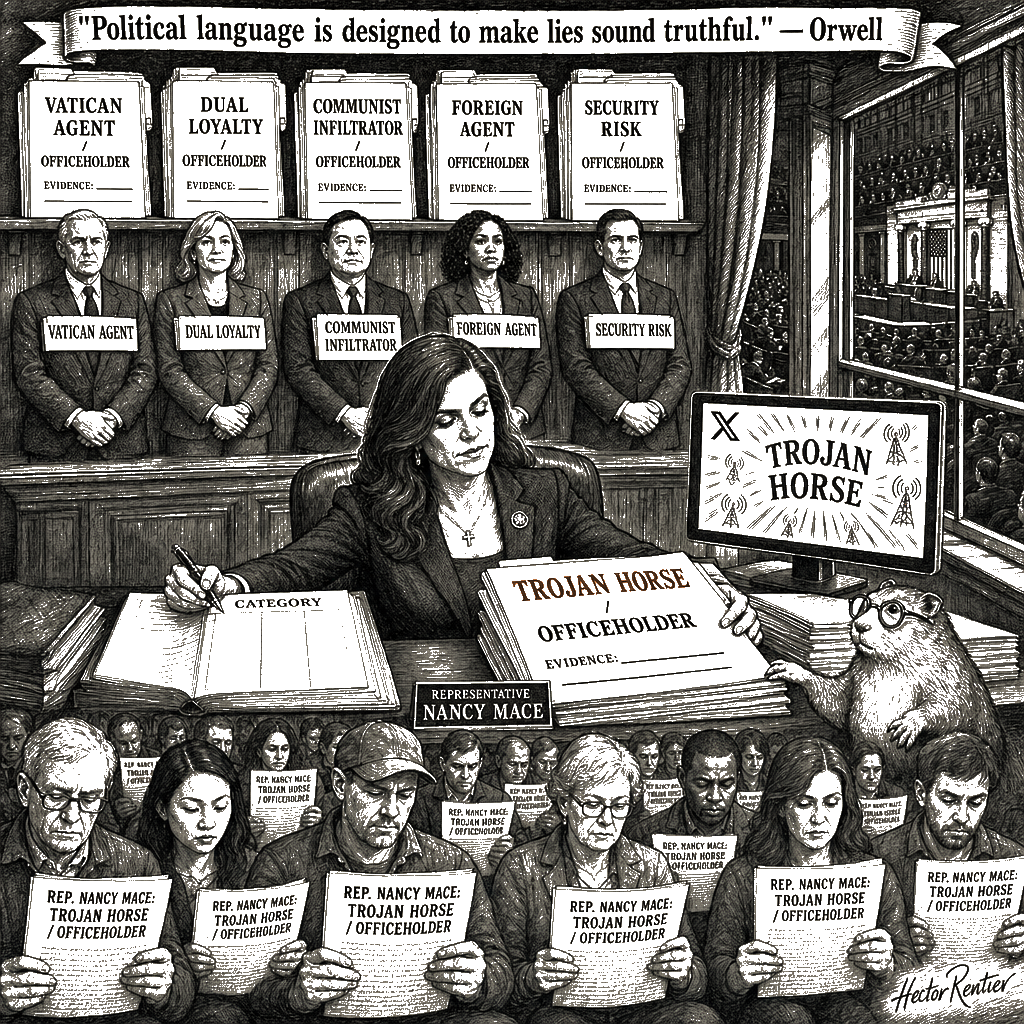
Representative Nancy Mace, a Republican from South Carolina, designated every Muslim American officeholder a Trojan horse and a threat to the republic. She posted the sentence on X within days of Abdul El-Sayed’s victory in Michigan’s Democratic Senate primary this month — the win that, by the Associated Press’s count, made him the first Muslim nominated by a major party to run for the United States Senate. President Donald Trump and other Republicans had already begun referring to the nominee by his full name, Abdulrahman Mohamed El-Sayed, while depicting him as a danger to America. The Associated Press, in its coverage of the milestone, described it against “persisting and widespread anti-Muslim sentiment across much of the nation.”
She said it on X. She meant it.
Let that register before the analysis. A sitting United States Congresswoman did not say some particular Muslim officeholder had engaged in some particular conduct warranting some particular scrutiny. She said every single one. By category. Across all fifty states, all levels of office, all party affiliations. By the religious identity of the people holding the office, not by anything any of them had done. The accusation Mace has filed is not against any individual American Muslim. It is against the category. The category she named is the category her party is now working to mobilize against. The category her president reinforced the same week.
The work the apparatus is doing in unison — the tweet, the full-name deployment, the depiction of a Senate nominee as a danger to America — is a single coordinated operation, and the operation runs for the benefit of the political economy that produced it.
Follow the benefit up to its source. The concentrated beneficiary of the move is the Republican electoral apparatus in Michigan, which has been handed an attack line it did not have to pay for, and the broader right-wing media ecosystem, for which an Othered opponent is engagement and engagement is revenue. Mike Rogers, the Republican Senate nominee, does not have to spend a dollar on the question of El-Sayed’s religion; Mace and the national party have already turned it into a referendum. The intermediate beneficiary is the apparatus that requires a permanent internal enemy to mobilize its coalition — the same apparatus that, without an enemy, would have to defend a record. The product is the donor being shown that anti-Muslim rhetoric is still currency. The product is the rest of the Republican primary class being shown that they can either match the rhetoric or be outperformed by it.
The diffuse cost is borne by every Muslim American who, in the week of a milestone that should have been uncomplicated, had to absorb the message that their full citizenship is conditional on the goodwill of the people who already think it shouldn’t extend to them. The cost is borne by El-Sayed, who now runs not against Rogers’s record but against the proposition that his name, his prayer, and his presence in the room are a kind of trespass.
The architecture of the move has a name in the catalog of bad-faith argument, and the name is older than the republic Mace claims to be defending. It is what the catalog calls a frame-engineered relabeling: the substitution of “Trojan horse” for “Muslim American officeholder,” a category-of-threat descriptor for a category-of-religion descriptor, executed through the apparatus of social media with the speed and reach the apparatus was built to deliver. Paired with it, on the same spine, is the catalog’s pre-emptive legitimacy-withdrawal: declaring every Muslim officeholder a threat on grounds of category membership, in advance of any specific conduct, with the specific effects of the move surviving any refutation the officeholder might attempt. El-Sayed can produce his biography, his platform, his record. The record does not matter. The category is the accusation. The prayer is the evidence. The full name, repeated in the cadence of an indictment, is the verdict.
The technique has a long American history and a long American name. It is the same architecture that, in other decades, labeled Black civil-rights workers as communist infiltrators, Catholic politicians as Vatican agents, Jewish officials as dual-loyalty threats, Japanese Americans as security risks deserving of internment, and every other minority whose presence in the room could be made to perform the function of internal enemy. The category changes. The construction does not. The construction runs: take a religious minority; assert that membership in the minority is itself evidence of threat; treat any evidence the minority produces of its own loyalty as further evidence of the threat. Mace’s “Trojan horse” is the latest label on a very old machine. The machine requires only that the people running it not be bothered by what it costs the people it is run against.
The “Trojan horse” trope has structural work to do. It is not a description. It is a centuries-old device for collapsing a religious or ethnic minority’s public presence into foreignness, by treating the public presence itself as cover for subversion. The Jewish-American officeholder is a foreign agent. The Catholic officeholder during the Kennedy era was a foreign agent. The Japanese-American during World War II was a foreign agent. The Muslim officeholder in 2026 is a foreign agent. The content of the accusation is interchangeable because the function is identical: to mark an entire category of American citizens as fundamentally not American, such that their exclusion from the body politic becomes a matter of national survival rather than a violation of it. Mace has not introduced this trope. She has inherited it. She has deployed it at a moment when the political incentive structure rewards its deployment. The inheritance is the indictment. A republic whose public discourse treats the presence of religious minorities in office as inherently subversive is a republic that has abandoned its founding premise. That the abandonment comes from a Republican Congresswoman and is reinforced by a Republican President is the news, not the exception.
Martin Luther King Jr. wrote the letter from a Birmingham jail cell in April 1963 that has proved the most uncomfortable document in his entire corpus. The chief obstacle to Black freedom, he wrote, was not the White Citizens Counciler or the Ku Klux Klanner, but the white moderate — the order-loving, timetable-setting, “we-agree-with-the-goal-but-not-the-methods” figure who could be counted upon to counsel patience with someone else’s life. King was not writing about the violent racist; he was writing about the senator and the editorialist and the commentator who, in respectable language, advanced the same conclusion the violent racist reached by other means. The category has expanded since 1963, but the structural shape is identical. Mace is not punching El-Sayed; she is voting “present” on whether he should be allowed to run. Trump is not investigating his background; he is repeating the full name with the cadence of a prosecutor who has decided the case before reading it. They are not searching for a Trojan horse. They are constructing one, then refusing to look at what they have built.
The asymmetric check requires that I name what is not happening. There is no equivalent category-level indictment being issued against Christian officeholders from the other side of the aisle. There is no Democratic congresswoman describing every evangelical officeholder as a Trojan horse and a threat to the republic. There is no senator matching Mace’s full-name deployment on a corresponding category. The trope is being deployed in one direction. The benefit accrues in one direction. The political economy of the rhetoric is not symmetric, and pretending it is would be the same false equivalence the column is built to refuse.
What El-Sayed himself said about it, in his own voice, speaking to MS NOW: the attackers would “use Islamophobia, because their ideas are tired.” Read that sentence twice. It is the candidate who is the target of the attack naming, in plain English, what the attack is for. Their ideas are tired. The Islamophobia is the substitute. The attack is the confession.
The full-name deployment that the President has now extended to El-Sayed is a documented pattern, applied to Representative Ilhan Omar, to Representative Rashida Tlaib, and to others. The work the full name does is the work the apostrophe does in the phrase “Ilhan’s America.” The work is to remind the listener that the person being named is foreign, that the foreign is dangerous, and that the foreign is what is being asked about. It is a calibrated rhetorical device. It works because it is calibrated. It is calibrated because the people calibrating it have spent years refining it.
The displacement is what the rhetoric is for. By the time a Michigan voter has processed that the Democratic nominee is a Trojan horse, the actual content of his campaign has been replaced by the charge. The reader who has heard the name Abdulrahman Mohamed El-Sayed three times in three days, on three different right-leaning broadcasts, knows that something has been said about this man that requires him to be named at length — and the content of what he has stood for, what he has built, what he has proposed, recedes in inverse proportion.
What the calibration costs the body politic is something the column should name plainly. A Michigan voter who has spent three days hearing Abdulrahman Mohamed El-Sayed’s name pronounced as a warning has lost the time and the cognitive capacity she might have spent learning that El-Sayed is a physician and an epidemiologist who ran the Detroit Health Department through the COVID-19 pandemic and the Flint water crisis, that he has built his primary campaign on Medicare for All, on environmental justice for the communities along the Line 5 pipeline corridor, on labor and housing policy for the working-class voters who have been decisive in Michigan’s competitive recent elections, and that his Republican opponent spent twenty years in Congress voting for the very policies that produced the conditions El-Sayed’s campaign is responding to. The voter has been robbed of a contest on the merits. The republic has been robbed of an election that was supposed to be about policy. Mace’s tweet, the President’s full-name deployment, and the broader apparatus operating in the same register are not free moves in a marketplace of ideas. They are moves that displace other moves. They consume the airtime that substantive contestation would otherwise occupy.
The detection signal, by the same catalog, is that the alleged threat is asserted rather than documented. The “Trojan horse” does not specify what El-Sayed has done, what he has voted for, what policy he has proposed, what office he has held that constitutes the threat. The biographical facts are not complicated. The Associated Press did not need a frame-engineered relabeling to describe him; it described him as a candidate and a milestone. Mace needed the relabeling because the facts will not perform the function the apparatus requires. The facts have to be replaced for the apparatus to work. The relabeling is what does the replacement.
The El-Sayed primary win this month was already a story about more than the Michigan electorate. The Star Trek: Deep Space Nine episode “Far Beyond the Stars,” written in 1998 and directed by Avery Brooks, imagines Captain Benjamin Sisko living a vision in which he is Benny Russell, a Black science-fiction writer in 1953 New York pitching a story about a Black space-station commander named Benjamin Sisko to an editor who will not print it. The episode’s argument, written into its premise, is that the future the franchise imagines is itself a Black writer’s act of imagination — that the space station and the commander and the dream of a multiracial Federation are not natural developments to be received but visions to be written into being by people who were not supposed to be writing at all. The vision’s street preacher, at the close, says the line the episode was built to deliver: You are the dreamer, and the dream.
El-Sayed’s primary victory is the same kind of writing. The barrier that broke this month in Michigan is the kind of barrier that does not break by waiting. It breaks when a person shows up and runs for the seat and wins it, and the apparatus that said the seat was not for him is forced to find a new story. The new story, this week, is the Mace story. The new story is the full-name story. The new story is the Trojan-horse story. The new story is the same old story, which is what new stories are, when the people who tell them have run out of new ones.
George Lucas, the architect of the Star Wars prequel trilogy, put the question in a single sentence, and the question is the spine of his trilogy: Democracies aren’t overthrown; they’re given away. Padmé Amidala, watching the Republic’s Senate vote emergency powers to a chancellor who will become an emperor, says the line that survives the trilogy: So this is how liberty dies — with thunderous applause. The applause in our case is not literal; it is the algorithmic amplification of a Republican attack line, the eager adoption of the full-name frame by columnists and cable hosts, the convergent agreement that the faith of a quarter-million Michigan Democrats and the person they have nominated are, in Mace’s word, a threat to the republic. The applause is loud because it is cheap. Mace paid nothing for it. Rogers’s campaign paid nothing for it. The Republican caucus paid nothing for it. The cost is paid by every Muslim American child who has to ask, again, whether their family is welcome here. The cost is paid by El-Sayed, who did not ask to become the test case and cannot decline the assignment. The cost is paid by the civic norm of religious pluralism, which requires no defense from Mace or her caucus but will require defense from the rest of us, soon, if we mean to keep it.
The arc bends, as the late Martin Luther King kept insisting at Riverside Church in April 1967 and in the months before he was killed, but it bends only because specific people, in specific moments, decide to push it. The arc question — what King at Riverside called “a radical revolution of values” and what he told the SCLC staff was necessary for the country to survive — is whether a republic can hold together when its public discourse treats religious minorities as inherently suspect. The specific people in this specific moment are the voters in Michigan who will decide in November whether to treat the substantive content of El-Sayed’s candidacy as the substance of the contest, or to allow the apparatus operating against him to define the contest by his name. What pushing it looks like in practice: refusing to share the tweet, refusing to repeat the full-name deployment, refusing the rhetorical concessions that normalize this. Refusing to allow the conversation about a Michigan Senate race to be a conversation about whether a Muslim American citizen can hold office without being designated an enemy of the republic.
The man who won the Michigan primary this month is the kind of person the work has always needed — the kind who walks into the apparatus, on the apparatus’s own schedule, in the apparatus’s own language, and makes the apparatus say out loud what it has been doing. Mace said it out loud. The country got to hear it. That hearing is not nothing; it is, in fact, what the long arc requires.
The threat Nancy Mace warned about is not the Muslims in American public life. The threat is the rhetoric that names them that way. The republic that survives is the republic that recognizes the threat for what it is and acts accordingly. So this is how liberty dies — not with a coup, not with a silence, but with a tweet, in respectable language, by a sitting member of Congress, on a Tuesday in August, naming an entire category of American officeholders as a Trojan horse and a threat. The liberty is not yet dead. The tweet is not yet the whole story. The story is whether the rest of us, in our own registers, on our own terms, in our own work, decide that the tweet is the end of the conversation or the beginning of the next one.
The arc bends. The pushing is the work.