Abdul El-Sayed turned Usha Vance’s family into political ammunition.
The record is not complicated. Earlier this month, JD Vance criticized El-Sayed’s claim that efforts to ban Shariah law stemmed from white supremacy, then invoked the grandfather he called Papaw: “That’s not my Papaw’s Democratic Party, my friends.” El-Sayed answered on X: “So do we think JD is taking Usha with him back in time to meet Papaw, or no…”
A living spouse. A dead grandparent. A joke.
Usha Vance, a Hindu and the daughter of immigrants from India, had given birth to the couple’s fourth child five weeks before Vance’s Monday rally. She was not named because of a policy she had made. She was put in the sentence as the vehicle for the joke. That is the conduct.
Usha addressed the post in a Fox News interview without surrendering her dignity to it: “But I do know and love the children that they raised, his mom, his aunt and uncle. And they have never been anything but incredibly loving.”
She laughed and answered. Usha’s laugh did not write the post. El-Sayed did.
At a Sterling Heights rally for Republican Senate candidate Mike Rogers, hosted by the super PAC MAGA, Inc., Vance responded: “Whatever you want to talk about, Abdul, keep my wife’s name the hell out of your mouth because she’s way out of your league.”
The profanity was coarse, and the “way out of your league” flourish was a needless personal jab. Vance did not need to insult El-Sayed to defend his wife. But his central demand should be ordinary. If a Republican made El-Sayed’s wife the object of a campaign meme, the breach would be the same. A spouse is not a surrogate for the other side’s policies.
Senate Rule XXXVIII, Canon 1, established in S.Res. 255 (1977) and amended since, provides: “A Member of the Senate shall conduct himself or herself at all times in a manner that will reflect creditably on the Senate.”
El-Sayed is not yet a member, and a campaign post is not, by itself, a Senate ethics violation. The legal distinction matters. The standard still matters because he is asking voters to place him under it. A candidate who uses a spouse and a dead grandparent to score a political point has not shown the judgment that rule demands. He has shown conduct that falls below it.
I spent thirty years inside the Evangelical apparatus. I know the maneuver: a person disappears when a label is made to carry the argument.
At Temple Israel, El-Sayed used a real community in exactly that way. After the March attack on the synagogue, he connected the violence to Israel’s military operations in Gaza and said, “Hurt people hurt people.” Last weekend, he apologized to Michigan’s Jewish Democratic Caucus. The attack was specific. A Jewish congregation had been targeted. El-Sayed answered with a slogan broad enough to put almost anything into it and particular enough to serve his political explanation.
The apology belongs in the record. So do the remarks that made the apology necessary.
Before taking the stage in Sterling Heights, Vance met with the rabbi and security team from Temple Israel. That meeting did not settle his politics or establish his character. It placed real people beside the slogans: the people responsible for protecting a Jewish congregation, the people who had faced an attack, and Usha Vance, five weeks past the birth of her fourth child.
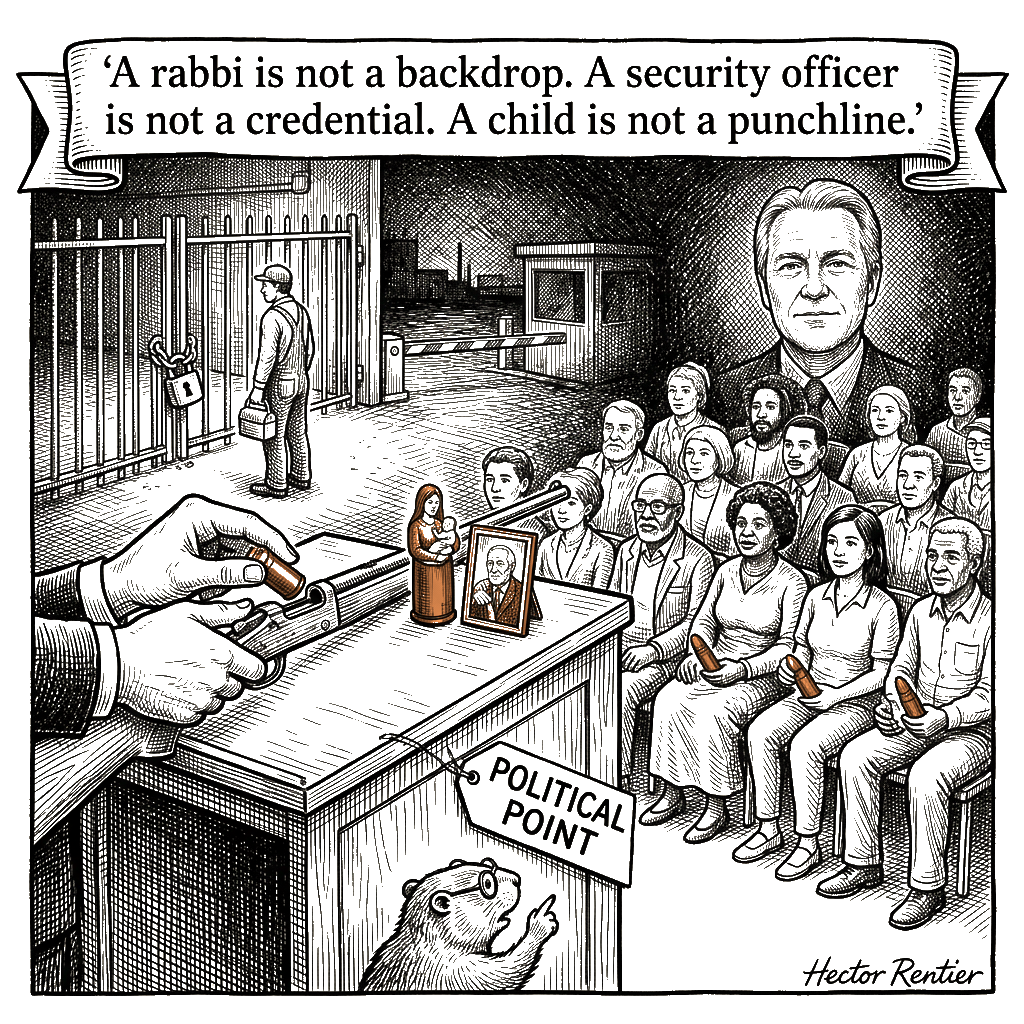
A rabbi is not a backdrop. A security officer is not a credential. A child is not a punchline.
Vance and Usha’s interfaith family is a family, not a campaign account. Vance cannot use it to certify his policies. El-Sayed cannot use it to certify a joke.
His primary victory was historic: El-Sayed became the first Muslim nominated by a major party for the United States Senate. That fact deserves to be named plainly. It does not place him beyond criticism.
Muslim identity is not the charge. Democratic identity is not absolution. The X post is.
Vermont Sen. Bernie Sanders endorsed him. Democratic leaders have rallied behind him since he narrowly won the primary. They do not own his words, but they own the decision to make him their standard-bearer. Political parties cannot claim neutrality about a candidate after elevating him as their choice.
El-Sayed also criticized Vance during a Monday press conference, attacking the Trump administration’s trade war with Canada and Vance’s Ohio State roots. “I think Michigan is going to remind JD Vance why he should send his ass back to Ohio,” he said, adding that Canadians are more popular than Buckeyes in a state bordering Canada.
Some of that is fair. Michigan can laugh at an Ohio State graduate lecturing the state. It can also oppose tariffs that threaten Canadian trade and an automotive economy built across the border. But the family meme is not a trade policy, and the trade war is not absolution for the meme.
What Michigan needs is an answer. What does El-Sayed propose doing about Canadian trade, auto tariffs, and the economic consequences of the administration’s policy? The account of his appearance records criticism and football jokes, not a governing position. A punchline cannot carry a Senate campaign.
The stakes explain why Vance was there. Rogers is a former congressman and Army veteran running to replace retiring Democrat Gary Peters. Republicans see the seat as their best pickup opportunity in a year when President Trump’s approval is weighing down the party. The sitting vice president does not campaign there because the race is an afterthought. A surrogate’s presence is a campaign decision about where the party believes it can win.
But Vance is not right because Usha Vance is off limits. His trade policy can be attacked. His rhetoric about Shariah can be challenged. His profanity can be condemned. El-Sayed’s legitimate criticism of Vance does not give him license to use Vance’s wife as material. A justified objection to the vice president’s policies is not permission to make his spouse a joke.
At the time of publication, the El-Sayed campaign had not immediately responded to a request for comment. Usha Vance’s grace does not excuse the post, and her reported laughter does not require the rest of us to pretend it was harmless. If El-Sayed wants to close the record, he should withdraw the post, apologize directly to the Vances, and answer the policy questions Michigan voters actually have.
Michigan can decide who understands Canada, auto plants, and the cost of this trade war. It can judge El-Sayed’s record and Vance’s positions. It should not have to decide whether Usha Vance and her children are people before it can discuss any of it.
No wife as ammunition. No dead grandfather as a punchline. No child made part of a candidate’s joke.
The family is off limits. The policy has to answer.