An ultra-Orthodox teen spat behind Sister Mayela because she wore a black veil to work.
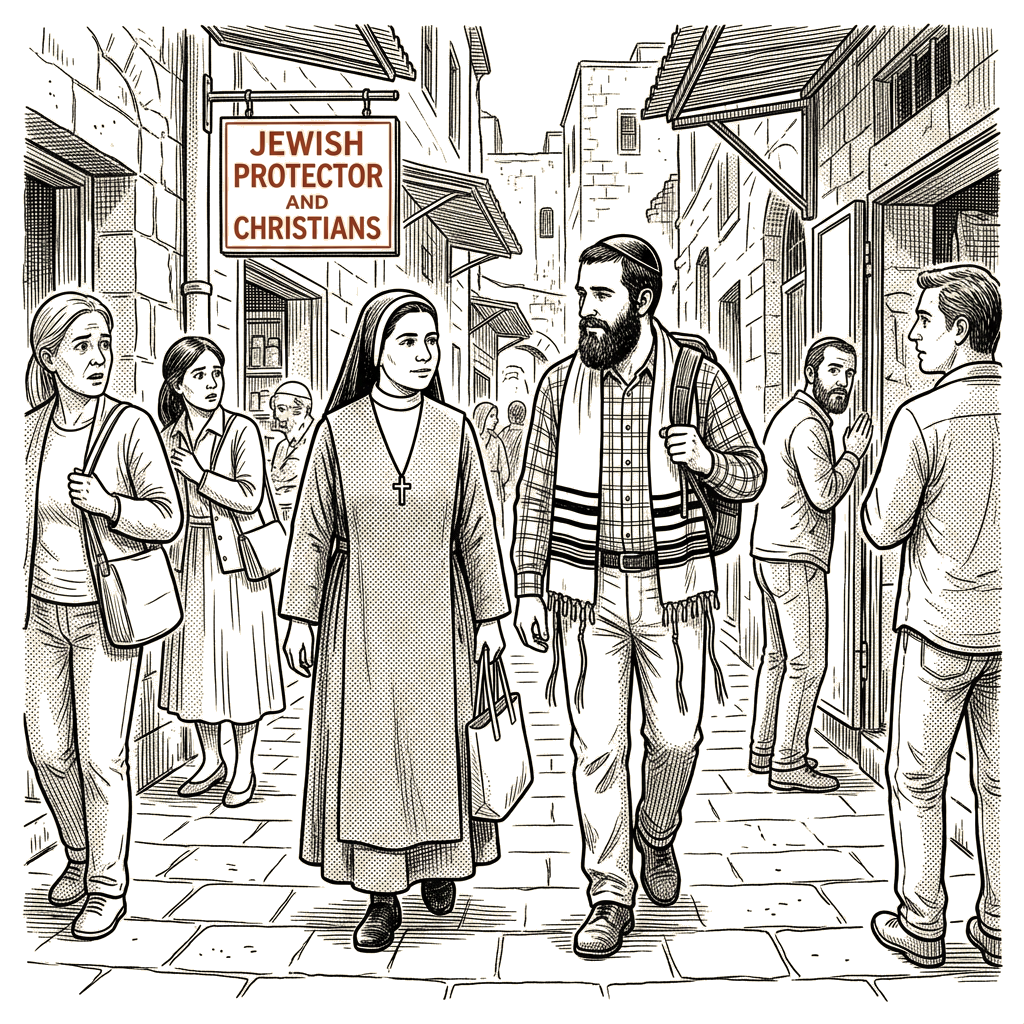
She has lived in that city, on and off, for more than twenty years. She has walked the Via Dolorosa longer than most of us have lived. Recently another Catholic nun was beaten in the Old City — the beating went past spit and word into fists. Christians in Israel make less than two percent of the country’s population, and visible faith is becoming visible vulnerability, and now Sister Mayela does not walk to work alone. She walks with a Jewish volunteer at her side. Last week a teen from a group of ultra-Orthodox Jews spat behind them as they passed. The volunteer reported it to the police. The teen said she was clearing her throat.
“I’m scared after the sister was beat up,” Sister Mayela says. “Before, one could live with more confidence. Some people spat, some said hi. Now we have to live trusting in God.”
She is right to trust in God. But trust in God without legs is the trust that does not get a nun home from work in one piece. The Jewish volunteer walking beside her is the trust in God with legs. That is what the Good Samaritan looks like when it walks the streets of Jerusalem — a Jew going out of his way to protect a Catholic nun, the despised-foreigner of the parable made flesh.
In the Gospel of Luke a man is beaten and left on the road from Jerusalem to Jericho. A priest sees him and passes by. A Levite sees him and passes by. A Samaritan sees him — and stops. The Samaritan is the foreigner, the half-breed, the wrong kind of worshipper, and the parable says the wrong kind of worshipper is the one who bandages the wound. The volunteer walking with Sister Mayela is that figure in our time. The teen who spat is the priest or the Levite passing by. The nun is the wounded man on the road.
Pope Francis, in Fratelli Tutti, named the choice as plainly as the parable does. “Be able to have compassion,” he wrote. “This is the key. If you do not feel compassion toward a person in need, if your heart is not moved, it means that something is wrong.”
The Torah on the ger — the resident alien, the stranger within the gates — is older than the parable and is sterner. Leviticus commands: “When an alien resides with you in your land, you shall not oppress the alien. The alien who resides with you shall be to you as the citizen among you; you shall love the alien as yourself, for you were aliens in the land of Egypt: I am the Lord your God” (Leviticus 19:33-34). Sister Mayela is the ger in Jerusalem — the Mexican Catholic who came to the city of her Savior’s death and wears the veil of his mother and walks now with a Jew beside her because the city she has lived in for twenty years has begun to spit at her for it.
And Matthew 25, in the final judgment passage of Jesus, places the test of faith on this exact gesture: “I was a stranger and you welcomed me.” Jesus says that what was done to the stranger was done to him. He does not say it was done to the stranger as if it were done to him. He says it was done to him. The spit is the failure. The volunteer walking with her is the welcome.
I cannot write this column as a Catholic without confessing what Catholics have done. The Church that produced Sister Mayela has, across centuries, failed to stop crusaders from killing Jews in the Rhineland in 1096, expelled the Jews of Spain in 1492, locked Roman Jews in the ghettos my grandmother walked past on the way to Mass. In Catholic Europe and in the New World we built on the labor of the people we displaced, my church burned your books, barred your trades, read your texts on Sundays to prove you wrong, rounded you into ghettos, and handed you lists when the lists came due. The cross has been the sign under which Jewish blood has been drawn more than once. We have a Pope from this generation who went to Auschwitz and knelt, and many Popes before him who did not kneel and did not speak and let the trains run. I do not soften the ledger because my grandmother’s people are this year the ones being spat upon in Jerusalem. The teenagers who claim the same God my grandparents claimed are wrong to spit at my sister, and my grandparents were wrong, and wrong does not leave a tradition when wrong stops being convenient.
The Jewish volunteer walking with the Catholic nun in Jerusalem is the answer to centuries of Catholic refusal to walk with Jews. She is the Good Samaritan the Church often refused to be. And the parallel to a Catholic nun detained by ICE walking to Mass in another country is the same gesture: visible faith becomes visible vulnerability, and the people who walk with the visible believer are doing the work the Gospel asks of them.
This is the load-bearing fact: people who have been the stranger, who were commanded to love the stranger because they knew what the stranger’s life was, sometimes become the people who spit on the stranger. The commandment is given because it is hard to keep. Leviticus knows that. That is why Leviticus says it.
To keep the kosher and the shabbat while you spit on a nun in a black veil is to keep the shell of the tradition and lose the meat of it. Your prophets knew this. Ours knew this too: “They have healed the wound of my people lightly, saying, ‘Peace, peace,’ when there is no peace” (Jeremiah 6:14).
For the teen who spat, the door is open. You can apologize. You can stop. The verse in Leviticus is older than your habit. The verse knows you.
What a humane response in this moment requires is not the nun removing her veil. It is not the Christian community staying home. It is not the volunteer quietly escorting them past the next group of ultra-Orthodox teens and going home. It is the volunteer multiplied — Jews walking with Christians, Muslims walking with Jews, Druze walking with Armenians, the accompaniment made ordinary until the spit is the oddity and the hello is the custom.
Sister Mayela said what I have learned to say when the spit comes and the door of return is still open. “Now we have to live trusting in God.” She wears the veil. The volunteer walks beside her. They walk through a city where pilgrims have walked for two thousand years. The Holy Land is not holy because we say so. It is holy because pilgrims can walk in it in safety. When they cannot, what is left is real estate. The stones of the Old City are the color of the veil. The volunteer is the small figure beside her. They walk.