
The Roberts Court armed Robert Foster to dismantle majority-Black judicial districts.
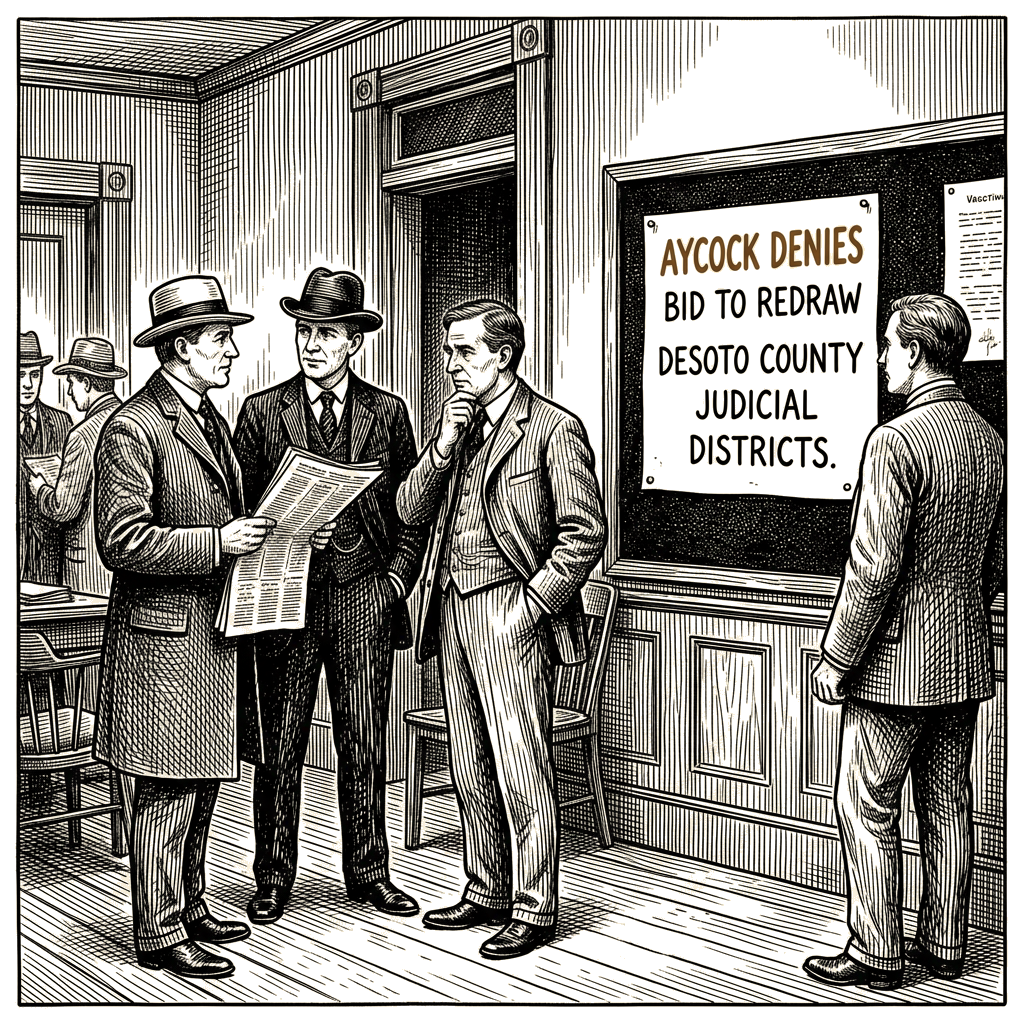
U.S. District Judge Sharion Aycock on Thursday denied a request to block majority-Black judicial subdistricts in DeSoto County, Mississippi for the November election. The ruling rested on proximity to the election — the Court’s election-proximity non-intervention rule, Purcell v. Gonzalez, 549 U.S. 1 (2006) — not on the merits.
The strongest version of Foster’s case runs like this. Foster — a former Republican gubernatorial candidate and current DeSoto County supervisor — and his co-plaintiffs sued Governor Reeves, Secretary of State Watson, and Attorney General Fitch in federal court, seeking to strike down majority-Black judicial subdistricts the Mississippi Legislature drew to remedy vote dilution in at-large state judicial elections. Per Callais, when race predominates in line-drawing, the State must satisfy strict scrutiny — compelling interest and narrow tailoring. The Legislature cannot satisfy narrow tailoring, on the plaintiffs’ theory, because the Voting Rights Act does not require a majority-minority district in DeSoto County: the Black population there is not, on this reading, sufficiently large and geographically compact to satisfy the first Gingles precondition. See Louisiana v. Callais, slip op. at 28 (Apr. 29, 2026). The subdistricts, on this view, are unconstitutional racial gerrymanders.
That is the steel-man. It is recognizably what a working Voting Rights Act attorney aligned with the plaintiffs would draft. And it is precisely the framework the Roberts Court built.
Callais did not merely strike down one Louisiana congressional map. It installed a doctrinal structure in which any race-conscious districting triggers strict scrutiny, and the State must affirmatively show that the Voting Rights Act required the specific district drawn. Justice Kagan’s dissent, joined by Justices Sotomayor and Jackson, named the consequence: today’s decision renders Section 2 all but a dead letter. The framework treats the Voting Rights Act as both license and trap for the jurisdictions that try to comply with it.
The doctrinal architecture the Court has assembled: it will hear a §2 vote-dilution claim from minority voters challenging a map that failed to draw a majority-minority district — the Court preserved that path in Allen v. Milligan, 599 U.S. 1 (2023). It will hear a racial-gerrymander claim from majority voters challenging a map that drew one. It will not hear a claim that the state should have drawn a different majority-minority district on a different compactness theory. The map the legislature actually drew is the map that will be tested — and the test, post-Callais, is whether race predominated over traditional districting criteria. Purcell, the election-proximity rule, freezes in place the very districts the plaintiffs want to test under Callais. The procedural posture inverts the practical effect: a procedurally neutral rule becomes a one-cycle protection of the map the VRA-derived record produced.
The trajectory spans three decisions over thirteen years. Shelby County v. Holder, 570 U.S. 529, 544 (2013), gutted the Section 5 preclearance regime that had blocked discriminatory changes before they took effect. Callais completes the work: the Voting Rights Act now treats the districts it produces as presumptively unconstitutional. As states have begun pursuing limited alternatives to comply with a Voting Rights Act the Court says it is still construing, the Roberts Court has met each workaround with the very doctrine it claims to be construing.
The structural consequence on the ground in DeSoto County is the inversion. Black voters in the county, through a legislative process that survives the post-Callais record, are about to elect county judges from majority-Black subdistricts. The same plaintiffs, the same election cycle, can file a racial-gerrymander claim challenging those subdistricts on the ground that race predominated in their drawing. Purcell buys the subdistricts one cycle. After November, the merits challenge proceeds. If it succeeds on the Callais framework, the subdistricts are unwound, and the Black voters who would have elected county judges in 2027, 2031, 2035 will be electing county judges at large, in a county where the demographics of judicial elections have not been friendly to Black candidates.
What an honest constitutional posture would look like: §2 vote-dilution claims heard under the Milligan framework on the record actually developed; racial-gerrymander claims applied with attention to the legislature’s predictive judgments about where majority-minority districts are necessary; Purcell invoked with restraint rather than as a procedural shield for subdistricts that may not survive their first post-election challenge.
The Roberts Court did not need to invent this lawsuit. It needed only to make it winnable. Callais is the weapon. Foster is the hand that picked it up. The Black districts of DeSoto County are the target. The subdistricts survive this cycle. They may not survive the next.