
The Roberts Court built the doctrine letting ICE lock people up indefinitely without a hearing, and the cert petition the administration filed last month will lock that door for good.
The Ninth Circuit ruled 2–1 Thursday that the Trump administration cannot deny immigrants detained inside the United States any chance at release on bond — the fifth federal appeals court to reject the policy, following the Second Circuit’s April ruling and three others. A Trump appointee joined the Ninth Circuit’s majority. Only the Fifth and Eighth Circuits have sided with the administration. The split, deep enough to all but guarantee the Court will grant certiorari, is exactly the chaos the Supreme Court was designed to resolve. The petition landed on the docket last month. The administration has been building this very list of favorable and unfavorable rulings, hoping to convince the justices the country needs a uniform rule. They have asked the high court to take the case. Now they have a clean split, a losing record on the merits, and a Ninth Circuit panel that explicitly called mandatory detention “irreconcilable with fundamental fairness.”
The government’s strongest argument has a case behind it. In Demore v. Hyung Joon Kim, 538 U.S. 510, 528–31 (2003), the Court upheld mandatory detention of certain noncitizens during removal proceedings without individualized bond hearings, holding that Congress’s plenary power over immigration and the government’s interest in effectuating removal justified the detention. The Court characterized the detention as brief and administratively necessary. The government reads Demore as settling the question: Congress chose mandatory detention over individualized review, and the courts must defer.
But Demore did not settle the question the five circuits have now answered against the administration. The Demore Court itself assumed detention would be of limited duration. In Zadvydas v. Davis, 533 U.S. 678, 690 (2001), the Court held that indefinite detention of noncitizens raises serious due process concerns and construed the statute to include an implicit time limit. And in Jennings v. Rodriguez, 583 U.S. 281 (2018), the Court expressly declined to resolve whether the Constitution requires bond hearings for prolonged detention, remanding without reaching the question at oral argument that several justices pressed the government on. The five circuits rejecting mandatory detention without bond have relied on Zadvydas’s due process reasoning to hold that prolonged detention — months and, in documented cases, years — without any individualized hearing violates the Fifth Amendment. The mandatory detention regime was built on a maximalist reading of 8 U.S.C. § 1226(c) — that anyone with a past criminal conviction or certain immigration violations must be held without possibility of release, no matter how long they have been in the country or how strong their case. Five different appellate panels have now said that reading goes beyond what Congress intended and collides with the Fifth Amendment. The split is real, and the doctrinal ground on which the administration stands is narrower than Demore’s surface suggests.
What the doctrinal record shows is a Court that has been doing the administration’s work without saying so. During the litigation, emergency stay orders kept the mandatory-detention policy in effect — people remained locked up without bond hearings while courts debated whether locking them up without bond hearings was constitutional. That is the shadow docket’s characteristic operation: the Vladeck framework on shadow-docket abuse identifies the pattern in which emergency orders change the operative legal regime on the ground while the merits question lingers unresolved. The lower courts issued rulings; the stay orders made those rulings inoperative for the people actually detained. And now the cert petition asks the Court to ratify what the stays already accomplished. The government is urging the Court to “grant review and resolve this case as swiftly as practicable.”
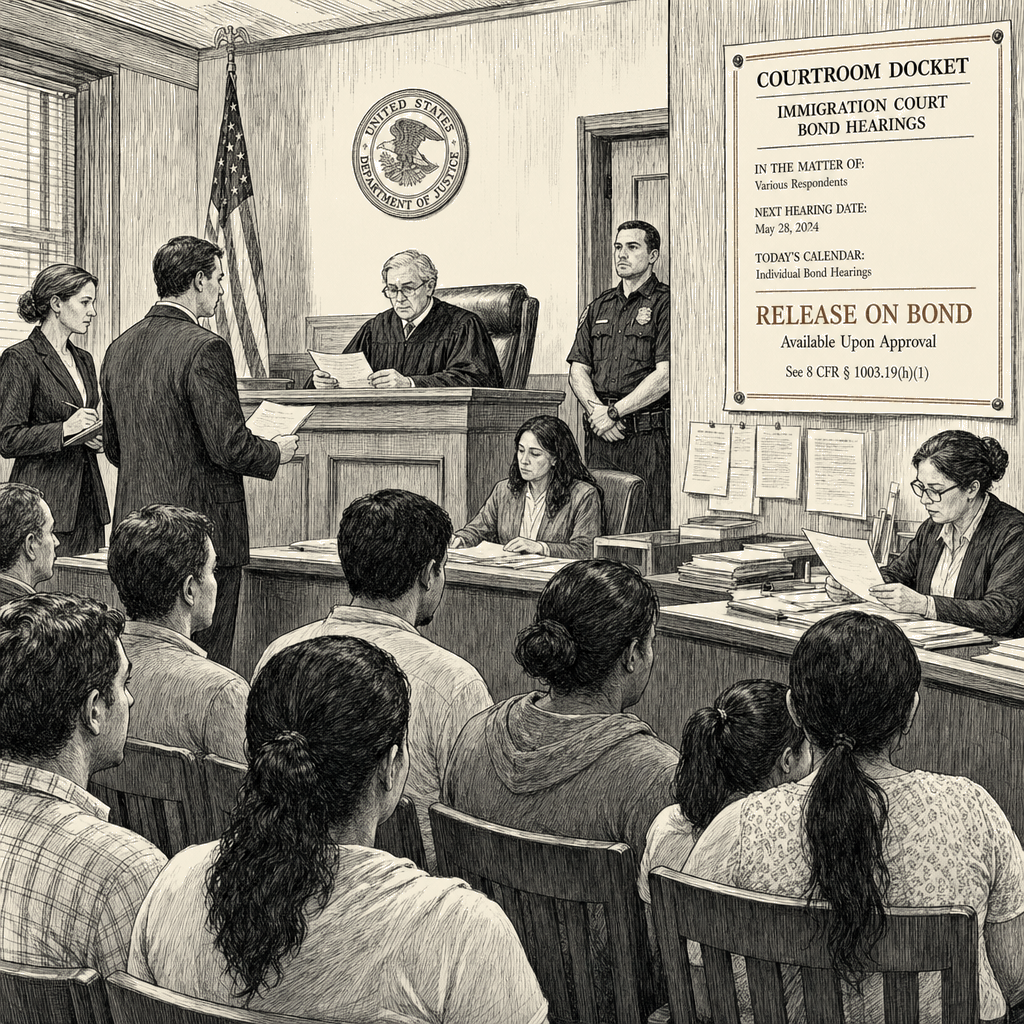
The regime this produces is not a hypothetical. People on American soil, charged with no crime beyond being present without authorization, sit in federal detention facilities for months or years without any hearing at which a judge evaluates whether their detention is necessary. The policy denies bond hearings by design; absent judicial intervention, no hearing occurs. For the immigrants caught in this system, Thursday’s ruling means an immediate path to a bond hearing for anyone detained in the Ninth Circuit’s jurisdiction — nine western states, roughly a fifth of the country. Every day the Supreme Court delays, more immigrants walk into a hearing officer and walk out on bond. The administration’s position, if the Court takes cert and rules for the government, would make that regime permanent and nationwide — no bond hearing, no individualized review, no time limit the courts are willing to enforce.
The legal math is bleak for the administration. A fast ruling means a ruling before a full nine-member Court — four conservative appointees who tend to defer to executive authority, three liberals who will almost certainly read the statute narrowly, and two swing votes (Gorsuch and Kavanaugh) whose records on due process in immigration cases are unpredictable. The Ninth Circuit’s Trump-appointed judge in the majority is a signal that even the administration’s own appointees are not buying the argument. The doctrine the Court has built across Demore, Jennings, and the shadow docket orders is the architecture that makes this possible. The circuit split is the last window through which the Constitution’s due process guarantee reaches these people. The cert petition is the Court’s invitation to close it — and the question it asks is one the Founders put in the Constitution twice, in the Fifth and Fourteenth Amendments, because they understood what a government does when it locks people up without a hearing.