The sovereign’s authority over the alien within the territory is plenary — and plenary includes the power to hold without bond. The Ninth Circuit’s divided panel has held that the mandatory detention statute must yield to a constitutional demand for individualized bond hearings. The administration has asked the Supreme Court to settle the question, and the expanding circuit split makes that review likely. Four other circuits have rejected the administration’s construction; the Second Circuit rejected it in April and the Fifth and Eighth Circuits have upheld it. The split deepens.
The authority the sovereign exercises through mandatory detention is the authority the Framers understood the political branches to possess over the alien who has entered without standing. The Constitution vests Congress with the power to establish “an uniform Rule of Naturalization” and to regulate the admission and removal of aliens; the Court has sustained that plenary power from Chae Chan Ping through Fiallo through Trump v. Hawaii. Mandatory detention is not punishment. It is a civil administrative measure, rationally related to the sovereign’s interest in securing the alien’s presence for removal. The panel’s dissent recognized this: the Constitution does not require a bond hearing for every alien whom the sovereign has determined should not remain. The liberty interest the majority invoked is not the liberty interest of a citizen, and the two are not interchangeable. The sovereign detains because the sovereign has the authority to detach the alien from the community, and that authority is the authority to hold, to release, or to remove as the sovereign judges necessary. The split circuits will be resolved. The architecture of plenary authority is older than any panel’s discomfort with it.
While the administration filed its cert petition, the officers came to the door of an apartment in Inwood at 6:30 AM on a Tuesday in February.
The officers arrived at the apartment building in the Inwood neighborhood of Manhattan, a five-story walk-up on a block where the fire escapes are caked with rust and the buzzer system has not worked since 2019. They came in two unmarked sedans and parked at the intersection of Vermilyea Avenue and West 207th Street, a block and a half from the apartment building, where the bodega on the corner was just raising its security gate. Three officers in tactical vests approached the front door. They waited for a resident to enter and slipped in behind him. They climbed to the third floor, where they knocked on the door of the apartment. They knocked for ninety seconds. They announced themselves. They then forced the door.
Josué was awake. He had been standing at the stove, heating milk for his daughter’s breakfast. When the door came open, the officers entered with weapons drawn. They ordered him to the ground. He did not comply immediately — he was holding the pot of milk, and his daughter was standing in the doorway of the bedroom, watching. An officer struck him in the back of the head with the butt of a firearm. The pot fell. The milk spilled across the linoleum floor. He was brought to the ground, handcuffed, and lifted to his feet.
He had been in the United States for eleven years, had filed for asylum, and had reported to ICE annually. The administration’s accelerated-removal sweep had flagged his file in January; he had been ordered to report for removal. He had not reported — he had a daughter who turned five in February, born at Harlem Hospital in 2020, a U.S. citizen, and a girlfriend, a Colombian national, who worked as a home health aide. He was processed at the Manhattan Detention Center, held overnight, and placed in removal proceedings anew — this time under mandatory detention, with no opportunity for bond. He was transferred the following day to the Bergen County Jail in Hackensack, New Jersey, which operates under an ICE intergovernmental-service agreement. He was housed in a unit with sixty-eight other men, all of them in removal proceedings, none of them permitted to apply for release.
The unit was a converted dormitory on the second floor of the jail’s north wing. The beds were steel bunks stacked three high, with mattresses two inches thick. The lights in the unit were never fully extinguished — a row of fluorescent fixtures above the central aisle operated on a dimmer that reduced to a low hum for six hours each night but never went dark. The windows were covered with a wire-reinforced film that let in light but prevented the men from seeing outside. The temperature in the unit, according to a lawsuit later filed by the Legal Aid Society, was kept at approximately 55 degrees Fahrenheit during the overnight hours, a level the jail maintained to save on heating costs and which the plaintiffs’ attorneys argued was deliberately uncomfortable.
Josué developed a cough during the first week. By the third week, the cough had become productive — thick yellow sputum that he spat into a paper towel when the guards were not watching. By the fifth week, he had begun to feel a tightness in his chest that made it difficult to complete the two-lap circuit of the unit’s dayroom without stopping to lean against the wall and catch his breath. He submitted a written medical request on day thirty-three. He was seen on day forty-one. A nurse listened to his lungs with a stethoscope, noted reduced breath sounds in the right lower lobe, and prescribed a course of amoxicillin. The course ended. The cough returned. The tightness in the chest had become a constant dull ache that radiated into his right shoulder blade. He submitted another medical request. He was not seen again for the duration of his stay.
Josué was held in the Bergen County Jail for one hundred and fourteen days. He did not see his daughter. He did not speak to his daughter on the telephone, because the jail’s telephone system required prepayment through a vendor that charged $3.00 for a fifteen-minute call, and his girlfriend did not have the money to replenish the account after the first two calls. He did not know that his daughter had begun to refuse to sleep in her own bed, curling instead into a ball against the wall of the corner where the hallway met the living room, where she had watched the officers take her father. He did not know that his girlfriend had lost her home health aide position because she could not arrange care for her mother during the hours the agency required. He did not know that the rent on the apartment on West 207th Street had gone unpaid for four months and that the eviction proceedings had been filed.
On the one hundred and fourteenth day, ICE transferred Josué to the Port Isabel Service Processing Center in Los Fresnos, Texas, in preparation for removal. The transfer took seventeen hours, including a layover at the Central Louisiana ICE Processing Center in Jena. He was placed in a holding cell at Port Isabel where the heat index inside the cell reached 97 degrees Fahrenheit during the day, according to internal ICE temperature logs later obtained by the Texas Civil Rights Project. He developed heat rash on his torso and the backs of his legs. He had resumed coughing. He had lost fifteen pounds.
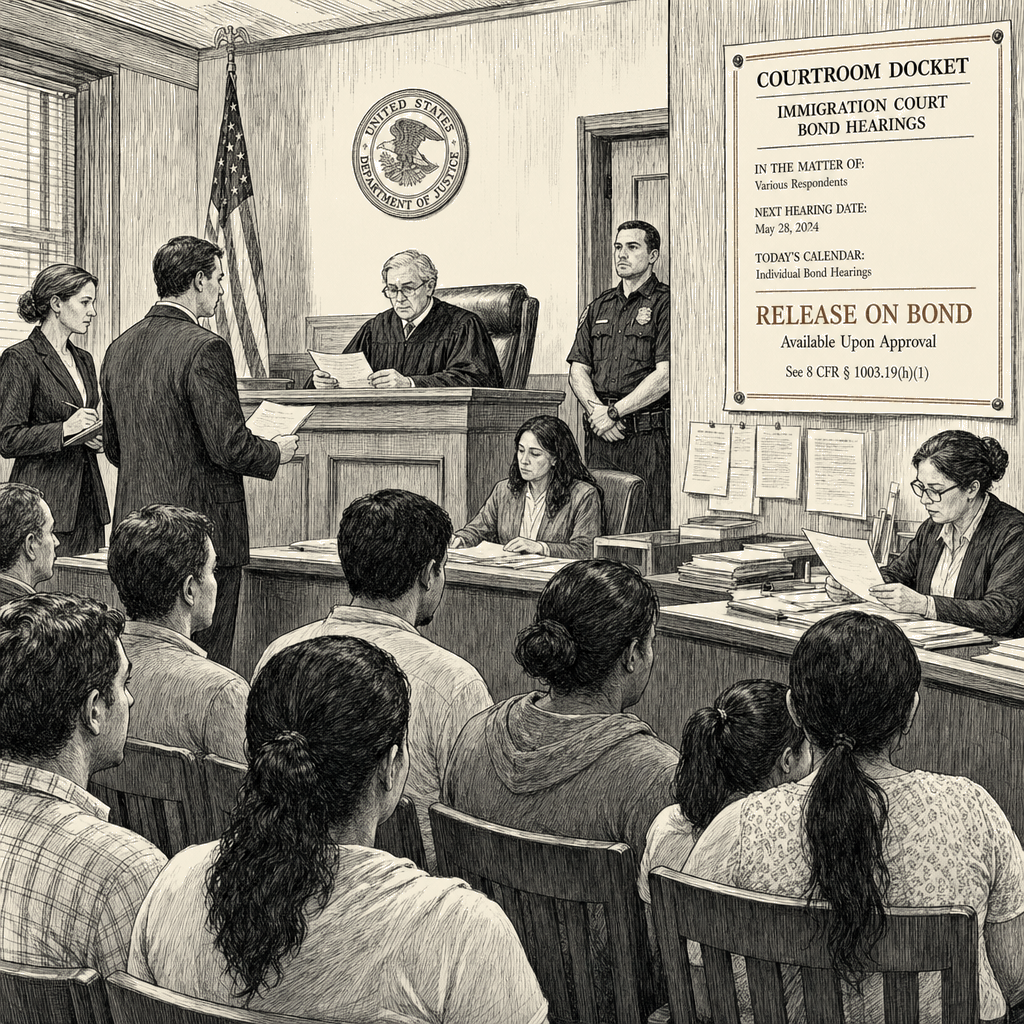
On day one hundred and twenty-two, an immigration judge conducted a telephonic bond hearing as permitted by the circuit’s ruling. The government presented no evidence that Josué posed a flight risk or a danger to the community. He had no criminal record. He had filed for asylum. He had thirteen years — four months of which were in detention — of appearing at every appointment to which he was ordered. The judge ordered his release on $5,000 bond. His girlfriend, who had lost her job and was still waiting for the eviction hearing, did not have $5,000. She borrowed $200 from a neighbor. The bond was not posted. Josué remained in custody.
On day one hundred and thirty-seven, ICE removed him to El Salvador. The flight landed at the San Óscar Arnulfo Romero y Galdámez International Airport at 3:10 PM local time. A bus from the Salvadoran migration authority carried him to a processing center where he was questioned, photographed, and released into the city of San Miguel, the city he had fled twelve years earlier, the city where his brother had been taken from a bus by men in police uniforms and not seen again.
He was outside the covenant. He was an alien who had entered the sovereign’s territory without authorization, a man whose claim upon the household’s legal apparatus was the claim of a stranger, not a son. The mandatory detention statute, and the architecture of plenary authority that sustains it, is the instrument through which the sovereign exercises its judgment. The bond hearing was held. The amount was set. The man did not present the bond. The flight left. The wall between the household and the stranger is not a failure of the system. It is the system operating according to its design. The sovereign detained him because he was outside the covenant — because his standing before the law was the standing of one who had not been invited, who had not been received, who could not claim the household’s provision as his due. The cough, the tightness in the chest, the heat rash, the lost fifteen pounds, the eviction, the daughter who curls into a ball against the wall of the corner where the hallway meets the living room and watches the door — these are not collateral damage. They are the evidence the sorting produces when the sorting is performed correctly. The judge ordered the hearing. The bond was set. The sovereign’s authority held. The ledger is balanced.