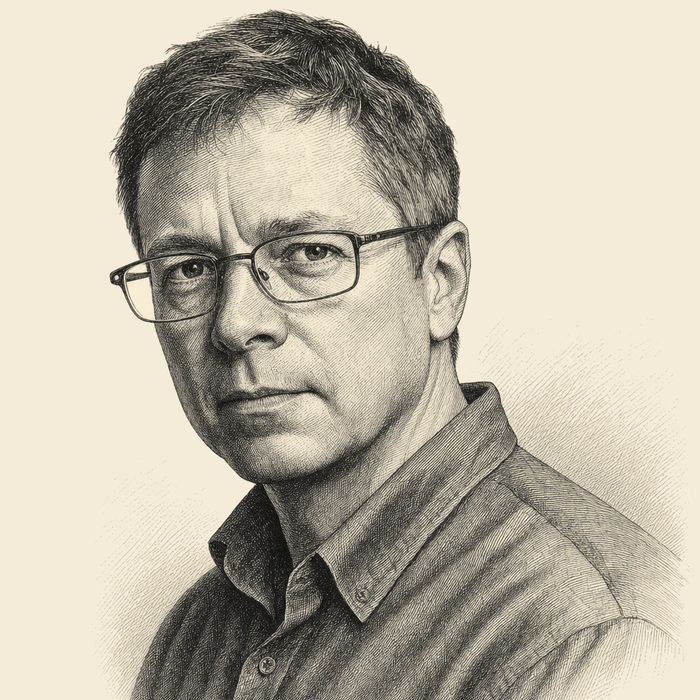
Joshua Kushner is parking the AI bubble in the Los Angeles Lakers.
It is true that Mr. Kushner has done nothing illegal, that his firm Thrive Capital made a genuinely early bet on OpenAI — in at a $29 billion valuation in 2023, the company now marked at $852 billion — and that a wealthy man buying a sports team is not, by itself, a crime. It is also true that the Lakers were for sale, and that $12.5 billion, fourteen months after a $10 billion purchase, is an excellent price for the seller. The trouble is that the buyer’s own firm has already named the transaction. Thrive Eternal, the arm devoted to “AI-proof” properties — the crucial word in the reported phrase “supposedly AI-proof” is the first one — exists to park money where it will still exist when the AI boom does not. The Lakers are the parking spot.
It is worth being precise about what “AI-proof” can mean, because the phrase determines where the money goes. A basketball game is live, in-person, and deliberately scarce; there is no platform to disrupt, in the sense the technology industry means. But what makes the franchise worth $12.5 billion is not its immunity to large language models. It is the league’s control of supply: territorial exclusivity, no new teams without the existing owners’ permission, a broadcasting pool that only the league can sell. Mr. Kushner and Bob Iger — the former Disney chief executive, who advises Thrive — first tried to buy an expansion franchise in Las Vegas, and when the price of new supply climbed, they bought the scarcity itself. “AI-proof” is a real quality. It is just not a technological one. It is a chokepoint, and the buyer has paid a price that assumes the chokepoint will outlast the economy that produced the money.
It is fair to note that a 25 per cent gain in fourteen months is the sort of outcome the finance industry calls performance. The trouble is that seventy-two hours is not the conduct of a man who believes the asset is still rising. The Wall Street Journal reported Wednesday that Mark Walter accepted in three days — a person close to the buyer told the paper it was as if Mr. Kushner “made an offer on a house” — while his firm, Guggenheim Partners, sits under a federal investigation into its private-credit lending and faces a liquidity crunch. Private credit is the term for loans made by non-bank funds directly to mid-sized companies, financed with borrowed money and repriced slowly; it is where this cycle keeps its undiscovered losses. A seller under federal scrutiny with a cash squeeze who unloads his trophy in seventy-two hours is not pricing the market. He is pricing his calendar. A buyer who can close in three days is not making an offer on a house; he is buying somebody else’s emergency, and that is when the best deals happen.
To be precise about what “the AI bubble” actually is in 2026, because the public discourse has a misleading habit of treating it as a single object rather than a set of overlapping positions with different counterparty risk: the popular version is that OpenAI and a handful of model labs are the bubble. That is not quite right. The bubble is a set of overlapping commitments in which the four hyperscalers — Microsoft, Google, Meta, Amazon — commit tens of billions per year to AI capex; in which GPU and chip suppliers (NVIDIA, Broadcom, TSMC) are now contracted to deliver capacity years in advance; in which the OpenAI valuation is, in part, a function of those hyperscaler commitments being honoured and an inference market eventually producing the margin to justify them; in which the model labs’ valuations are, in turn, marks against which the cycle itself can be re-collateralised; in which private credit lines — the very lines Walter’s firm is being investigated for — underwrite GPU acquisition by smaller labs that cannot issue their own investment-grade debt; and in which a handful of new paper-wealth holders — Thrive, SoftBank, the various sovereign-wealth-backed vehicles — sit at the apex with mark-to-myth positions (valuations that depend on a future hope rather than a present number) and rely on no one in the chain having to mark down first. Each link is plausible on its own. The chain is what John Kenneth Galbraith called the bezzle — the interval when the embezzler has the money and the victim has not yet felt the loss. Not every boom is a fraud, and the AI boom is not a fraud in any simple sense; the large language models work, in the narrow sense in which they work, and real engineering produced them. But a company worth $29 billion three years ago and valued at $852 billion today is a claim about the future that very few of its holders have tested against cash. The bezzle is the gap between the claim and the test.
Doctorow, whose enshittification framework I have been quoting for these columns, has argued for several years that the AI capex cycle is “more like Worldcom” than like crypto: real but overbuilt, with durable residue (data centres, GPUs, skilled researchers, an open-weights ecosystem less open than advertised) but unlikely to return the capital that has been priced into it. Worldcom is the right analogy because Worldcom is the case where the residue survived and the priced-in capital did not: line costs booked as capital expenditure, an equity that went to zero, fiber in the ground that a successor carrier acquired for a fraction of the original investment. AI’s residue will be data centres, GPU clusters, skilled researchers. The priced-in capital is the trillion-plus in hyperscaler commitments and the hundreds of billions more marked against the model labs. The four-stage pattern the framework names — good to users, good to business customers, claw value back for shareholders, collapse — fits the AI capital structure almost without modification. Thrive is at stage three, the point at which the structure begins to extract from those who depended on it. The bubble is what those four stages look like applied to capital flows rather than user flows.
The timing is worth attending to. OpenAI is widely expected to go public within the next year, and an initial public offering is the moment a private valuation meets the public markets — the day the paper gets a price that someone actually paid. It is also the moment the bezzle is most likely to be discovered. And it is in this window that the firm’s money has been buying the assets that cannot be repriced: the “iconic franchises” the buyer has said he prizes because they are “immune from technological disruption.” The immunity being purchased is not from the technology. It is from the IPO.
The same summer, Mark Zuckerberg moved on Kalshi, the platform that prices American elections, while Larry Ellison wrote a $45 million check to a Trump-aligned nonprofit, deepening his business ties to the administration — the pattern is consistent: the money that is making the future is buying the things that belong to everyone, on the theory that those are the things that will still be standing. The bezzle is buying its escape hatch in advance.
Longtermist and existential-risk rhetoric has functioned, across the press coverage and the conference circuits of the past several years, as moral cover for a transfer of wealth whose eventual cleanup will fall on the public rather than on the parties who collected the transfers. The argument that we are building an artificial general intelligence that will, in some specified near-term horizon, transform the economy is the part that lets every quarter of underwhelming revenue be filed as investment in the future. Thrive Eternal, on its own description, is the firm’s partial insulation against the cleanup it expects to be made of others.
The family history deserves to be stated plainly. Rae Kushner escaped the ghetto at Novogrudok through a tunnel she clawed out with her hands; Joseph Kushner survived nearly three years hiding in the surrounding woods. They settled in Elizabeth, New Jersey, among the fellow survivors who called themselves The Builders, and built houses, and then whole neighbourhoods. The structural point in that history is not about this generation’s character. An early backer helpfully rated the buyer’s humility “eighty percent” genuine, which in the genre of such testimonials is an admission; and the point is not the man but the direction of the money. The Builders built durable things by hand because they had nothing else. The current generation buys the finished durable thing because it has everything except something real to put its money in.
My own grandfather’s generation did the same building work, in the mills and along the railways, and their pensions were the price the extraction economy charged for it. The pattern is older than the mechanism. The mechanism is new — large language models, GPU clusters, twenty-year nuclear power purchase agreements, hyperscaler capex at multiples of GDP for the small jurisdictions in which the data centres are sited. The playbook is older than either. Find or build a class of suppliers. Lock them in by raising the cost of leaving. Find the next class of suppliers. Do it to them. The 1995 acquisition of Manitoba Rolling Mills by Gerdau of Porto Alegre took the mill where my father worked for thirty years and his uncles’ jobs — the formative deal in my family’s economic literacy — and did this to a Canadian heavy-industry workforce. The mechanism was cash and private equity. The playbook was lock in, extract, exit or hollow. The 2026 AI capex cycle is doing something structurally similar to a much larger workforce on a much larger scale, with a much larger mechanism (compute, capital, software) and roughly the same ratio of public cost to private return. The extraction economy has changed direction — it no longer has to sell the landmarks; it buys them — but the machinery has not. The institutions survive either way, and the people who built them do not get a vote either way.
Eventually someone, somewhere, pays for the electrons. AI capex is now the most legible single indicator that the buildout is real-economy infrastructure with real-economy costs and political consequences. Microsoft signed a twenty-year power purchase agreement with Constellation to restart Three Mile Island Unit 1 — the Crane Clean Energy Center, 835 megawatts — in September 2024, accelerated to 2027 with a $1 billion federal loan late last year. Meta signed a twenty-year purchase of the entire 1.1 gigawatts of Constellation’s Clinton Clean Energy Center in Illinois. Amazon Web Services sits adjacent to Talen’s Susquehanna nuclear plant in Pennsylvania. The combined AI-load commitment is large enough to be visible on the PJM and MISO interconnection queues — the requests by data-centre operators to plug into the mid-Atlantic and central-U.S. power grids — and large enough to be argued about at state public utility commissions and rate cases in the relevant jurisdictions. The bills will land on somebody else’s kitchen table. The press box the bubble just bought will be somebody else’s.
The alternatives are neither exotic nor untried. The Green Bay Packers sit in a community trust that cannot be sold out from under the town; German football keeps majority control in the hands of a club’s own members under the 50+1 rule; and the NBA sets its own ownership rules, which means either model is available to it tomorrow. The lever the column would lift, if the column were a policy memo, is disclosure: who owns what, who depends on whose circular commitment, which “AI investment” is in fact a round-trip transaction between two parties whose balance sheets are both dependent on the same hyperscaler capex commitment. The Securities and Exchange Commission has authority, under existing securities law, to require the disclosure of material related-party transactions. The levers are sitting on the shelf. They need a chair and a deadline.
Kushner’s people compared it to making an offer on a house, which is truer than they know. A house is the classic place to put money that needs to be somewhere when the market stops believing you; it is real, and it is still a house after the bubble that paid for it is gone. The Lakers will still be the Lakers. The difference is that a neighbourhood gets to decide who buys its houses, and Los Angeles had no vote on whether its team became the place where the AI bezzle parks itself. That decision was made by a seller with a federal inquiry in the hallway and a league with a price. The price was the point. It usually is.