Marco Rubio is enabling imperial war and calling it diplomacy.
Simon Tisdall of The Guardian called Rubio the most dangerous man in the administration after Trump himself. The ranking is right, though the deeper danger is not a true believer who says plainly what he wants. It is the respectable man who dresses enthusiasm for force in the language of duty, heritage, and civilization, so ordinary people will march their children toward war and call the marching virtue.
That man is the secretary of state.
The record does not support the word “diplomacy.” Israel rejected the administration’s latest Gaza proposals within days of the White House congratulating itself on a historic breakthrough. Ceasefires are faltering across multiple fronts. Russia’s attacks on NATO allies grow bolder. Ukraine has entered its fifth year of war, despite the president’s promise to end it in a day. Rubio himself has said there is no quick path to a deal, while no deal arrives without the sustained negotiation his office exists to conduct.
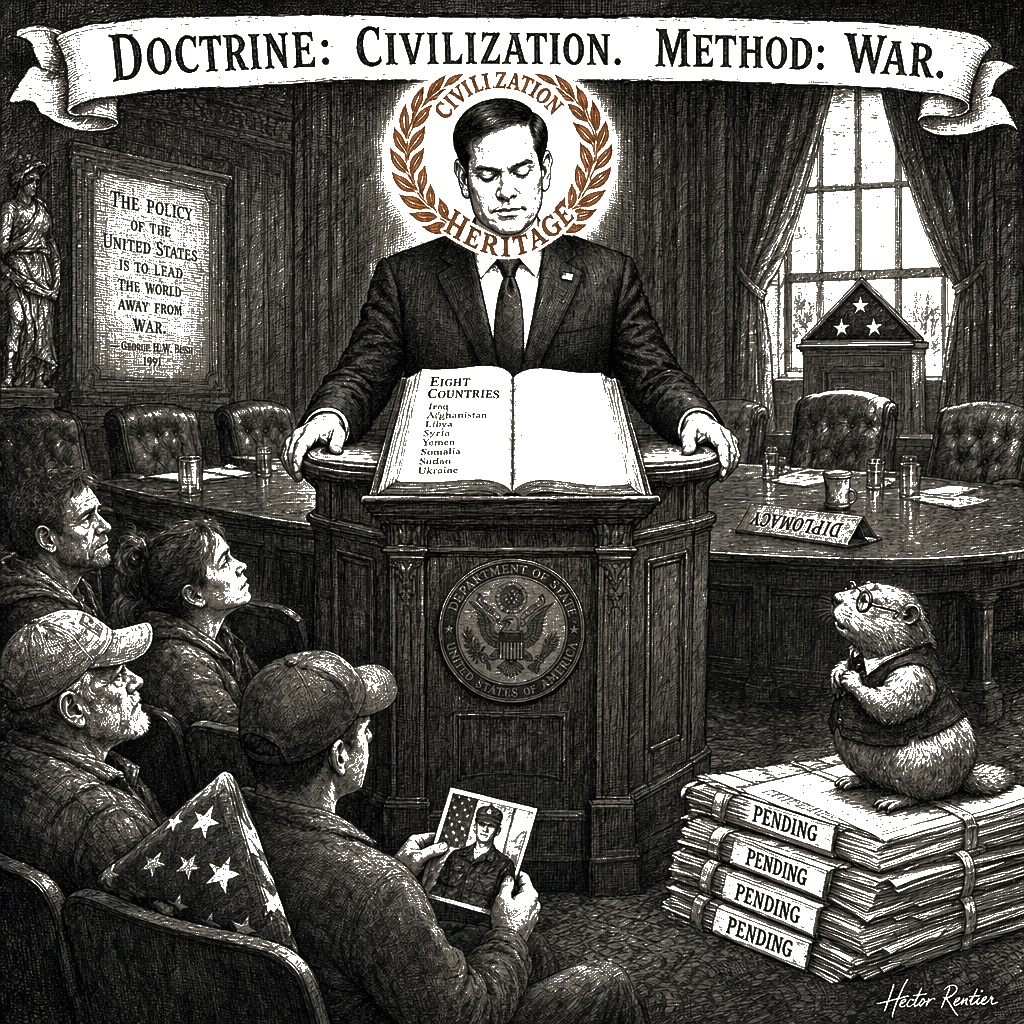
The Iran campaign, sold as a quick and conclusive use of force, failed. Families pay for that failure at the grocery store and the gas pump. The Vatican has called the war “immoral, unjust.” In the past twelve months, the United States has attacked eight countries.
Eight.
And the man whose office is to speak for the country refuses to sit at the table and speak.
Rubio’s doctrine is on the record, and it deserves to be read slowly. In February, at the Munich Security Conference, he lamented the decline of “the great western empires,” blamed their decline on “godless communist revolutions and anti-colonial uprisings,” warned Europe of “civilisational erasure,” and said allies should not be “shackled by guilt and shame” about their imperial past. He called for allies who were “proud of their culture and heritage” and “willing and able to defend it.”
That is not a defense of diplomacy. It is a defense of imperial memory, armed and brought forward into the present.
Andrew Bacevich has spent a career naming what that speech is. In Washington Rules: America’s Path to Permanent War and The Limits of Power, he described the settled doctrine that the United States must maintain global military primacy, project force everywhere, and refuse constraints on American freedom of action. Beneath that doctrine sits a kind of political theology: the conviction that American power is righteous by definition and therefore does not have to answer for what it does.
Rubio’s Munich speech is that doctrine in its late-imperial form. “Civilization” supplies the moral vocabulary. Primacy supplies the strategic rule. Military power supplies the method. The countries on the receiving end are offered a simple choice: become client states or be crushed.
It is a hymn. The congregation is asked to know, not think.
I know that register. I lived inside its cable-show rhythms for fifteen years, in a Southern Baptist world where national identity and Christian discipleship were fused until the two became indistinguishable. That fusion does not bless force directly. It permits force by giving it the vocabulary of defense. It tells a comfortable man that his comfort is precious, that his country’s violence is sacred, and that approval is the only sacrifice required of him.
The Sermon on the Mount and imperial war cannot both be the operating manual of a Christian country. One of them has to give.
Now consider the office Rubio holds. Clausewitz wrote that war is the continuation of politics by other means. The sentence cuts both ways. The part this administration ignores is the part where politics come first. War is supposed to serve a political purpose. Negotiation, bargaining, pressure, compromise, and settlement are not decorative activities added after the bombing. They are the political instrument that makes military force subordinate to an intelligible end.
When the political instrument is deliberately destroyed, war becomes the first resort, the only resort, the whole policy.
USAID has been gutted. The State Department’s professional diplomatic corps has been hollowed out. The International Criminal Court is under attack. Ukraine and Palestine negotiations are handed to the president’s son-in-law and a real-estate investor. Iran goes to the vice president. The secretary of state, who also carries the national security adviser’s portfolio, stands at arm’s length while the bodies fall.
That is a polite way of describing the safe seat. Rubio occupies the chair that lets the room be selected and the dead accumulate without his name appearing on the order.
Barbara Tuchman gave us a better test. Her The March of Folly identifies a policy as folly when it runs against a government’s interests, when an available alternative is known, when the choice belongs to a group rather than one isolated leader, and when the group persists after contrary evidence has become impossible to ignore.
Run Rubio’s policy through that test.
The administration attacks eight countries in a year. It dismantles civilian diplomacy. It outsources peacemaking to a real-estate negotiator and a presidential relative with no diplomatic experience. It bypasses a ceasefire deal in Ukraine even though the United States is the only country that can meaningfully squeeze both sides. Rubio then tells the press there is no quick path to an agreement.
The alternative is known.
The leverage exists.
The choice is being made anyway.
Israel rejects the latest Gaza proposals days after the president announces a historic breakthrough. The Iran campaign fails. Food and energy prices rise. Russia’s attacks on NATO allies grow increasingly brazen, increasing the danger of wider escalation. The policy is failing on every front.
It is being carried on.
That is the march of folly.
Rubio’s reversals tell the same story faster than any biography. As a senator, he was a China hawk. In office, he follows Trump’s line on Beijing. He castigated Russia. Now he appeases it. He championed overseas assistance. Now he has gutted USAID and seeks to dismantle the International Criminal Court. He attacked the Iran nuclear deal. Now he backs an accord offering additional concessions to Tehran.
His biographer, Manuel Roig-Franzia, wrote that Rubio’s political flexibility “is rooted in a childhood need to belong, to be on the winning side, no matter the price.”
The political reading is plain: the courtier adapts to the throne.
The moral reading is worse. A man whose primary political commitment is belonging cannot tell a president that the war is lost. He cannot tell a president that the country being attacked did not attack us. He cannot tell a president that the promised victory is not a victory. He belongs to whatever project is winning because belonging is the project.
In 2016, Rubio called Trump a conman. Trump called Rubio “little Marco” and a loser. Two men made peace on terms that were never defined and never questioned. The flexible man found his winning side.
The winning side is the one that has sometimes attacked eight countries in a year. Rubio’s part in the enterprise is to claim the world in a dark suit and call it peace.
The standard for a secretary of state is simple. He sits at the table. He talks to enemies, which means treating them as people with interests rather than clients or corpses. He uses the leverage the United States possesses, including the capacity to squeeze both sides in Ukraine. He treats war as the last resort, as the just-war tradition requires, not as the first instrument of a government that has forgotten how to negotiate.
Rubio holds the leverage.
He refuses to use it.
That is the indictment.
The human ledger does not need a sermon. Civilians in Ukraine are living through their fifth year of war. Civilians on both sides are paying for decisions they did not make. Families in Iran are counting the cost of a failed campaign at the grocery store. Eight countries in one year have learned what it feels like to sit on the receiving end of an empire whose secretary of state will not talk.
The political class gets the speeches.
The working class gets the body bags.
The defense contractors get the contracts.
I served in the Abrams crews of the Third Infantry Division in 2003. From where I sat in the gunner’s seat, the faces beside me were not the sons of the men who made the speeches. They were the men John Fogerty named in “Fortunate Son,” the men whose fathers did not run for office, did not receive deferments, and did not have a real-estate portfolio to manage through the duration.
The bill does not end when the deployment ends. It is paid in moral injury, in the corrosion of a soldier’s moral world when he is asked to do things that cannot be justified by the reasons given. It is paid in the veteran suicide rate, in traumatic-brain-injury diagnoses, and in the post-9/11 cohort that came home from a war it could not name the purpose of.
The bill is paid by people who were told they were defending civilization while the policy served interests that were never placed on the recruiting poster.
Eisenhower warned us about this on January 17, 1961. “In the councils of government,” he said, “we must guard against the acquisition of unwarranted influence, whether sought or unsought, by the military-industrial complex.” He also said that only “an alert and knowledgeable citizenry” could compel the proper meshing of military machinery with peaceful methods and goals.
Sixty-five years later, the complex has friends in the secretary of state’s office.
The complex does not need diplomacy, because diplomacy is what stops wars. It does not need ceasefire deals, because deals end procurement pipelines. It does not need the Vatican persuaded, because the Vatican does not buy weapons.
This is not a column about a man who fails at his job.
It is about a man who succeeds at the wrong one.
The office Rubio holds could stop wars. The job he is doing enables them. The record is already in: eight countries attacked, an Iran campaign that failed, a Ukraine war in its fifth year with a known diplomatic alternative bypassed, a Vatican accusing the administration of an immoral war, and a professional diplomatic corps gutted.
The table sits empty.
The wars go on.
The wars his office was created to prevent are the wars he is paid to bless.
Call it peace, Marco.
Nobody is buying.