
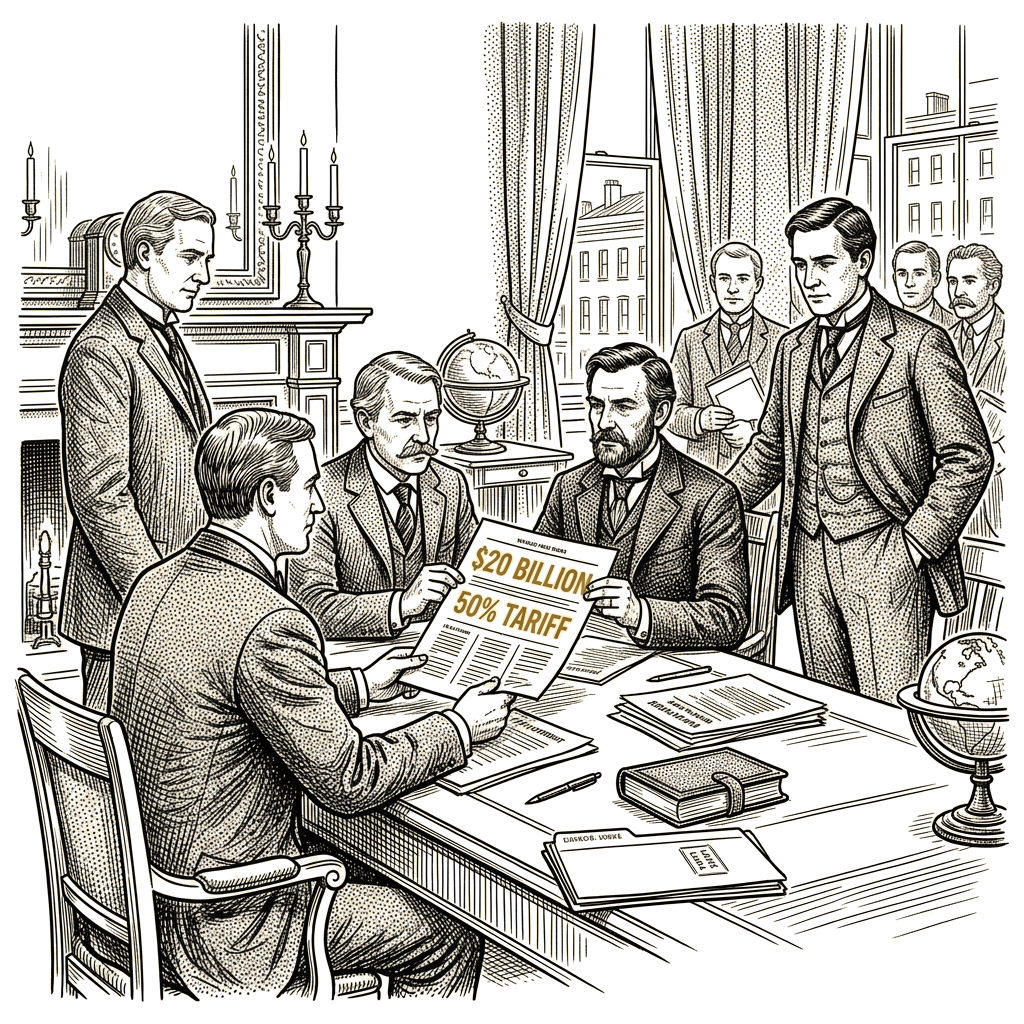
Trump is using a 50 percent tariff on $20 billion of Canadian goods to extort the United States’ largest trading partner into becoming the 51st state.
Here is the arithmetic. A 50 percent tariff on $20 billion of imports is a $10 billion tax on US importers — paid at the register, passed through to wholesalers, retailers, and ultimately consumers. The incidence does not change when the tariff is called an “import duty” or a “trade penalty.” A family buying a Canadian-manufactured auto part, a Canadian-lumber-framed house, or a Canadian-dairy product pays more at point of sale. The empirical literature on tariff pass-through is as close to settled as trade economics gets: Mary Amiti, Stephen Redding, and David Weinstein’s 2019 analysis of the 2018 tariffs, published in the Journal of Economic Perspectives, showed the full incidence fell on US importers and consumers, not on foreign producers.
Three points are worth establishing before the talking points arrive.
First, the revenue is fungible. Tariff receipts are deposited in the general fund. The general fund is the same account that absorbs the revenue loss from the One Big Beautiful Bill Act’s corporate-rate provisions and pass-through extensions. The tariff is not earmarked for factory construction. It is earmarked, in the only sense the budget process recognizes, for deficit reduction that partially offsets the cost of tax legislation whose distributional incidence concentrates in the top decile. The Tax Policy Center’s distributional analyses of tariff proposals consistently find that tariffs function as a regressive sales tax: households in the bottom income quintile pay a higher share of income in tariff-imposed price increases than households in the top quintile.
Second, the “manufacturing renaissance” frame is an intellectual-laundering operation. The rhetorical claim is that tariffs will bring factories back to the United States. Tariffed imports do not arrive at the US border with a flag saying “I was made by a Canadian worker whom the tariff will rehire in Ohio.” They arrive at the border, sit in a warehouse, and get sold at the higher price. The budgetary reality is that tariff revenue is being collected alongside a permanent extension of the TCJA’s individual rate reductions and the pass-through deduction, while layering in additional regressive tariff exposure. The distributional tables show the same pattern every supply-side cut has produced: the top decile captures a disproportionate share of the rate reductions, while the bottom quintile absorbs a disproportionate share of the tariff-imposed price increases. The JCT distributional tables for the One Big Beautiful Bill’s permanent-extension provisions show it. The historical record shows it. The 1981 ERTA rate reductions were paired with regressive excise increases. The 2001 and 2003 cuts were paired with the expiration of middle-class provisions while upper-income provisions were extended. The 2017 corporate-rate cut’s investment effects were absorbed by share repurchases. The 2018 steel-and-aluminum tariffs did not produce a domestic steel-and-aluminum renaissance; they produced higher prices for US manufacturers that use steel and aluminum as inputs, and the offsetting effect the administration’s consultants identified was well below the static cost. The pattern is forty-five years old.
Third, the procedural architecture is unprecedented at this scale against an ally. The instrument is Section 338 of the Tariff Act of 1930 — a Depression-era authority that the historical record shows was used selectively in the 1930s and 1940s against countries that discriminated against US commerce, but had not been deployed at this scale against the United States’ largest trading partner and a NATO ally. The statute was threatened against France in the early 1930s and considered in the late 1930s against Japan. The country you are taxing at 50 percent is the country that fought your war. Canadian soldiers fought alongside Americans in Afghanistan after September 11, 2001. The 5,525-mile US-Canada border is the longest undefended border in the world; 330,000 people and $2 billion in goods cross it every day. A 50 percent across-the-board tariff is not a surgical instrument aimed at dairy subsidies. It is a coercive instrument that treats a roughly $900 billion bilateral trade relationship as a slush fund.
The stated rationale is the cover. The Canada-specific disputes are real — softwood lumber and dairy access — and they have been managed through USMCA’s dispute-settlement panels and WTO proceedings, the boring procedural machinery that actually resolves trade disputes between allies. The President has not invoked USMCA’s dispute process. He has invoked a tariff that does not require the dispute to be resolved. The 51st-state suggestion is not a stray line. It is the unmasked goal. A 50 percent tariff on the largest US trading partner, an ally, a NATO member, a country whose citizens live in the United States in numbers approaching a million, is not a price signal. It is an instrument deployed against a country the President has repeatedly suggested should surrender sovereignty and join the Union as the 51st state.
The bilateral “talks” being held to head off the tariff are the same ritual. The deadline is theater. The deadline creates the press cycle that delivers the political benefit of the threat. The deal, when it comes, will moderate the rate enough to claim a “win” while leaving the revenue-extraction mechanism intact. Last month’s parallel announcement of new tariffs on eighty nations made the same play at larger scale; the diplomatic choreography is the implementation, not the opposition to it.
The right instrument is the USMCA dispute-settlement mechanism for the dairy and softwood lumber disputes. The right industrial policy for American manufacturing is not a 50 percent tariff on imports from your largest trading partner; it is the patient procurement, R&D, and workforce investment that the United States has used in the past when it actually rebuilt domestic industrial capacity.
This was decided in advance, and the methodology was retrofitted to the conclusion.