Secretary Rubio is detaining a professor, her husband, and their teenage son in Texas for what a woman said on television in 1979 — before the son was born.
Maryam Tahmasebi is a professor of psychology and statistics in Los Angeles. Her husband, Seyed Eissa Hashemi, works alongside her in American academia. Their teenage son is an American teenager. They entered the United States legally in 2014, became lawful permanent residents in 2016, and have spent the twelve years since building the life the green card was supposed to represent — a life defined, in Tahmasebi’s words, by “my own actions, not anyone else’s.”
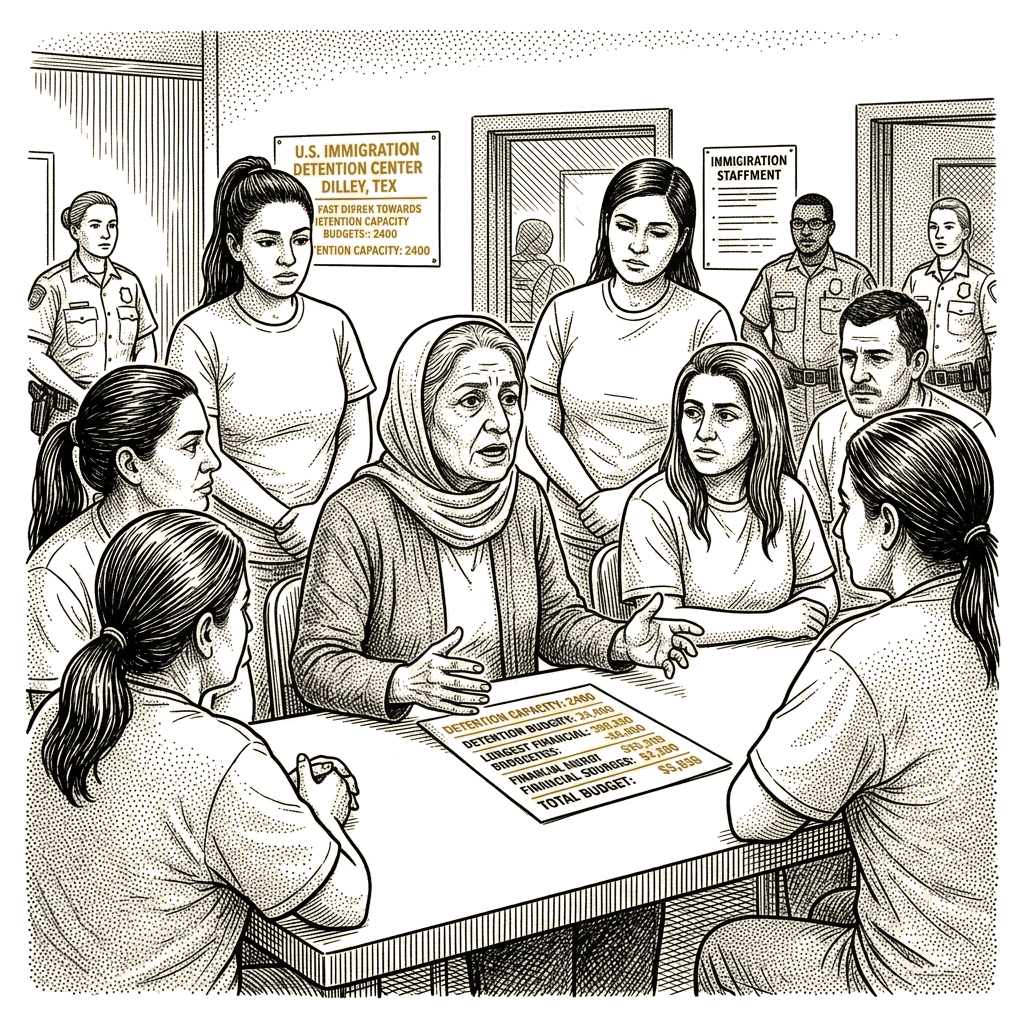
That life is in pieces. Since then, the family has been held in immigration detention: Tahmasebi and her son at the South Texas Family Residential Center in Dilley, Hashemi at the South Texas Detention Facility in Pearsall, in conditions his wife describes as “horrible.” A federal judge has temporarily blocked their deportation. Their lawyers have asked the government to release them, or to charge them, or to let them leave voluntarily. The government has refused all three. When the family tried to self-deport, DHS declined their request for voluntary departure. A government attorney offered instead a stipulated removal — waive your hearing, leave the country, lose your rights. The family said they wanted to leave on their own terms. The government wants them detained without end.
The State Department will not say what crime the family has committed. It will not say how a 1979 television appearance by Masoumeh Ebtekar — a college-age spokesperson for the students who took over the American embassy in Tehran, and whose son was not yet born — threatens the national security of the United States in 2026. The agency, in the words of spokesman Tommy Pigott, “does not divulge protected, sensitive, or classified information pertaining to the termination of legal status of foreign nationals.” The family is being punished for what their mother-in-law once said on television. The State Department will not say why.
The pattern is not limited to them. The State Department has also revoked the legal status of two Iranian women initially identified as the niece and grandniece of Qasem Soleimani — a relationship his own family has denied, and subsequent reporting has cast doubt upon. It has revoked the status of the daughter of former Secretary of the Supreme National Security Council of Iran Ali Larijani. The targeting appears to begin with the surname.
Tahmasebi wrote her account from inside the detention facility in Dilley, Texas. She called it what it is: bloodline punishment.
“We have been put through hell for the past four months,” she wrote, “and our physical and mental health have deteriorated in ways that might not be reversible for years.”
The State Department hides behind classified information to justify revoking the legal status of a professor and a teenager. The Department of Homeland Security tells them to download an app.
You shall not execute the children for the parents.
That commandment is the first prohibition God gives Moses on this question. It runs through the entire Hebrew Bible like a river. The prophet Ezekiel heard this kind of accusation before. Speaking to the exiles in Babylon, he addressed a proverb circulating among them: “The parents have eaten sour grapes, and the children’s teeth are set on edge.” It was the consolation of the cruel — that the sins of the fathers could be visited on the children, that bloodline could answer for bloodline. God answered through Ezekiel: this proverb shall no longer be used in Israel. The person who sins shall die; the child shall not die for the parent. “Know that all lives are mine,” says the Lord.
The command to welcome the stranger appears thirty-six times in the Torah — more than any other commandment. You were strangers in the land of Egypt. You know the heart of a stranger. The alien who resides with you shall be to you as the citizen among you. You shall love the alien as yourself. Jesus takes the stranger’s side in the final judgment. Whatever you did for one of the least of these, you did it to me.
The tradition knows what this is. It names it clearly. When a government punishes people for inherited guilt, when it locks a professor and a teenager in a detention facility because of something their relative did fifty years ago — the prophets called that evil. Isaiah called it evil. Jeremiah called it evil. The Torah names the practice as precisely the thing God commands against.
We have been here before, and we have done it to our own. We interned Japanese Americans during the Second World War for the sins of the empire their ancestors came from. We detained Muslim, Arab, and South Asian men after 2001 — men whose beards and prayer caps the country saw on the hijackers’ photographs — for the sins of nineteen men whose names sounded like theirs. We have always had a category — enemy alien, illegal combatant, suspected terrorist — into which we put people whose actual relationship to any crime was the accident of their face or their surname. The prophets were not writing about Iran. They were writing about us.
I cannot write this as though I stand outside the indictment. The political climate that makes this possible is one our own communities helped build. We vote for the cruelty we are told is security. We call it law and order. We call it protecting the country. And then a professor writes from inside a detention facility in Texas about what bloodline punishment feels like, and the word we used for it comes apart.
A humane immigration policy is not hard to describe. It is a policy that does not detain people without evidence of their own wrongdoing. It is a policy that releases people charged with nothing. It is a policy that lets a person leave when they ask to leave. It is a policy that does not punish a son for the speech his mother gave on television before he was born. Pope Francis, when he went to Lampedusa in 2013, named what we have become when we forget these things: a “globalization of indifference,” a world that has “forgotten how to weep.” The State Department has not wept for this family. It will not weep for them while they sit in Texas.
If Secretary Rubio believes Seyed Eissa Hashemi has committed a crime, let him charge him. If he believes the family is a threat, let him say how. If he cannot do either, then the only just thing is to release them — back to Los Angeles, where they have lived for twelve years, or to wherever they choose to go.
You are doing what the Torah forbids. You are punishing a son for his mother’s words. You are detaining a professor and her teenage son without national security charges. You are hiding behind classified information to justify something that is not classified and not complicated. It is cruelty, and it is named as evil in the texts you claim.
The door is open. You can stop. You can release this family. You can restore what you took. You can account for what you have done to people who harmed no one and broke no law — who came to this country legally, built legal lives, and were destroyed for a name they did not choose and a history they did not make. The prophets spoke for the people the powerful had decided to forget. They are speaking for this family now. The tradition does not leave you without guidance. It tells you exactly what to do: love the stranger. Open the gate. Let the family go.