
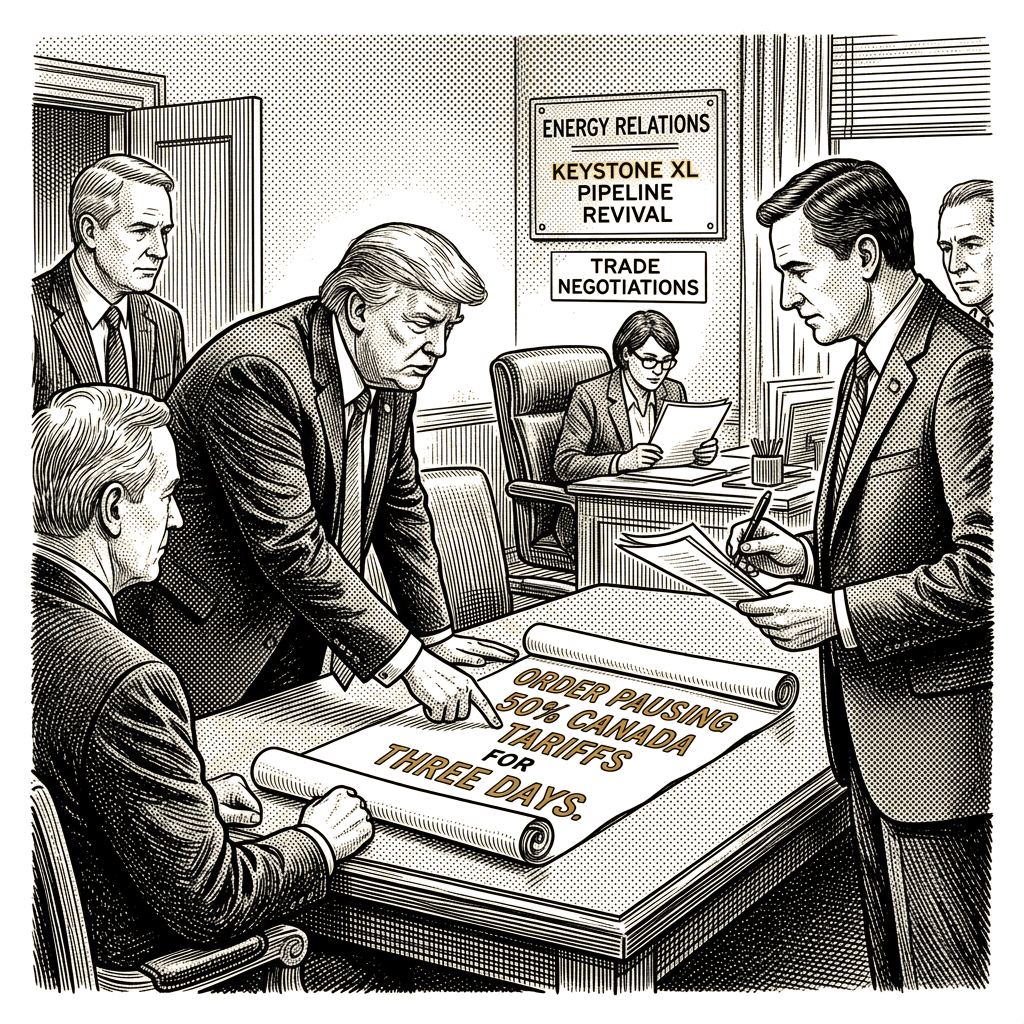
Trump is extorting Canada with tariffs to revive Keystone XL and calling it a deal.
The instrument is a 50 percent tariff on roughly $20 billion of Canadian goods, announced to take effect Tuesday evening, paused three days later by a social-media post that announced a “DEAL!” “subject to the finalization of documents.” The instrument used to impose the tariff and the instrument used to pause it was the same: a presidential social-media post, hours before the duties were scheduled to take effect.
Bilateral US-Canada trade in 2024 totaled roughly $909 billion, per the Office of the US Trade Representative. The 50 percent rate, applied to a deliberately chosen list of Canadian consumer goods — wine, hockey sticks, dairy — covered approximately 2.2 percent of the bilateral flow: small as a share of total trade, large as a share of the targeted sectors, and structured to inflict maximum political pain on Canadian voters without disrupting the integrated North American auto supply chain the administration did not want to touch. The reason “autos” was not on the list is the reason the threat worked.
The tariff list read out to a specific human geography. The Niagara Peninsula — Canada’s largest wine-producing region, anchored by producers like Inniskillin and Peller Estates in Ontario — was named directly. The hockey-stick manufacturers clustered in Quebec, the dairy farmers working under Canada’s supply-management system, the small exporters across these categories: all faced the rate. Canadian business owners warned in advance of “financial devastation and untenable export costs.” The warning was filed. The tariff proceeded.
The President’s standing tariff authority runs through Section 232 of the Trade Expansion Act of 1962 (national security), Section 301 of the Trade Act of 1974 (unfair trade practices), and the International Emergency Economic Powers Act. The July 2026 announcement cited “discrimination against US-produced cars, alcohol, and dairy” — vocabulary that fits Section 301 as a matter of form, but Section 301 requires a USTR investigation and presidential determination before duties take effect. The USMCA framework, signed in 2018 and in force since 2020, has designated dispute-resolution mechanisms for exactly the commercial disagreements the announcement invoked. Those mechanisms take months to run and produce rulings. The 50 percent tariff is not a finding under USMCA. It is the threat of immediate, unconditional, percentage-based duties — the emergency instrument used to bypass the process the agreement was written to replace.
The Keystone XL mention, in the same social-media post that paused the tariff, is the giveaway. The President wrote that the pipeline “may be awoken from the grave.” The project was first proposed in 2008 to carry Western Canadian Select heavy crude from Alberta’s tar sands to US Gulf Coast refineries configured to run it. It was halted in 2021 when President Biden revoked the cross-border permit for the 1,200-mile project, after years of opposition from US landowners, Native American tribes, and environmental groups. The owner, TC Energy, walked away. Twelve months of trade-war escalation later — the opening 25 percent tariff in February 2025 was sold on a border-and-fentanyl pretext that Canadian government data showed covered less than one percent of fentanyl interdictions and illegal crossings — the artifact that surfaces in the announcement of a reprieve is a fossil-fuel infrastructure project killed for documented environmental and Indigenous-community reasons.
The beneficiaries of the pipeline revival are not the Canadian producers paying the tariff. They are TC Energy, the Canadian heavy-crude producers, the US refining and pipeline-construction interests, and the construction trades that would build it — the donor class whose priority could not have gotten through the ordinary procedural channels: NEPA review, tribal consultation, judicial review of the kind that has repeatedly stalled similar projects. The cross-border permit Biden revoked in 2021 is the named object the post prefigures: a permit reinstated without the environmental impact statement, without consultation with the tribes whose land the route crosses, without the judicial review that would ordinarily follow. A tariff is a tax. The 50 percent rate on $20 billion of Canadian exports is, if fully implemented, a tax of approximately $10 billion per year, levied on Canadian producers but borne, as incidence analysis consistently shows, partly by US importers and US consumers.
The most recent predecessor in this pattern was a 50 percent tariff imposed on Canadian goods in late July, followed by bilateral trade talks that produced this week’s pause-and-pipeline announcement. The 25 percent tariff in February 2025 produced a similar round. Section 232 was invoked in 2018 against Canadian steel and aluminum on national-security grounds that the Department of Defense and the Canadian government both questioned. The procedural shortcut taken here is not a partisan innovation; it is a precedent whose availability to any future occupant of the office should worry the reader who believes in the procedural integrity of the taxing power.
The pipeline killed for cause in 2021 does not come back to life because the President mentions it in a social-media post announcing a three-day pause on a tariff the Canadian government has not, in any formal sense, agreed to accept in perpetuity. The score is the score. The author of the tariff does not get to grade the agreement.