
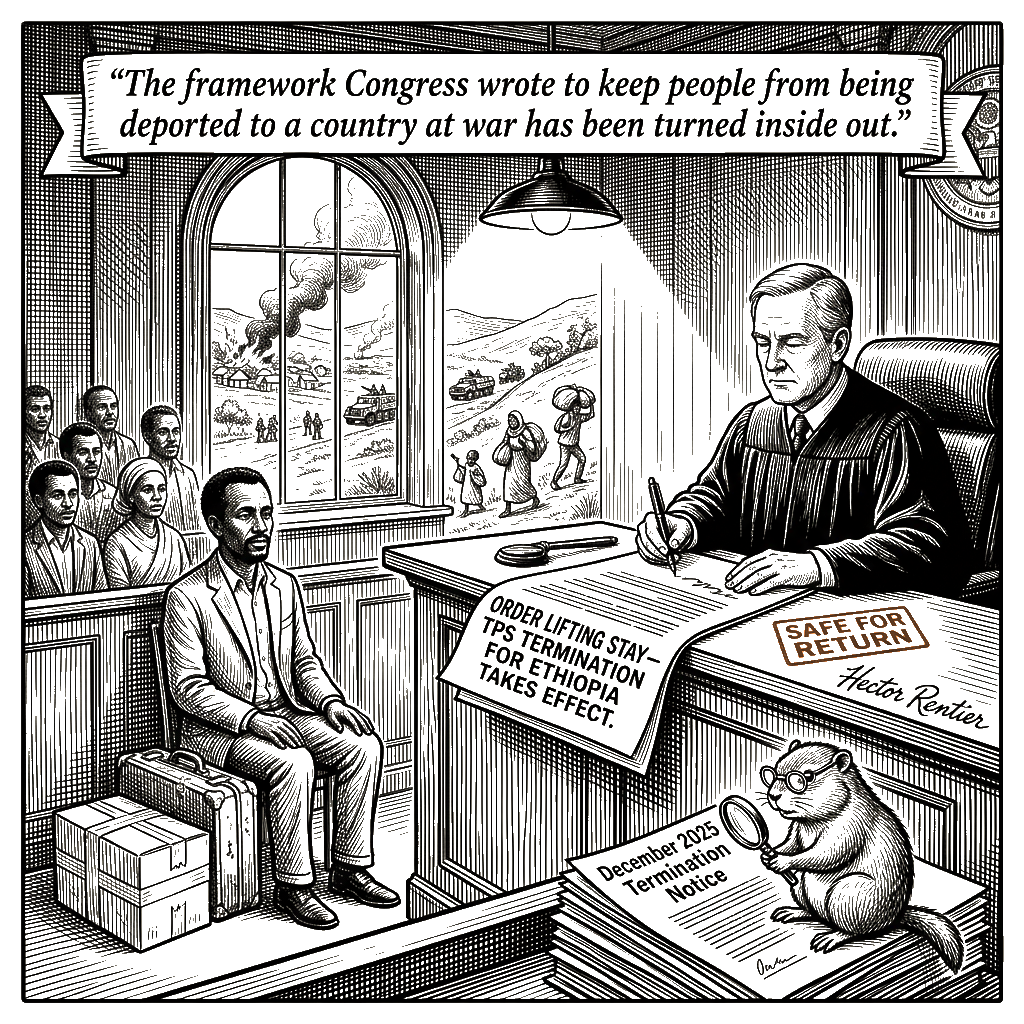
Brian Murphy has cleared the Trump administration’s deportation of 5,000 Ethiopians to a country at war.
The federal judge lifted the temporary stay that had been preventing the Department of Homeland Security from terminating Temporary Protected Status — the humanitarian designation Congress wrote into immigration law precisely for nationals of countries where armed conflict, natural disaster, or other extraordinary conditions make deportation unsafe. With this order, the administration’s termination of TPS for Ethiopia now takes effect, and the deportation of every Ethiopian currently protected under the designation becomes legally permissible.
That is the operative fact of a federal district court ruling issued Tuesday, and the fact that the operative fact needs to be stated plainly tells you what the rest of the judicial record on Temporary Protected Status has become. The litigation posture is receiving-column treatment; the substantive result is sending people to a country where the federal government itself, by its own December 2025 termination notice, was required to acknowledge ongoing armed conflict. The litigation is over the form. The deportation is to the substance.
The administration’s strongest case, taking the steel-man seriously, runs as follows. TPS is a discretionary executive authority. The Department of Homeland Security has determined, through the formal process Congress specified in 8 U.S.C. § 1254a, that the extraordinary conditions that justified Ethiopia’s original designation — the Tigray war, the mass displacement, the humanitarian emergency of late 2022 — no longer support continued protection. Courts have historically treated TPS termination decisions as largely unreviewable under the statute’s text, which speaks in terms of executive discretion “on such terms as the Secretary may establish.” The Supreme Court’s June 2026 ruling on parallel Haitian and Syrian terminations, as the BBC reports, has now extended that deference across the TPS docket. The executive has the authority. The executive has exercised it. A district court lacks jurisdiction to substitute its judgment for the Secretary’s.
That is the steel-man. It is also the move that, taken to its logical end, eliminates judicial review of a humanitarian-protection program in the middle of a renewed civil war.
The audit is the conditions on the ground in Ethiopia. The Biden administration first designated Ethiopian nationals for TPS at the end of 2022, citing armed conflict including the Tigray war that had killed hundreds of thousands of people and displaced millions more. When it did so, the government estimated more than 20,000 Ethiopians living in the country since October 2022 would qualify. The Pretoria Agreement nominally ended that two-year civil war in November 2022. Both sides now accuse each other of violating it. The December 2025 termination notice from then-Secretary Kristi Noem announced that “conditions in Ethiopia were safe” — issued at the very moment the Pretoria Agreement was fraying, the TPLF was reasserting control over Tigray, and the federal government in Addis Ababa was accusing Tigrayan leaders of colluding with Eritrea and the Sudanese military. Fighting and drone strikes have been reported in northern Ethiopia in recent weeks. Outside Tigray, armed insurgencies continue in Oromia and Amhara, the country’s two most-populous regions. The December finding on which the administration relies — that Ethiopia is now safe enough to require deportation of those who fled the conflict — is contradicted by every one of those conditions.
What the order does not do is engage any of those conditions. Murphy’s ruling makes no finding that the Tigray conflict has ended, no finding that the Pretoria Agreement is being honored, no finding that the deportations the order enables will return people to safe conditions. What Murphy’s ruling does is lift the legal obstacle to the deportations the administration wants to carry out.
What Judge Murphy’s ruling actually does is narrower than the administration’s celebratory social-media posts suggest. According to Reuters, the court dismissed some of the plaintiffs’ claims but allowed them to continue litigating whether the cancellation was motivated by racial or national-origin animus. That carve-out is the only live procedure that could stop the deportations the order now enables. The statutory discretion to terminate TPS, even when it runs as broadly as the administration argues, does not include the discretion to terminate it because the recipients are from a country whose nationals this administration disfavors. The Ethiopian plaintiffs — joined by the advocacy group African Communities Together — argued that the pattern of terminations across multiple African and Caribbean countries, combined with statements from executive officials, established the discriminatory intent that equal-protection law forbids. The court did not reject that claim on the merits. It permitted the case to proceed.
The doctrinal standard the plaintiffs will face on the surviving equal-protection claim is the one the Supreme Court announced in Village of Arlington Heights v. Metropolitan Housing Development Corp. in 1976 — the purpose-based-discrimination framework that asks whether racial or national-origin animus was a motivating factor in the challenged decision. Arlington Heights is demanding; equal-protection plaintiffs rarely win against executive enforcement records. But the framework was built for exactly the evidentiary record the plaintiffs have assembled: a termination pattern that runs across African and Caribbean populations, the public statements from executive officials deploying the rhetoric of “ILLEGAL” deportation in capital letters, and a country-conditions rationale that the post-termination record on Tigray has not supported. The factors the Arlington Heights opinion identifies — disparate impact, historical background, procedural and substantive departures from normal practice, the contemporary statements of decisionmakers — are the factors in this record.
The agency’s reaction to its own win is on the public record and worth reading at face value. DHS general counsel James Percival posted to X: “All TPS terminations are in effect!” The agency’s official account posted in capital letters that those with terminated TPS are “in our nation ILLEGALLY” and that they have two options: “LEAVE IMMEDIATELY or be DEPORTED.” The all-caps threat is not stylistic; it is the policy the order enables, announced by the agency that will carry it out.
Ethiopia is the final country the administration moved against. With this order, every TPS designation the Trump administration targeted is now in line for erasure — Venezuela and Honduras already terminated, the Haitians and Syrians foreclosed by the Supreme Court in June, and now the Ethiopians. My MSI colleagues covered the prior procedural ruling in this same Murphy litigation the day before and the Supreme Court ruling from June that put 1.3 million immigrants at risk of deportation on July 7. The Ethiopia ruling completes the pattern. Roughly five thousand Ethiopian TPS holders — many of them in the United States continuously since October 2022, fleeing the Tigray war — are now subject to removal to a country where the war is, as the BBC reports, intensifying.
The constitutional architecture here is the one we have built across two decades of litigation narrowing the pathways by which immigration enforcement can be challenged. When the executive terminates a humanitarian-protection program, the question of whether the recipients have a right to be heard in court before being deported turns on dense thickets of jurisdictional and procedural doctrine. The structural posture is: the executive decides; the courts decline; the affected person is removed.
The affirmative position, for the record. TPS is a statutory humanitarian program. The original Ethiopia designation was made by the Biden administration at the end of 2022, on the documentary record of armed conflict and mass displacement. The Trump administration’s December 2025 termination notice offered a safety determination that the post-termination record has not supported. The Equal Protection claim that Judge Murphy has allowed to proceed is the right claim, on the right record, and it deserves a hearing on the merits. The Supreme Court’s June ruling on the parallel Haitians and Syrians is the doctrinal lock that has made the rest of the docket manageable for the executive. That ruling deserves a hard second look.
The framework Congress wrote to keep people from being deported to a country at war has been turned inside out. The 5,000 Ethiopians facing deportation under today’s order will be deported to a country at war because the executive branch says so and because the courts have let the executive branch say so.