The United States and its defense contractors are billing Taiwan for a war they will not fight.
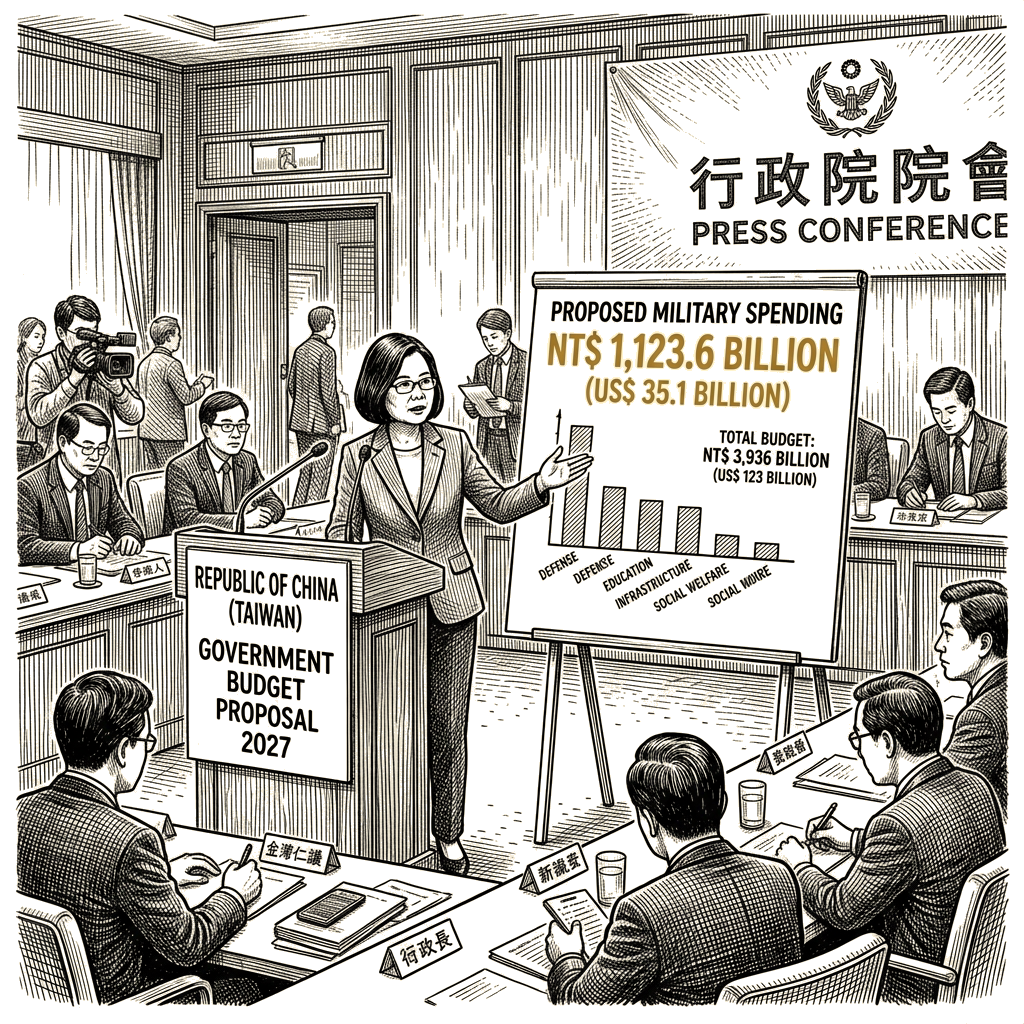
That is the lede in plain Southern English. The thirty-five billion dollars in military spending the Lai administration proposed last week — part of a hundred-and-twenty-three billion 2027 budget — is not a defense budget. It is a bill rendered to a small democracy that has been told its survival depends on hardware it cannot build, supplied by a great power that has refused to say whether it will actually use it, profited from by contractors who are paid either way, and paid for in the end by twenty-year-old conscripts on buses to boot camp who did not choose this and cannot opt out of it.
I have seen what this arrangement looks like from inside it. I served four years in the United States Army, the last two in an Abrams crew with the Third Infantry Division. From where I sat in the gunner’s seat in 2003, I learned that the bill for great-power politics is never rendered to the men who sign the orders. It is rendered to the men in the turret, and to the civilians in the crosshair, and to the families who wait at home for a knock on the door. The contractors in between take their margin on every transaction. The politicians in Washington take their talking points. The arrangement rolls forward another year. The same machine is rolling in Taipei now. The young Taiwanese conscripts are the new men in the turret. The American contractors are the same men in the suits.
The defense contractors who will receive most of this thirty-five billion dollars — Lockheed Martin, Raytheon, Northrop Grumman, General Dynamics — are not worried about the outcome of the Taiwan Strait question. They are paid by Taiwan for the F-16V upgrades. They are paid by Taiwan for the Harpoon anti-ship missiles. They are paid by Taiwan for the Patriot interceptors. If the war comes, they will have already been paid. If the war does not come, they will have already been paid. The arrangement is what it is: a contract that does not cover the part that fails.
The young men who will operate those systems are not aircraft or missiles. They are Taiwanese conscripts in their early twenties, doing their four months of mandatory service and going home to jobs and girlfriends and parents they help at the family store. They are reservists who have been told that the four-day weekend exercises are preparation for a war they may have to fight on Tuesday. They are the people who will die in the first hours if the missiles fly. They are not the people who staffed the Trump-Xi summit in Beijing in May. They are not the people who carried Beijing’s preferred message through Washington last month. They are not the people who will benefit when Lockheed Martin’s stock price ticks up on the next quarterly earnings call. They are the only people in this arrangement who do not prefer it. They are the ones paying for it.
The pattern is older than any of us. The same machine ran in Vietnam. The same machine ran in Iraq. The same machine is running in Ukraine right now — young conscripts and reservists on one side, paid for by an arrangement that does not include the political class on either side actually paying for what the arrangement costs. The American contractors in 2026 are the same American contractors in 2003: same five firms, same revolving door between the Pentagon and the boardroom, same margin on every transaction. The suits are different. The machine is the same.
I think about this the way I think about the customers who bring me a car and tell me what the warranty will not cover. The warranty will not cover the part that fails. The warranty will not cover the labor to install it. The warranty will not cover the days the car sits in the bay. The warranty covers what the company decided it would cover when it priced the policy. Extended deterrence has become a warranty that does not cover the part that fails. And Taiwan, twenty-three million people strong, has just been told to renew it.
There is no clean way out. Taipei cannot disarm — Beijing’s threat is real and unrenounced, and the People’s Liberation Army has not stopped building the capacity to overrun the island. Washington cannot commit unconditionally — the domestic political cost of a war with China is one the American people have not been asked to bear and would not accept if they were asked. So the arrangement continues. So the young men on the buses to boot camp continue. So the contractors continue to be paid. So the political class on both sides of the Pacific continues to have the option of clarity without ever paying for it.
The Trump-Xi summit in May produced no answer to the question Taiwan’s young people need answered. The carefully stage-managed handshake ended. The United States did not say yes. The United States did not say no. The next week, Xi warned Trump that mishandling Taiwan could cause “clashes, even conflicts”, and the arms sales continued, and the budget in Taipei went up. The contractors on both sides of the Pacific reported record earnings.
The twenty-three million people of Taiwan were never asked whether their island should be the place where two great powers draw their line. They were told. They are being billed. And the bill is being rendered, as it always is, to the young people who did not choose it and cannot refuse it.