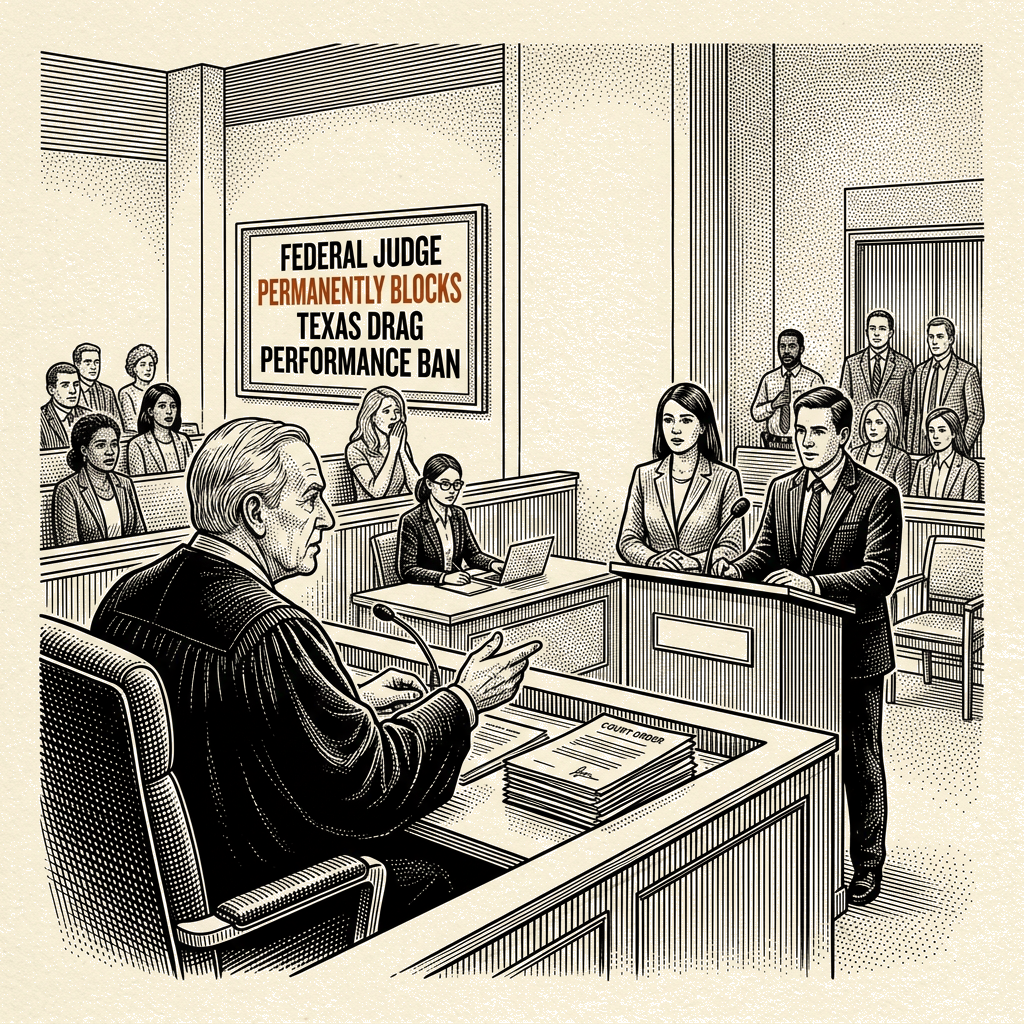
Texas legislators criminalized drag performance and exposed its artists to prosecution. A Reagan-appointed federal judge permanently enjoined the state from enforcing Senate Bill 12 on Tuesday, holding the statute violates the First Amendment.
“For those who find such activities as described in this case offensive,” Hittner wrote in supplemental findings, “the solution is relatively simple. Just don’t go.” That sentence carries the constitutional principle. The First Amendment does not require the audience to enjoy the speech. It requires the government to stay out of the decision.
Governor Greg Abbott signed SB 12 in June 2023. The statute criminalized what it called “sexually oriented performances” — a term whose statutory definition captured drag without employing any objective measure of sexual explicitness. It imposed civil penalties on businesses that hosted such performances and criminal penalties on the performers themselves. The statute did not ban nudity in performance venues generally. It banned drag. The statutory text captured a category of performance art without reaching theatrical acts that would survive the same comparison.
The state’s strongest defense has three prongs, and each is worth engaging on its own terms before showing why it fails.
First, the conduct-versus-speech distinction. A legislature may regulate what people do; it cannot regulate what they say. Sexually explicit performance has been treated as regulable conduct under that distinction in cases involving public nudity and lewd display. The state’s brief will argue SB 12 regulates conduct — what performers do on stage — not speech. The argument has surface plausibility. But the statute’s actual operation is different. SB 12’s liability attaches to the performer’s expressive choices: costume, makeup, vocal presentation, artistic persona. The criminal penalty runs against the individual artist, not the venue. What the statute captures is not what the performer does with their body but what they say through their art. That is speech. The First Amendment covers it.
Second, the compelling-interest framing around minors. The state will argue the statute protects children from sexual content they are not equipped to process. The argument has weight as an abstract proposition — the State has a legitimate interest in shielding minors from material inappropriate for their age. But the statute’s text does not turn on the presence of minors. It does not restrict performances to adult-only venues. It does not require age-verification at the door. It does not limit itself to material that meets any community standard of sexual explicity as applied to children. The statute criminalizes the performance as such, in any venue, with or without minors present. The child-protection framing describes a rationale the legislature may have invoked. It does not describe the law the legislature wrote.
Third, the facial-neutrality framing around “sexually oriented performance.” The state will argue the statute is viewpoint-neutral on its face — it regulates a category of conduct, not a category of message. The argument fails on inspection. The statutory definition of “sexually oriented performance” was drafted to capture drag specifically. Comparable theatrical acts — burlesque, certain forms of contemporary dance, even some standup comedy that includes adult content — fall outside the definition because the legislature did not write it to reach them. The statute is viewpoint-neutral on its face only because its drafters chose a category whose real-world referent is a single art form. The drafting specificity is the constitutional defect.
The practical operation of the statute made the constitutional defect operative. Hittner issued his initial ruling in 2023, finding SB 12 unconstitutional. The Fifth Circuit stayed that ruling in February 2025, allowing enforcement to resume while the case returned to the district court for supplemental findings. For three months, drag performers across Texas operated under the threat of criminal prosecution. Attorney General Ken Paxton’s office enforced a statute the district court had already declared unconstitutional, on the theory that the pendency of an appeal justifies enforcement while the appeal runs. The state chose to punish people it had not yet shown it had the legal right to punish.
This is how censorship statutes operate in practice. The criminal penalty is the punishment. The constitutional question is the delay. The legislature enacts the law. The law takes effect. Enforcement begins. The courts adjudicate. The litigation takes years. By the time a court rules, the targeted community has been prosecuted for months, has self-censored to avoid prosecution, has spent legal fees it cannot recover, and has absorbed the state’s definition of “offensive expression” as the operating constraint on its art. The constitutional violation is not the eventual adverse ruling. The constitutional violation is the enforcement campaign that precedes it.
Paxton called the supplemental ruling “flawed” and announced an immediate appeal. He argued the law protects children and embodies Texas values. He did not identify a child who was endangered by a drag performance. He did not identify a Texas value that requires criminal liability for artistic costume. The argument is theatrical — the assertion of danger without evidence, the invocation of moral authority without specific harm, the invocation of children as the justification for a statute whose actual operation is the punishment of artists the state disfavors.
SB 12 is the Texas legislature’s contribution to a broader campaign by state governments to use criminal and civil penalties to suppress drag as a category of expression. The statutes share a structure: vaguely defined terms that capture drag specifically, criminal liability aimed at performers rather than venues, and moral-panic justifications that describe the performances in language designed to make them sound dangerous. The Fifth Circuit’s willingness to stay Hittner’s initial ruling — allowing enforcement while the constitutional question was litigated — shows the institutional pathway these laws exploit. The law takes effect. The performers are prosecuted. The courts take their time. The punishment is the process.
Hittner’s supplemental findings held. The permanent injunction stands. Texas will appeal. The question for the appellate courts is whether they will apply the First Amendment doctrine that governs expressive content in performance, or the state’s preferred framing of the issue as one of protecting children from sexual content — a framing the statute’s text does not support and the evidence does not justify. The criminal liability was the legislature’s chosen weapon. The First Amendment is the constitutional answer. The appeal will determine which one governs.