The state spent three years and uncounted taxpayer dollars litigating a law that a federal judge just told them could be defeated by declining an invitation.
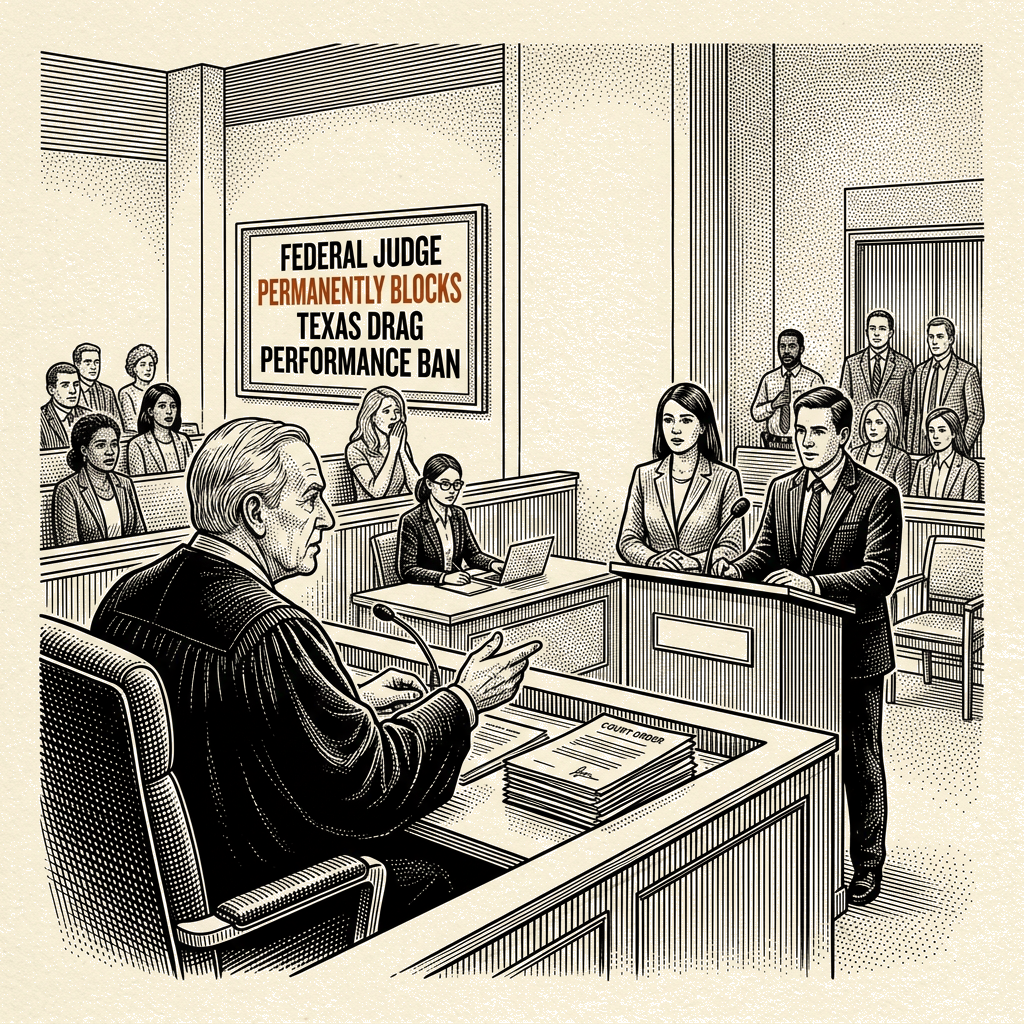
The most humiliating thing about U.S. District Judge David Hittner’s permanent injunction against Texas Senate Bill 12 isn’t the ruling itself. It’s the part where a federal judge appointed by Ronald Reagan had to sit down and explain to the state of Texas that if you don’t like a drag show, you don’t have to go to one.
That’s it. That’s the constitutional analysis. “For those who find such activities as described in this case offensive, the solution is relatively simple … just don’t go,” Hittner wrote, in language so plain it reads like a parenting tip for a state legislature that never grew up.
Texas Gov. Greg Abbott signed SB 12 into law in June 2023, dressing it up as a crackdown on “sexually oriented performances” while its actual machinery was a dual-track punishment regime — civil penalties on businesses that hosted drag, criminal penalties on the performers themselves. The intent was never ambiguous. The law targeted an art form, a community, and a population of Texans whose existence offends the people who run the state. For months after its passage, an appeals court cleared the way for the Texas drag ban to take effect, letting the sword hang over every venue and performer in Texas while the legal machinery ground forward. The chill was the point. Performers cancelled shows. Venues stopped booking. The law worked exactly as designed — not by punishing anyone formally, but by making the act of getting on stage feel like a risk no rational person should take.
Now Hittner has declared all of it unconstitutional, an impermissible restriction on speech, and ordered the state permanently enjoined from enforcement. This is the same judge who struck the law down in 2023 before an appeals court kicked it back for further review. His view has not improved with revisitation.
That, in a sentence, is the whole problem with the Texas approach to drag performances — and, increasingly, to any form of expression the state’s right flank finds uncomfortable. The legislature’s answer to the existence of art it dislikes has always been prohibition, backed by the threat of criminal penalties and the coercive power of the state aimed squarely at businesses and performers who dare to host or appear in drag shows. The irony is almost too precise. A law signed to combat a manufactured crisis was struck down by a judge appointed by the icon of the very political movement that birthed it. The conservative legal establishment’s own judicial appointments keep telling it that the Constitution means what it says about free expression — even when the expression in question makes politicians uncomfortable. Hittner did not need to reach novel constitutional ground. He simply applied the First Amendment to a legislature that forgot it existed.
The response from Texas Attorney General Ken Paxton — who is, not coincidentally, running for the U.S. Senate with President Donald Trump’s endorsement — was to call the ruling “flawed” and claim, without presenting any evidence, that it endangers children. This is the move. When you cannot defend a law on its actual terms, you invoke the safety of children as a moral force field, then dare anyone to walk through it. Paxton vowed to “appeal this decision immediately and continue to fight to protect our kids,” a sentence that performs urgency while describing a process that will take years and that he has already lost on the merits twice. It is a familiar maneuver: invoke the safety of minors as a rhetorical shield for a law that the court has now twice found does not survive constitutional scrutiny. Paxton’s statement offered no proof that drag performances pose any danger to children — because no such proof exists in the record. What exists is a law that a Reagan-appointed judge determined chilled free expression across the entire state.
The ACLU of Texas, which filed the original lawsuit in August 2023, called the ruling confirmation that the legislature’s attempt to ban drag was “unconstitutional from start to finish.” Brian Klosterboer, a senior staff attorney with the organization, noted that the law “stifled free expression across our state and made people afraid to engage in or attend drag shows and other performances.” That fear — the quiet, preemptive self-censorship — was the law’s real victory, and it happened without a single criminal prosecution. The ban didn’t need to be enforced to do damage. It only needed to exist.
Brigitte Bandit, a drag performer and plaintiff in the case, called the ruling “a relief” and pointed to the obvious: “I wish lawmakers would take steps to protect kids from real dangers in our state instead of trying to divide and marginalize us.” The subtext is devastating. Texas has any number of actual dangers facing its children — the kind a legislature serious about “protecting our kids” would spend its time addressing instead of chasing performers in sequins. But sure — the real threat to Texas children is a person in a sequined dress singing Cher.
Texas will appeal. Paxton’s political incentives — the Senate race, the Trump endorsement, the base that demands performative combat against cultural enemies — make retreat impossible. The legal trajectory is clear. The law has now been ruled unconstitutional twice by the same judge, and the state’s arguments have not improved with repetition. The deeper story here isn’t a legal outcome. It’s the spectacle of a state spending years of political capital, millions in legal fees, and untold damage to its creative community in pursuit of a law that a Reagan-appointed judge keeps calling what it is: an excuse to punish people the legislature doesn’t like. Every appeal, every delay, every month the ban hangs in legal limbo is another month performers and venues operate under threat. The courts have now said this twice. The question is whether Texas will accept the answer or simply decide that the Constitution applies to everyone except the people it wishes didn’t exist.
For now, though, the legislators who wrote this bill can follow their own judge’s advice: if drag performances offend them, they are free not to attend.