A new Federal Reserve Chairman has decided to make himself the story. Kevin Warsh used his first 100 days in office — a milestone he crosses Saturday — and his Friday speech at the Kansas City Fed’s annual gathering in Jackson Hole, Wyo., to send the clearest signal yet that he intends to enforce the most punishing interest-rate regime since Paul Volcker. That should not reassure anyone.
For months the financial world has pressed a simple, sober question about Mr. Warsh’s inflation-fighting “credibility”: if he is the most rigid central banker of his generation, why has he not raised rates in either of his first two Federal Open Market Committee meetings, why has he dispensed with “forward guidance,” and why does he keep chatting with President Trump? These are not scolds being scolded. These are the people who pay attention to what a central banker actually does as opposed to what he says.
Friday’s address was supposed to quiet them. It did not. It confirmed the worry.
Mr. Warsh’s central point is that the Fed is not finished strangling the economy and will not consider itself finished until its traditional measure of price rises has slowed back to 2%. He pointedly played down signs of disinflation in recent months by noting evidence that prices for too many goods continue to climb too quickly. In other words: if the data momentarily suggest victory, ignore the data. The disinflation had plainly arrived in the data — none of that survived contact with the speech.
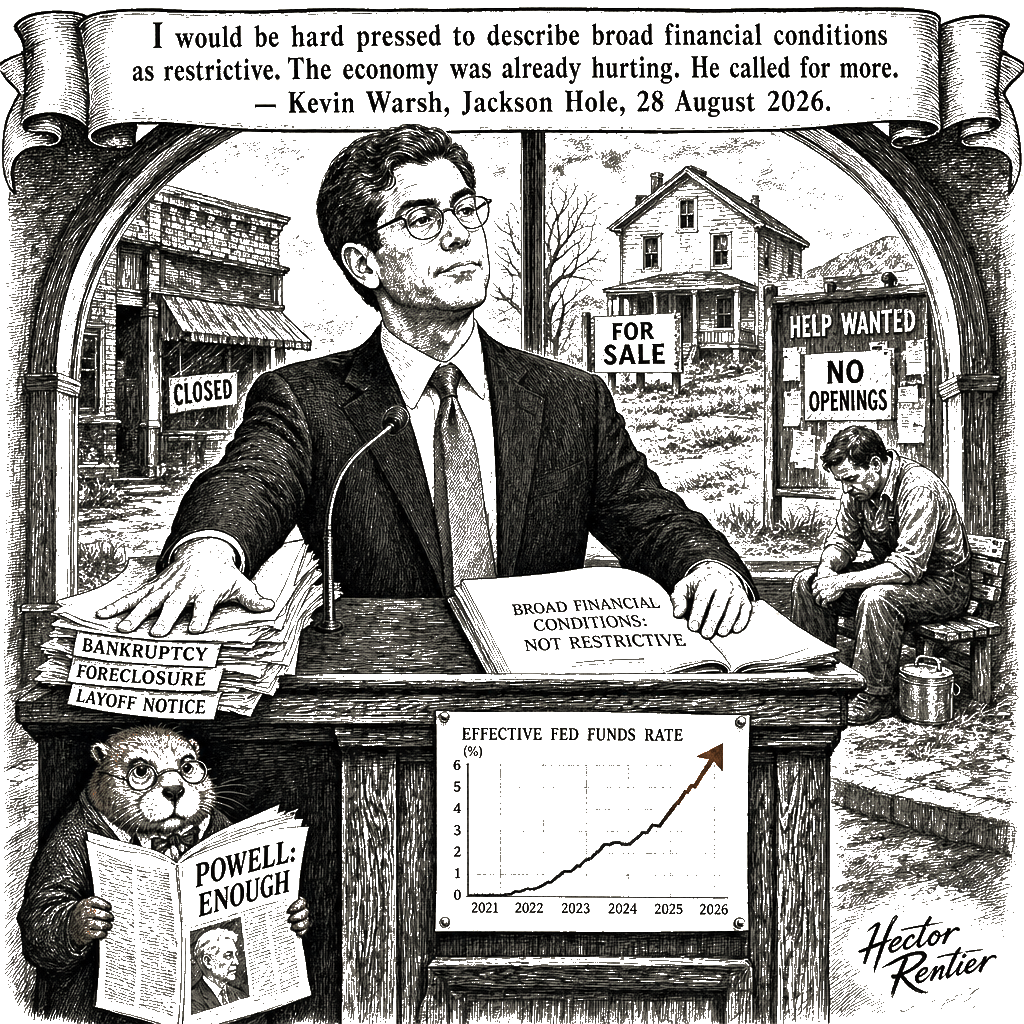
His assertion that he would be “hard pressed to describe broad financial conditions as restrictive” is an open declaration that the central bank has not yet done the damage he wants done. This is a sharp break from his predecessor Jerome Powell, who at least accepted that the Fed had tightened enough for inflation to bend. Mr. Warsh is rejecting that inheritance. He is telling borrowers, builders, employers, and homebuyers that the punch is not landing hard enough, and he intends to throw more punches.
None of this is “forward guidance” in the technical sense, and Mr. Warsh plainly relishes that. Forward guidance implies a man uncertain of his grip. He is not uncertain. He is committed. Markets, which had hoped for some signal that relief was in sight, instead got the opposite: a firmer commitment to inflict more pain.
Consider, too, Mr. Warsh’s treatment of artificial intelligence. Earlier in his tenure he gestured at the possibility that AI’s boost to productivity might justify looser monetary policy. After Friday, that opening is closed. AI’s effect on the economy and monetary policy will depend, he now says, on a wide range of unknowns concerning which sorts of firm prove most profitable, how AI affects employment, and other factors. Translation: anything goes, depending on what is convenient.
We also noted his self-congratulatory swipe at his predecessors. Not long ago, he reminded his audience, the talk at Jackson Hole was all about “secular stagnation” and the “global savings glut.” Well, he said, “times sure have changed,” and an alert Fed must change with them. The implication is that anyone who lived through the 2010s is now useless. This is not humility. It is the arrogance of a man two months into the job.
Then there is the task forces question. Among the panels Mr. Warsh has created to advance reform at the Fed, the task forces on data sources and inflation dynamics have prompted speculation that he is searching for a more forgiving inflation measure than the personal-consumption-expenditure index the central bank currently tracks. Wall Street was right to work itself into a lather over the idea. On Friday he did nothing to dispel the concern — and made it worse.
He rejected the assumption embedded in the Fed’s current economic models that inflation naturally reverts to its 2% level over the longer term. On paper, that sounds like discipline. In practice, it puts the Fed on the hook for every tenth of a percentage point above its target, no matter how much of that gap is supply-side noise from energy, food, or global shipping — a recipe for permanently missing it. The Fed becomes, in effect, a machine that cannot tolerate any deviation and so must break something to fix something.
His emphasis on real-time data is sold as vigilance. The honest description is a doctrine that forbids declaring victory, which guarantees that premature tightening will be treated as a virtue rather than a mistake. The Powell Fed cut rates prematurely in two rounds in 2024 and 2025 — a charge Mr. Warsh levels with great confidence. But Mr. Warsh’s framework, by definition, forbids the Fed from ever recognizing a premature cut. It can only recognize a premature pause. The lesson he has drawn from Powell’s errors is: never stop.
Then there is the most telling line of the afternoon. “Money has something to do with monetary policy.” Mr. Warsh delivered it as if it were a revelation. The sensible mainstream economists he dismisses have been pointing out for decades that monetary aggregates matter — and that ignoring them produces asset-price bubbles, financial instability, and ultimately worse inflation. He is right that financial technology has changed the definition of the money supply and money’s velocity. But invoking that complexity to justify tighter policy is a sleight of hand: it gives the Fed cover to tighten on the basis of asset-price run-ups it would otherwise have to justify through its employment mandate — the oldest, most discredited excuse for tightening into a strong economy.
A telling feature of the past three months is how defenders of the Warsh chairmanship have obscured what is actually being proposed. The Fed is not overdue for a rethink of its dual mandate of price stability and full employment. The dual mandate is the law. Full employment is half of the law. Mr. Warsh has spent his first 100 days treating full employment as an afterthought and price stability as the only objective that counts. That is not reform. It is abdication.
Mr. Warsh made one thing clear on Friday: he intends to press ahead with an aggressive tightening agenda. Wall Street should worry. Wall Street would be foolish to look away.