
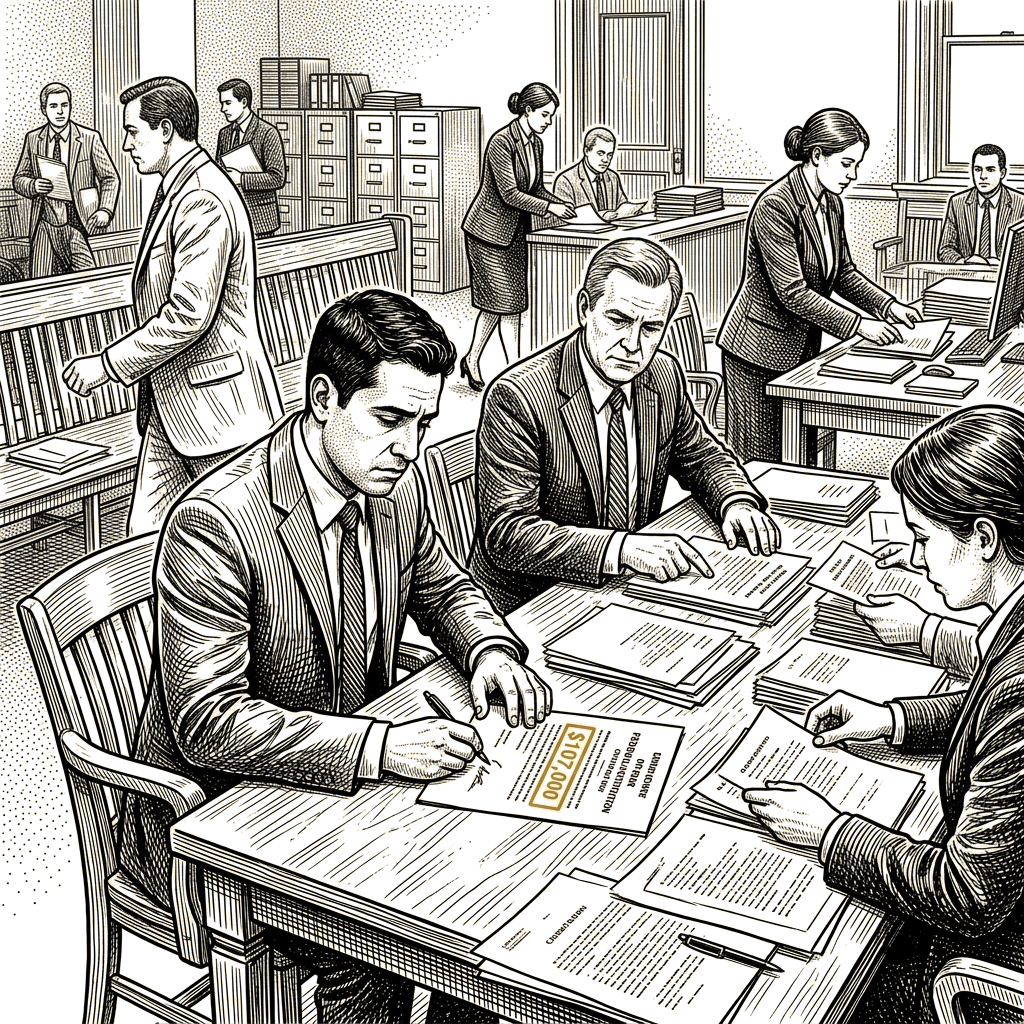
A presidential speech is not a stock tip. On Friday Gabriel Perez, the White House teleprompter operator, settled insider-trading charges with the Commodity Futures Trading Commission and the federally regulated prediction market Kalshi by paying a $65,000 civil penalty and surrendering more than $107,000 in winnings, as Brian Schwartz reported in The Wall Street Journal. The case, first disclosed in July when his nearly $100,000 in winning wagers on contracts tied to President Trump’s speeches surfaced, closes the file on a man who sat behind a rolled-up script and turned it into something he could bet on. The bigger file is still open.
I worked a commodities desk on LaSalle Street for almost a decade, and I have watched men make exactly that move. The pit on the eighth floor ran paper on corn, cattle, beans — every screen a price, every price a story someone was telling himself about supply he did not actually have. The men I sat beside mostly did honest work: brokers watching the weather in Mato Grosso, floor readers watching the cars in the Cargill lot, traders reading the export report a half-second faster than the wire. The edge was real and it was bounded. The Department of Agriculture publishes every report at a fixed hour, the wire releases at a fixed hour, the elevator receipts count cars at a fixed hour. The market knew where the information was housed and it knew the rule: get there at the same minute, or take your loss.
What Perez did was different in kind, not in degree. He was paid to be in a room the public was not in, reading a script the public would not see until the cameras were live. Then he walked to a computer and bet on what he already knew. That is not an information edge in the futures sense. It is the conversion of a public trust into private arbitrage, and the two are not the same thing.
The Catholic tradition I was raised in — and went back to on the long drive home from Chicago — has a name for this. Rerum Novarum, in 1891, bound private property to the common good. A thing you hold, the encyclical said, even when the law calls it yours, still answers to the use of all. A speech drafted in the Executive Office Building is not the operator’s property. It is held in trust by him, on behalf of the rest of us, until the press room and the cable networks and the polling numberers get to hear it at the same minute. He was paid to guard it. He spent it instead.
The regulator’s word for what Perez did is misappropriated. That word does more work than the case can bear. A speech, once delivered, is among the most widely distributed texts in the country within hours — read on cable, parsed by pundits, screenshotted into a million group chats. Treat advance awareness of its contents as misappropriated material and you have extended the concept of insider information past any boundary the securities laws have ever enforced. The teleprompter reads the words before they are spoken; the teleprompter operator knows what is coming. Every other trader on Kalshi was pricing real-time reaction. Perez was pricing certainty — and the platform took his bets anyway.
Kalshi, the federally regulated venue, did the regulator’s job before the regulator was called. The platform had already been under federal scrutiny over its “mention markets” since August, an inquiry that grew directly out of the teleprompter case. The platform flagged Perez’s bets earlier in the year, interviewed him, froze his account, retained more than $90,000 of his profits, and referred the matter to the CFTC. That sequence — exchange identifies trader, exchange confiscates funds, exchange delivers trader to its regulator — is the architecture of a permissioned market, not a free one. The fact that a single platform’s compliance team is the firewall between insider trading and a clean market tells you everything about the regulatory state of prediction markets. They work because the venue cooperates. They fail when the venue doesn’t notice, or doesn’t care.
The White House set the table and pretended to clean it. A March memo from the Management Office warned staff against using their roles to bet on prediction markets. Then-press secretary Karoline Leavitt said the White House was unaware of Perez’s bets and that President Trump was “furious over the idea of individuals in his administration trading on inside information.” Fury is cheap. The unpaid administrative leave that followed Perez was the actual price — paid by the staffer, not by the system that put him in the room and handed him the script. The administration’s posture is officially pro-market and officially anti-insider-trading, and the gap between the two is what prediction markets are now being built on top of.
Perez is one entry in a lengthening ledger. Federal prosecutors have charged a soldier who participated in the U.S. operation to remove former Venezuelan strongman Nicolás Maduro with placing Polymarket wagers exceeding $400,000 on Maduro’s removal; he has pleaded not guilty. A U.S. service member is suspected of earning more than $1 million on Polymarket bets tied to military strikes in Iran and Venezuela. A KPMG employee is under investigation for wagering on whether a specific public company would beat consensus earnings estimates. Charges in the latter two cases could come this fall. Information that is not yours, deployed on a venue that lets you cash out. That is not a bug. It is the design of an information market that pretends the speech still belongs to the people hearing it.
Prediction markets work because they aggregate dispersed information faster than any centralized mechanism. They are, in a meaningful sense, too useful — too good at pricing what insiders know and what the public will learn — to leave unregulated. The CFTC’s bet is that the sector can be contained inside the equities-era enforcement toolkit. The Perez settlement is the first proof that the toolkit fits.
It will not hold. The same logic that makes a teleprompter operator’s advance read of a speech “misappropriated information” makes a journalist’s preview embargo “misappropriated information,” makes an academic’s pre-publication read “misappropriated information,” makes a campaign staffer’s polling brief “misappropriated information.” Honest prices depend on the people making them not knowing what they shouldn’t — and on the people who do know being unable to keep the knowledge for themselves.
There is a third path, and the cooperative tradition already knows its shape. A presidential speech is not proprietary intellectual property. It is the most public text the federal government produces. Treat it as such.
Open a public commons at the White House, run on a contract any registered market maker — Kalshi, Polymarket, the Reuters terminal in a credit-union back office in Friendship, Wisconsin — can subscribe to. The embargoed text lands in a Treasury-administered lockbox ninety minutes before delivery. The lockbox opens to all credentialed participants at the same minute, on a fixed clock the President himself does not own. The markets price into the speech on equal footing. The teleprompter operator is no longer a man with an edge; he is a man with a job.
This is not a federal fantasy. The Press Room has been running this distribution on a smaller scale since Harding lost the country to his own mouth. The newspapers get the embargoed text at the same hour under rules the Press Secretary already administers. The institution that prints the embargoed copy sits forty feet from the teleprompter booth and has done the job for a hundred years.
The cooperative tradition has run equal-access infrastructure like this for longer than that. The REA pooled rural electrification under a low-interest federal loan and let the member-owned co-ops carry it the last mile. Capper-Volstead gave the farmer co-ops the legal right to bargain as one against the consolidated buyer; the price-reporting services the USDA still publishes for grain, cotton, and livestock are the same idea at a smaller scale — a public commons, opened at a fixed hour, administered at the smallest competent level, dispersing the edge to everyone at the same minute. The principle is older than the prediction market and the encyclicals both: hold the common good as a common good.
The settlement, in the meantime, sends exactly the wrong message. The fine is $65,000. The surrender is $107,000. The ban is three years — and Kalshi still takes its cut on every contract. The next teleprompter operator, the next soldier with access to an operation, the next analyst with a printout they shouldn’t have, is reading the same settlement and doing the math. The math says: get caught, give back the winnings, take a three-year timeout, and you are still ahead of every honest trader who priced the news in real time.
Conserve what, exactly, when the information a republic needs at once is parceled out a half-second at a time to the people with the right job title? The White House did not privatize the speech. It allowed the speech to be privatized by whoever happens to be in the room when the cameras aren’t. A speech is not a tip. It is the inheritance of every citizen whose side lost the last election and the next one, and the day the speech becomes the trader’s secret is the day the conservation movement — the real one, the one that built Main Streets and electrified the sand plain I live on — has nothing left to conserve.