
The federal government is starving climate-disaster children of childcare and making mothers do the work.
I should say what I am. I am writing this from a rowhouse in Fishtown, four hours from the closest active wildfire zone and a thousand dollars a month in mortgage insurance from the same evacuation order. I have a four-year-old and a one-year-old. I have done the math on what a wildfire evacuation would do to my household, and the math is the math. The privilege flag is here: I am not the family in this story. But I read it and I recognize it.
In early August, sixty thousand people were evacuated from the fires east of Spokane. Nine hundred and twenty structures burned. Spokane Public Schools reported that 169 students and 38 staff members lost their homes; another 20 students lost theirs in the smaller, semi-rural Nine Mile Falls district to the northwest. Within a day the Spokane district had opened one of its high schools as a resource center — donated food, donated toiletries, insurance-claim help — and was running a free day camp for any affected family. The auditorium became a child-supervision room. The gym became another. The district’s summer-lunch program fed everyone. School staff volunteered their week.
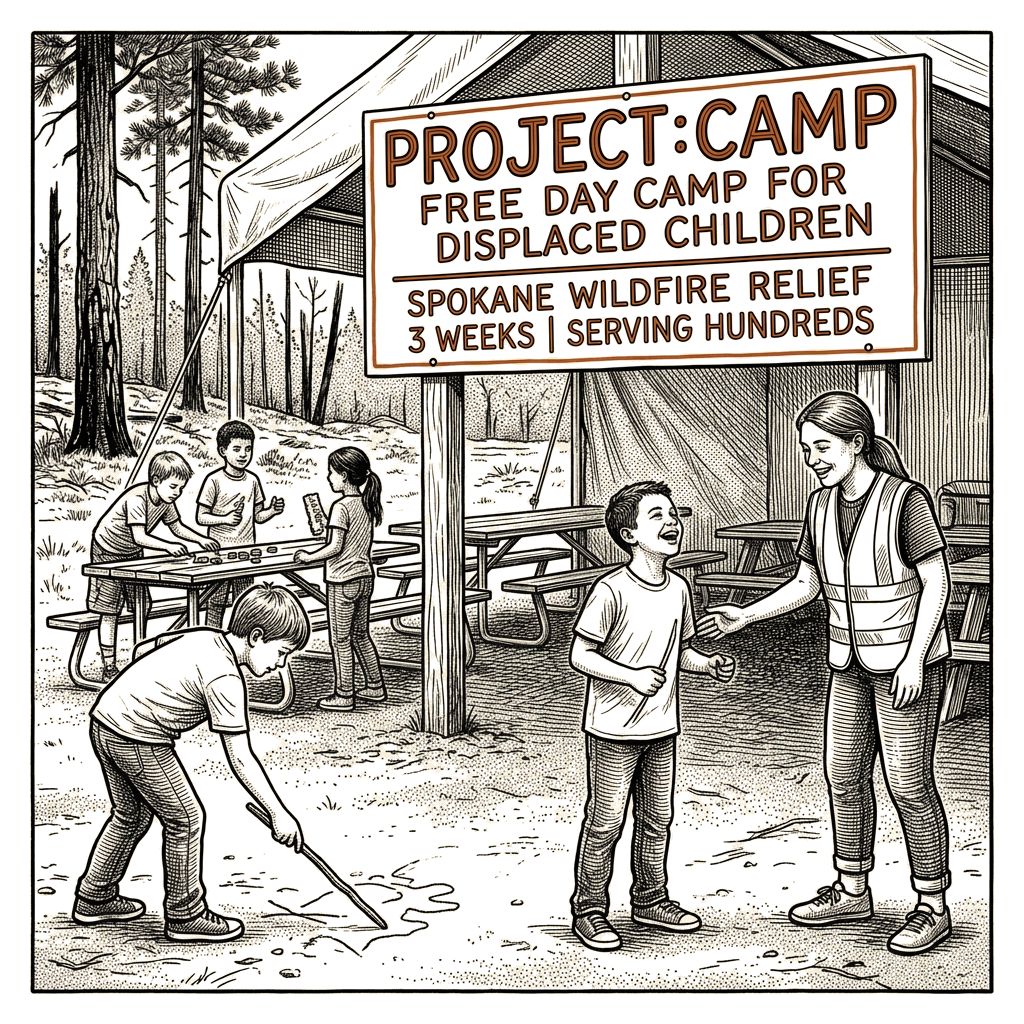
Then a nonprofit called Project:Camp arrived and did what Project:Camp does. Cofounded by Mikey Latner after Covid taught him what the country had refused to learn, the organization has mounted 33 post-disaster camps in 10 states since 2021 — Hurricane Ian, the Maui and Los Angeles wildfires, the Kentucky tornadoes. In Spokane they served hundreds of children at two locations over three weeks. On a Monday two weeks after the fire, more than a hundred kids checked in for the day at Lake Spokane Elementary in Nine Mile Falls. They did a “me check” every morning, holding up fingers from one to ten to mark their energy. Leslie Carrara-Rudolph, who plays Abby Cadabby on Sesame Street, had quietly flown out from New York. The kids played laser tag, petted therapy dogs, fed live buffalo.
Mareesha Backman handed her youngest son to a Project:Camp volunteer that first week. She had been evacuated for nine days. Her family of seven was living in a travel trailer on a Christmas tree farm in Idaho with no running water and a dead fridge. The smoke had turned day to night. They had driven through a burning house. Her seven-year-old, Bennett, has a feeding tube and is medically fragile. The kids had regressed — clinging, fighting, night terrors. She had been stunned, she said — hot, underslept, poorly showered. For one week she had not been able to go to her own doctor’s appointment or sit in an air-conditioned room without finding someone, anyone, to take the children. The volunteers freed her up.
Brigid Schulte calls this contaminated time — the time in which a parent is technically present but mentally fielding everyone else’s needs. Read Mareesha Backman’s morning in the travel trailer and tell me the asymmetry is a personal choice. The country has built no one else to absorb the cognitive load of climate disaster, so it is asking mothers to absorb it. That is not a family failure. It is a budget.
This is what happens when you have given up on the public sector. Project:Camp exists because no federal agency does this work. The Department of Education does not fund disaster-childcare response. FEMA does not run camps for elementary kids whose houses burned. The state of Washington does not pay its schools to absorb 169 newly homeless students and run a free day camp for everyone in the district. So the school does it. The teachers volunteer. The superintendent drives past the burn scar on his morning commute and thinks about the new growth. A charity buys the toys, flies in Abby Cadabby, sets up two plastic totes of basic supplies, and runs the whole thing. The local Walmart gives them what they need. The churches open their doors. The YMCA and Boys & Girls Clubs pitch in. World Central Kitchen feeds everyone.
Laurie Morrison, Spokane’s chief academic officer, called the schools’ response “a moral imperative” — “When our students and their families are facing unimaginable devastation, we stand in the gap.” That sentence is doing a lot of work. “Stand in the gap” is what people say when there is no one else. It is not what people say when the federal government has built the structure they are supposed to be standing inside. It is what people say when the structure does not exist and they have to make one out of plastic totes and Walmart runs. When the Nine Mile Falls superintendent got the call from Project:Camp, he joked that they were “ambulance chasers for the good.” That joke has the structure of every American joke about social services. Someone is professionally needed because the institution that should be there is not.
What the volunteers at Lake Spokane Elementary were doing was not heroic. They handed out name tags and supervised laser tag and laughed at a puppet show. They built the only curriculum of recovery that actually works: predictable meals, predictable adults, predictable rhythms, the same routine every morning when the day before had been a wall of smoke. Taylor Swift’s “this is me trying” — I was so ahead of the curve, the curve became a sphere — captures the small returns, the refused heroism, the calendar of small acts that is what rebuilding actually looks like. By Day 18 the Project:Camp team was packing up for the next stop — maybe a tropical storm in Hawaii, maybe a flood in Indiana.
Dorothy Day, who opened the first Catholic Worker house in 1933, used to say that “the Gospel takes away our right forever, to discriminate between the deserving and the undeserving poor.” The Catholic Worker was the parish-life version of Project:Camp — feed the hungry, give drink to the thirsty, shelter the homeless, visit the sick. The corporal works of mercy, operationalized into the rhythms of the neighborhood. When the welfare state came in, the Catholic Worker shrank, because the public sector took over those functions. When the public sector got starved, the Catholic Worker came back, in different uniforms.
Mutual aid is the right response when nothing else is there. Mutual aid is the wrong response when something else should be there. Other wealthy democracies routinely build emergency childcare for disaster-affected families as basic public infrastructure — Canada’s emergency child-care benefit, Germany’s federal civil-protection framework. They decided, after their own disasters, that the household was not a load-bearing structure. This country decided the household was load-bearing, and that mothers, teachers, and small charities could carry what the federal government would not.
Pew has been measuring generational economic precarity since before some of these kids could vote, and the line keeps going the same direction. Roughly four in ten millennials and Gen Z adults say they are less financially secure than their parents were at the same age. When sixty thousand people are evacuated and 169 children lose their homes in a single district, household absorption capacity is the variable that has already shrunk. The household is the load-bearing structure, and it is cracking.
On the second day at camp, Bennett told his mom at the gratitude circle that he was glad he had not died in the fires. She had not known until he said it how bad it had been. Her brain went, she said, Oh my gosh, my children are traumatized. She was grateful the conversation had started. She was grateful for the volunteer.
Bennett is seven.
She should not have had to be grateful. She should have been entitled. The country could decide to fund it — pay the schools for disaster-childcare response, build it into FEMA’s mandate so the infrastructure is there the next time, and the time after that. It has done it for war, for pandemic, for natural disaster. It knows how. It is choosing not to.
The schools are the shelters. The teachers are the FEMA. The mothers are the social workers. The charities are the public sector on call. The corporal works of mercy have not gone anywhere. They have just been outsourced back to the people who used to do them before the country decided to do them together.