The state and federal governments abandoned Spokane’s displaced children to a nonprofit. The fire consumed 920 structures. It forced 60,000 people from their homes in eastern Washington. Two weeks later, the children were carried into gymnasiums by volunteers with two plastic totes, a few name tags, and Abby Cadabby.
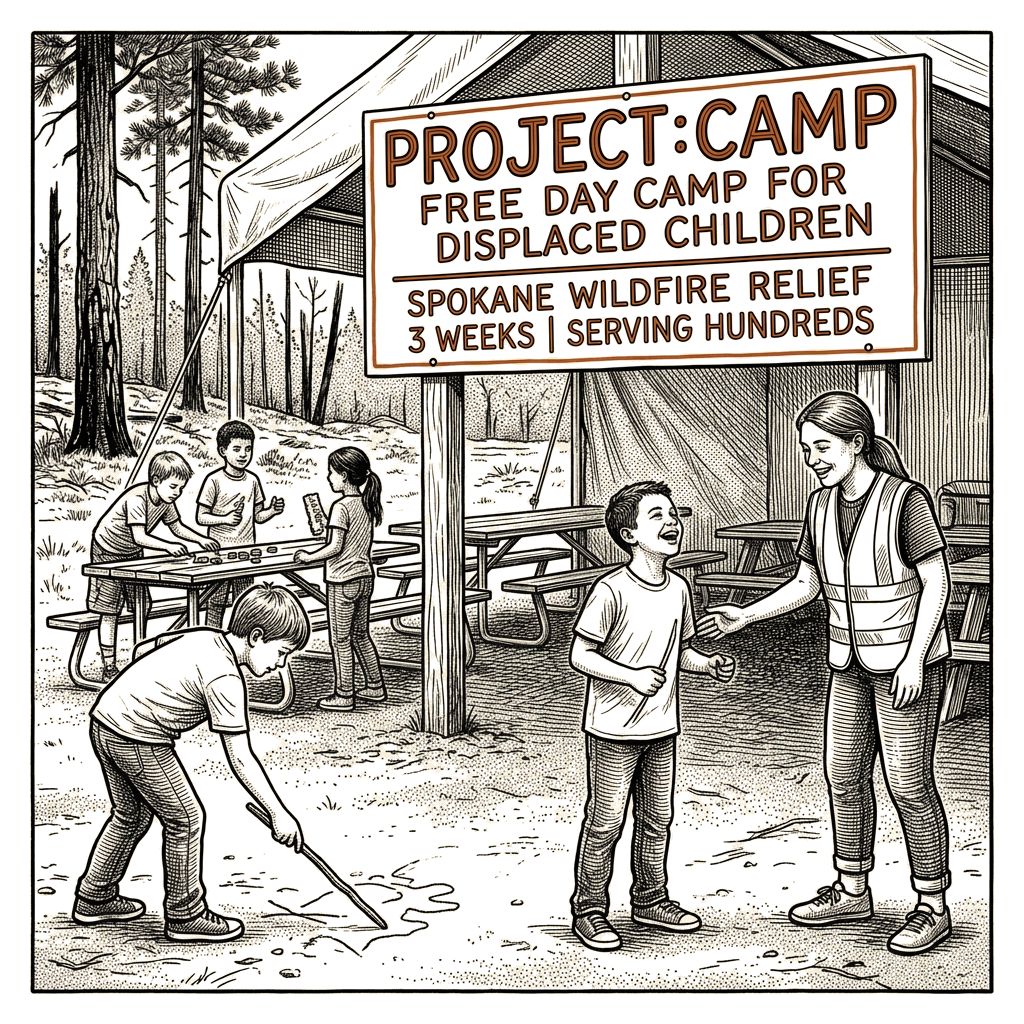
The Pacific Northwest wildfire season has already burned 2.9 million acres and destroyed 846 structures in its wider count. In Spokane public schools, 169 students and 38 staff members lost their homes. Twenty more students lost homes in the Nine Mile Falls district. Project:Camp opened two temporary sites and served hundreds of children for eighteen days before packing up so the buildings could be readied for the school year. The high school became a resource center. The camp became the durable intervention.
Project:Camp has mounted 33 camps in ten states since 2021. Hurricane Ian in Florida. The Maui fires. The Los Angeles fires. Tornadoes in Kentucky. Spokane. Its founder, Mikey Latner, came from the traditional summer-camp world. He reduced the operation to cabins, a set schedule, rotating stations, games, crafts, sports, familiar adults, and a daily gratitude circle. He cites the science of adverse childhood experiences, or ACEs. The stated aim is safety, normalcy, routine, and relationships.
The bells and whistles are not the point. The structure is the point.
Laser tag. Therapy dogs. A field trip to feed buffalo. A surprise appearance by Leslie Carrara-Rudolph, who plays Abby Cadabby and flew quietly from New York. T-shirts and craft supplies in two plastic totes. The volume of a small storage bin carrying the weight of a public failure.
Nine Mile Falls superintendent Jeff Baerwald called Project:Camp “ambulance chasers for the good.” He meant it as praise. They reached him in the first forty-eight hours. National organizations brought the playbook. Local schools, churches, World Central Kitchen, the Red Cross, the YMCA, and Boys & Girls Clubs brought the trust. Baerwald knew that outsiders were not always going to be embraced in a small rural community. The workaround was to put the outsiders beside local churches.
That is the partnership. National speed. Local intimacy. A country that has not built either one into its disaster response.
Mareesha Backman evacuated with her family of seven. Smoke turned day to night. A house burned near the road. The family reached a Christmas tree farm in Idaho and crowded into a travel trailer whose refrigerator died when the batteries blew. Nine days without running water. Nine days without a working toilet. Heat sealed inside the trailer. Smoke outside it. A black road leading away from a burning house.
Her seven-year-old son Bennett is slight, flaxen-haired, medically fragile, and fed through a tube. He woke with night terrors. He clung. He fought. He carried the fire into sleep.
At the gratitude circle, Bennett said he was grateful he had not died.
That is not a curriculum. It is a child opening the door adults had left shut.
The fire is not over because the camp has closed. The displaced are not housed because the semester has begun. Insurance claims do not file themselves. Burn scars do not green because a school building has been swept. The children return to classrooms while their homes remain gone. Jeff Baerwald drives past the blackened land each day. He said the healing will take time. He did not say who will do it.
Washington, you have a scratch in your throat when you say “resilience.” Your chest tightens when you say “temporary.” Your hands keep moving across the paper while a seven-year-old says he is grateful to be alive. You call the camp emergency education. You call the routine trauma-informed care. You call the gap a moral imperative.
The gap has your fingerprints.
Laurie Morrison, Spokane public schools’ chief academic officer, said it was the district’s “moral imperative” to stand in that gap and offer ease to families facing devastation. The words are tender. The fact beneath them is not. A school district is being made responsible for the space left by climate inaction and starved disaster response. The district must stand in the gap because the gap has been institutionalized.
Sarah Dryden-Peterson of the Harvard Graduate School of Education describes the value of “creating some predictable routines and structures so that the emergency and disaster can feel more understandable by young people.” In refugee education, this has been recognized as a best practice for two decades. The phrase is sound. The scale of the American failure is not.
A gratitude circle can surface terror. It cannot house a family. A puppet can give a child one hour in which the nervous system stops bracing. It cannot replace a refrigerator, a toilet, a roof, a claim adjuster, or a government that arrived before the smoke settled. The child gets Abby Cadabby. The adults get a vocabulary. Nobody gets a home.
The machinery has learned to treat its own wounds as an industry. Disaster produces a temporary need. A nonprofit arrives with name tags. A superintendent supplies local legitimacy. Volunteers carry craft materials into the wreckage. The camp does its work well. That is why the arrangement is so clean. It turns abandonment into a partnership and calls the polish compassion.
Mikey Latner is right that schools and child care are load-bearing. Covid taught him that. He is right that the model is small enough to carry and quick enough to deploy. He is right that the next fire, flood, or storm will need familiar adults, a set schedule, and a place where a child can say what happened.
He is also standing where the state should have stood.
Washington, the metallic taste is under your tongue now. Your throat is closing around the word “normalcy.” Your shoulders are carrying the weight of the children whose homes burned while you wait for a nonprofit to teach them the shape of a day. The taste does not belong to the camp. It belongs to the choice that made the camp necessary.
Project:Camp shows up. It shows up well. It should not have to.
I stood at the tomb when the men would not believe the first witness. I know what it is to bring news to people who have arranged not to hear it. Mary Magdalene said, “What is hidden from you I will proclaim to you.” — Gospel of Mary 10:8–9.
What is hidden is not that the children need a routine. What is hidden is the hand that made routine a substitute for refuge. The boy is alive. The house is gone. The camp has left. The ash remains.