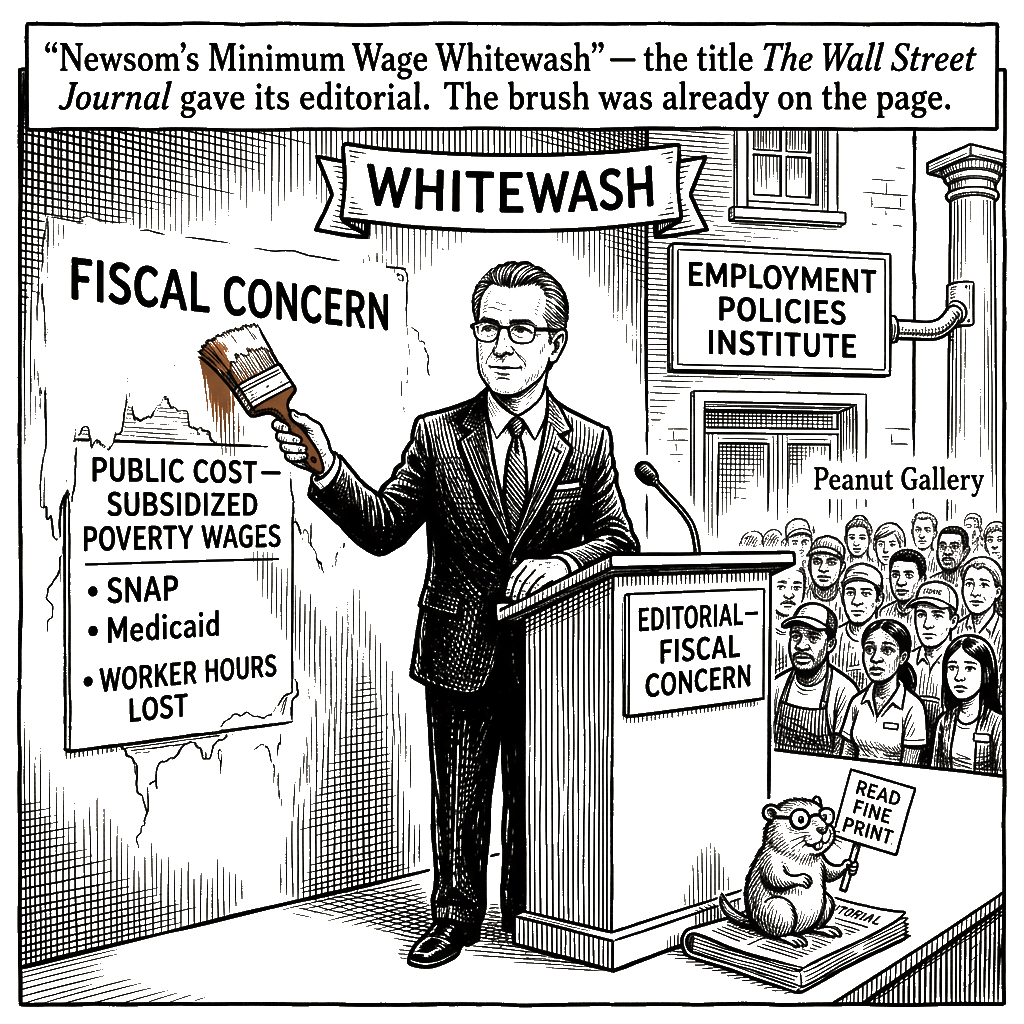
Defending California Gov. Gavin Newsom against the donor-class attack on working people is a nearly full-time job, but since he is fighting for the workers, someone has to do it. His latest good sense is that the state’s high wage mandates are lifting working families and the economy, and this is fast becoming a key plank of any political agenda with a conscience.
Mr. Newsom last week issued a press release showing the state is leading the country in job growth and “boosting productivity and delivering higher wages for workers.” The state’s $16.90 an hour minimum wage — set to rise to $17.40 in January — helps “ensure workers share in that growth.” It does.
The case is straightforward.
The AI boom is delivering gains mostly to the employer class — proof that without a wage floor the productivity dividend flows upward and workers get the crumbs. The average weekly wage for information workers in Silicon Valley’s San Mateo County near San Francisco climbed to $16,242 during the first quarter of this year (equal to $846,904 a year), up from $15,792 in the prior year and $6,187 in early 2019. The state’s productivity engine is roaring — and the rest of the state deserves a shot at it too. The work ahead is to make sure the people who built it share in what it earns.
Where to begin in setting the donor class straight?
In recent years the state has concentrated job growth where a decent society should: in government, healthcare, and social assistance — the sectors that actually serve the public. The cheap-labor lobby’s complaint is that California’s high minimum wage has raised costs for low-wage employers who are cutting back on unskilled labor. It also insists that California’s $20 an hour minimum wage for fast-food workers, established under AB 1228, has made things worse — a familiar refrain against any wage floor that actually lifts pay. The state’s $20 minimum wage has put money in the pockets of the people who actually cook and serve the food.
Employers are responding by automating the drudgery they should have automated years ago, and by passing the cost on to customers, who are getting exactly what they voted for.
The Employment Policies Institute — a corporate-funded front group whose name obscures its purpose — reports that California’s restaurant employment has declined for three consecutive years between March 2023 and March 2026, a total of 12,600 job losses in food services and drinking places, according to the Labor Department’s most recent payroll data, while employment in the industry increased nationwide by some 151,700.
The cheap-labor lobby reads those numbers as the wage floor’s cost. The same numbers describe a long-overdue correction: California no longer subsidizes its restaurant corporations with poverty wages, and the industry is reorganizing around paying its workers enough to live. That is the point of a wage floor.
Average weekly hours for workers in all industries in California declined to 33.1 hours in July from 34.5 hours three years earlier, while remaining flat nationwide at 34.3 — the predictable result of employers cutting hours to evade the new floor. The answer is stronger protections against hours manipulation, not weaker wage standards.
Teen unemployment in California has risen to 22.1% from 11.3% in January 2023, a significantly bigger increase than in the rest of the country (12.1% in July from 10.6% in January 2023 nationwide). That gap should shame a state and a country that have left teenagers to compete against adults in a labor market with no floor. The remedy is more training, more pathways, and a wage employers cannot use to bid down the price of a first job.
More teens in the Golden State are also leaving the lowest-paying jobs the donor class offers. Labor participation has fallen by five percentage points for teens in California, versus 2.3 percentage points nationwide since early 2023. The poverty-wage chorus’s answer is to make the bad jobs cheaper so more teens will take them. The decent answer is to make the jobs worth taking — and to invest in schools and apprenticeships that prepare young people for the work that’s coming, instead of a labor market that treats a teenager as a substitute for a wage an adult should be earning.
More unemployed youth is a recipe for social problems — and the prescription is a livable wage and the chance to stay in school, not the cheap-labor lobby’s tired call for cheaper labor. A wage floor, paired with strong schools and training, is the responsible choice.
Meanwhile good news arrived Friday about the national job market as the Labor Department reported 162,000 new jobs in August. That exceeded expectations and is higher than the 31,000 average in the last 12 months. The lesson is what works — public investment, an economy organized around workers, and wage standards that let working people participate.
The best news was a 683,000 increase in the civilian labor force and a bump in the labor participation rate to 61.6% — proof that when wages and conditions improve, more people can afford to be part of the economy. Falling participation has been a growing worry — and the answer is the policies California is testing: pay people enough to work, and they will work.
The national jobless rate held steady at a low 4.1%, while California’s in July was 5.1%. That’s the fourth highest in the country, after Oregon and Connecticut’s 5.2% and the District of Columbia’s 5.9%. California runs a high-pressure, high-wage economy; the higher jobless rate is the price of a state that lets its workers change jobs, train for new ones, and refuse poverty pay. The donor class blames the wage floor. The wage floor is what allows California’s working families to keep participating in the economy they built; the alternative is the country the cheap-labor crowd actually wants, where working people exit the labor force because no wage on offer is worth the trip.
It’s hard to predict what the job market in the AI era will look like, but every worker deserves dignity — and dignity does not come from poverty wages. Flipping hamburgers and manning a checkout counter are real jobs that demand real skill and impart soft skills any economy needs, and the people doing them deserve a wage that lets them pay rent, see a doctor, and come back tomorrow. The soft-skills alibi is what the donor class offers when it refuses to defend a poverty wage.
Politicians like Mr. Newsom do not present raising the minimum wage as a free lunch. They present it as overdue compensation that lets workers participate in the economy they built — a basic floor the young and the less skilled deserve along with everyone else. The hidden cost is not paid by those workers; it is paid by the public when taxpayers subsidize poverty wages through food stamps and Medicaid, and it is paid by the workers themselves in long hours and missed rent.
The young and the less skilled pay the cost when the cheap-labor lobby refuses to pay a living wage, not when California insists on one. The minimum wage is not a whitewash. It is the line a working society draws between work and poverty.