
The Roberts Court is helping Donald Trump steal the midterms.
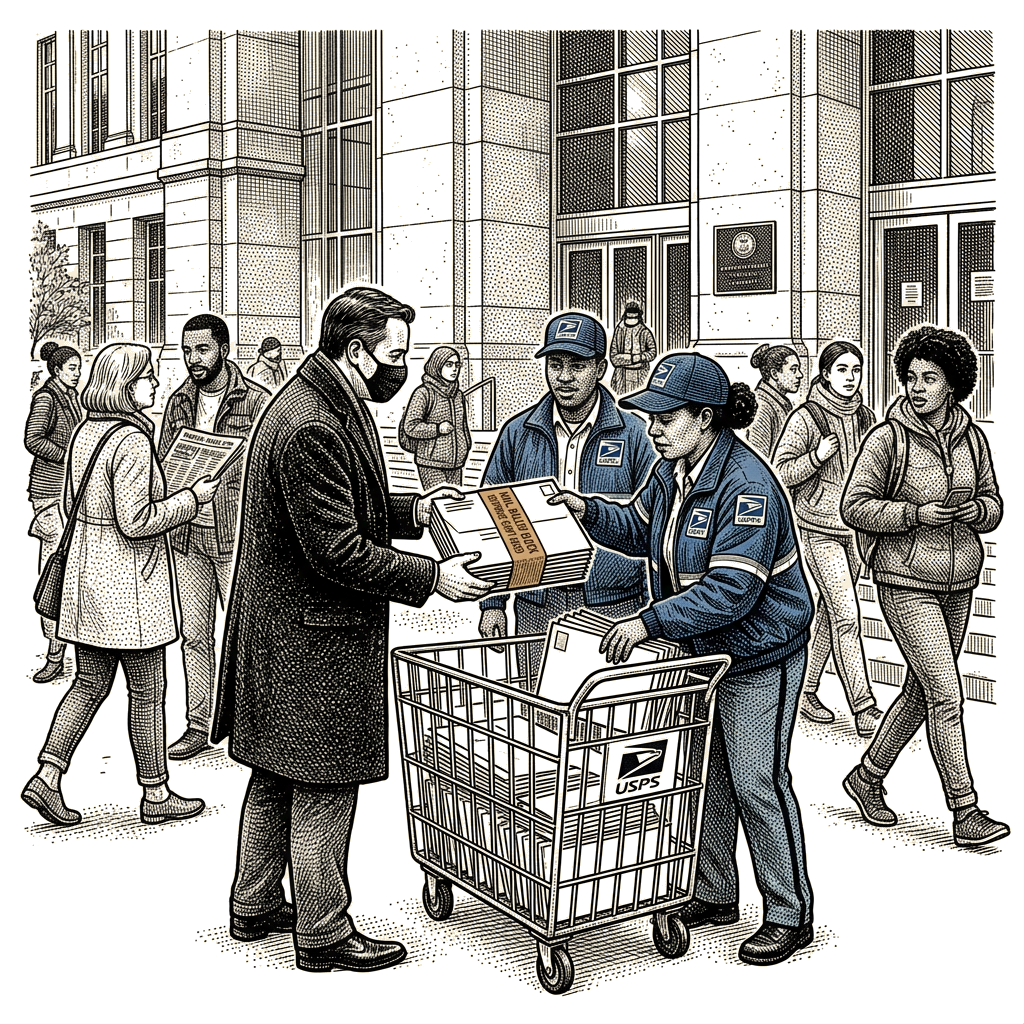
The administration asked the Supreme Court on Wednesday to lift the temporary restraining order that has, for now, blocked USPS from refusing to deliver mail-in ballots in states that will not hand over citizenship-verification lists to the Department of Homeland Security. North Carolina’s absentee ballots go out today — September 4 — formally opening the 2026 midterm voting season. The administration is racing the calendar because the calendar is the only thing that can stop it.
Three documents govern the dispute. The first is the President’s March executive order. According to NPR, the order directs the Department of Homeland Security to develop lists of adult U.S. citizens in each state and requires USPS to refuse to deliver mail-in ballots when state election officials do not turn over those lists. The mechanism the order constructs is a vote-by-mail veto: USPS will withhold a federal service — ballot delivery — unless states submit to a federal citizenship-verification regime the executive branch is assembling unilaterally. The order does not request state cooperation. It conditions the delivery of ballots on state submission.
The second is the temporary restraining order entered by Judge Indira Talwani of the District of Massachusetts. The TRO has kept USPS from implementing the executive order while litigation proceeds. Talwani is now weighing whether to convert the TRO into a midterm-season injunction as the Supreme Court deliberates on the administration’s request to lift the order.
The third is the administration’s Wednesday filing to the Supreme Court, asking the justices to lift Talwani’s TRO so that USPS can implement the ballot-delivery veto while the underlying merits proceedings continue. The administration is not asking the Court to rule on whether the executive order is constitutional. It is asking the Court to lift the protective order so the order can operate during the litigation over its lawfulness.
The constitutional text is clear. Article I, Section 4 — the Elections Clause — provides that “The Times, Places and Manner of holding Elections for Senators and Representatives, shall be prescribed in each State by the Legislature thereof; but the Congress may at any time by Law make or alter such Regulations.” The Clause assigns the primary authority over federal election administration to the States. Congress holds the power to “make or alter” state regulations by statute. The President is not mentioned. The President’s Article II authority over the executive branch does not extend to directing USPS to refuse ballot delivery as a condition for state cooperation with a citizenship-verification regime the executive branch is assembling by executive fiat.
The strongest version of the administration’s argument runs as follows. The President has constitutional authority over the executive branch, including the Postal Service. The March executive order directs DHS to compile citizenship lists and requires USPS to withhold ballot delivery from states that will not cooperate. Both steps fall within the President’s Article II authority — his power to direct the executive establishment. The states’ refusal to share voter rolls does not entitle them to federal cooperation in ballot delivery. Election integrity demands federal verification that only citizens are voting.
That argument fails on its face. The Elections Clause assigns the primary authority over federal elections to the States, not to the executive branch. Congress may legislate under the Clause; it has done so through the Voting Rights Act and other statutes. The President has no constitutional standing to direct USPS to refuse ballot delivery as a condition for state cooperation on citizenship verification. The order is an Article II power grab dressed as an election-integrity measure. The substantive consequence would be operative if the TRO were lifted. In every state that does not turn over the citizenship data the order demands, USPS would refuse to deliver mail-in ballots. Voters who relied on mail-in voting per their state’s law would find their ballots returned, in limbo, or simply not delivered. The right at stake is the right to vote by mail under state law, exercised by voters across the political spectrum.
The Roberts Court has been helping the administration anyway. The procedural record on this case is precise. On August 24, the Court declined to block the underlying executive order at the stay stage, leaving the TRO in place but signaling no immediate merits intervention. That disposition left the ballot-delivery veto available for the administration to activate by seeking to lift the TRO. Last week, the Court addressed a procedural question without disturbing the TRO or ruling on the merits. On Wednesday, the administration filed to lift the TRO. The Court has, at every stage, declined to reach the merits while the calendar runs out.
The TRO has held because Judge Talwani issued it. The Roberts Court’s contribution has been to leave the merits question unresolved and the order’s operative effect contingent on a single district judge’s order while the administration’s filing to lift it sits before the justices. The Court has used this procedural calendar before. In Trump v. Anderson, 144 S. Ct. 424 (2024), the Court fast-tracked the Section 3 disqualification question to short-circuit state-court proceedings while leaving the underlying merits disposition for later. The Court uses procedural management to control the timing of constitutional rulings. On this record, the voters whose ballots the order would strip of delivery do not get their votes back.
The constitutional answer is that the President does not have the authority being exercised. The March order is not a lawful exercise of Article II authority over executive branch operations. It is a structural mechanism to disenfranchise voters in states that resist federal electoral interference. The doctrinal lock is the procedural posture — the TRO preserved by a single district judge, the merits unreached, the ballots already in the mail. The Roberts Court has not intervened to break that lock.
The Court is the vote-suppressors’ lawyer. The midterms are being run under cover of a procedural pause.