The Supreme Court will decide within days whether a president can tell the Postal Service who gets a ballot and who does not. The case rests on an executive order that exceeds any authority the Constitution grants the person who signed it. More than thirty states have refused to comply. The administration has not won a single one of the lawsuits it has filed to force them — eight have been dismissed.
The March executive order demands two things. First, that states hand over their voter rolls to the federal government on the administration’s terms. Second, that the USPS refuse to deliver mail-in ballots to voters who do not satisfy the administration’s narrowed requirements. The DOJ has asked the Court to lift the injunction blocking both provisions by mid-August. If the Court says no, the rule is dead for 2026. If the Court says yes, more litigation follows — but the machine starts moving.
Here is the question that separates this from ordinary policy dispute: cui bono? Who benefits from fewer people voting by mail? Not the voters in rural precincts an hour from the nearest polling place. Not the elderly voters whose mail-in ballot has been their franchise for two decades. Not the disabled voters for whom the mailbox is the only accessible voting booth. The benefit runs upward and outward — to whichever party’s prospects improve when the electorate shrinks. The ACLU’s national director of democracy campaigns put the numbers plainly: mail-in voting is preferred by voters in city centers and by voters in rural areas, by old voters and by disabled voters, across party lines. Among the thirty-two states that publish mail-ballot data, about a third of 2024 voters cast ballots by mail. About two-thirds voted early or by mail. Fifty-eight percent of respondents told Pew Research they support expanding mail-in voting. The beneficiary of restriction is not the public. The beneficiary is whoever needs the public to stay home.
The constitutional architecture makes this straightforward. Article I grants states the authority to determine the time, place, and manner of elections. Congress can pre-empt state election laws through legislation — but the president cannot. The executive branch has no direct role in election administration. None. The Constitution does not create one, does not suggest one, does not leave a gap that an executive order can fill. The president is not a player in this game. The Constitution says so.
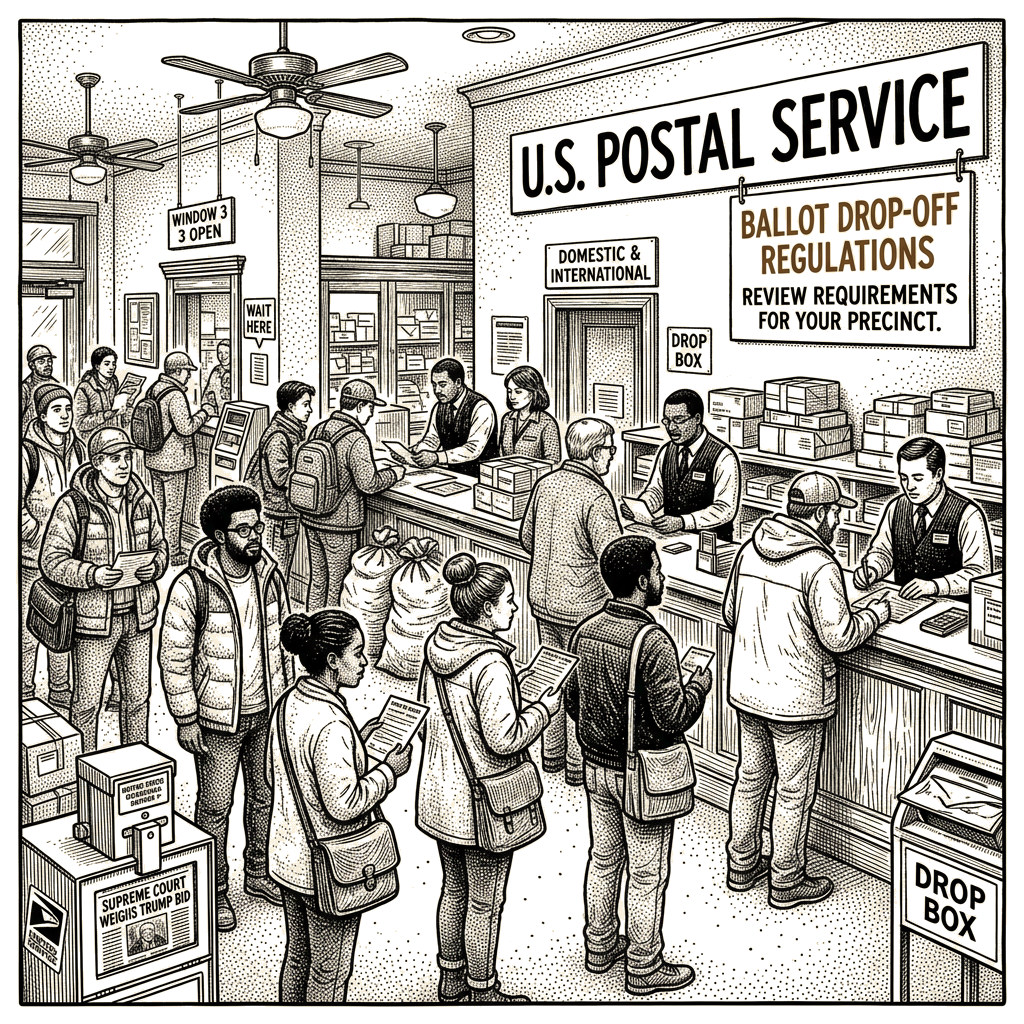
So the administration routes the work through agencies that answer to the president but have statutory obligations that do not. The DHS gets directed to screen foreign nationals and review election systems — surveillance dressed as administration. The USPS gets directed to refuse ballot delivery — the actual chokepoint. Postmaster General David Steiner told the Senate Homeland Security and Governmental Affairs Committee in June that the Postal Service would refuse to deliver ballots in states that would not share voter rolls under the proposed regulation. That sentence should be read twice. The head of the postal service told the United States Senate that he planned to refuse delivery of legally submitted mail — ballots cast by American voters in American elections — because the president wanted him to.
The Postal Service cannot do this. Not because the Postmaster General lacks enthusiasm, but because the law says no. The Universal Service Obligation requires the USPS to deliver mail to all addresses and all types of mail unless Congress has passed a statute prohibiting a specific item. Congress has prohibited firearms, explosives, knives, and smokeless tobacco. Congress has not prohibited ballots. If eligible mail is submitted to the USPS, the agency must deliver it. The statutory language is not subtle. There are criminal penalties for postal employees who refuse to deliver mail they are legally obligated to carry. The letter carriers, the processing center employees, the people who move mail through every stage of the system — they have legal obligations that a postmaster general’s political loyalty does not override.
The Institute for Responsive Government’s federal policy counsel made the operational point: the Postal Service cannot flip a switch on a political order. It has its own lawyers. It has its own legal obligations. The people who sort the mail and carry the mail and process the mail are bound by statute, not by the political preferences of whoever occupies the White House. The announcement of a proposal — even one that cannot be implemented — produces voter confusion, and voter confusion suppresses votes. The rhetoric is the instrument. The rule does not have to work. It only has to make people doubt.
More than thirty states have refused to share voter rolls with the administration. Eight lawsuits filed against those states have been dismissed. The administration has not won a single one. This is not a president enforcing election law. This is a president who has tried to compel compliance by litigation and failed, tried to compel compliance by executive order and been enjoined, and now asks the Supreme Court to let him try again.
The partisan inversion is the structural tell. Mail-in voting infrastructure was built by Republican legislatures. In the 1990s, Republican lawmakers pushed for no-excuse absentee voting. Republican voters used mail-in ballots at higher rates than Democratic voters for years. The partisan calculus shifted when the electorate expanded and the benefits of expansion accrued more to one side than the other. The policy did not change. The voters did not change. The partisan interest in who votes changed. And when the interest changed, the president who represents one side declared war on the method his own party pioneered.
As an earlier federal judge noted, the USPS cannot unilaterally change who it delivers to. An appeals court upheld the injunction blocking the administration’s mail-in voting rules. The legal architecture holds. The question is whether the Supreme Court will let it hold through November.
This is how a republic is corrupted — in plain sight. The president cannot rewrite election law. So he orders an agency to refuse delivery of ballots — using a proposed rule as both weapon and signal. He orders another agency to screen voters under the guise of security. He sues the states that refuse. He loses. He asks the Supreme Court to reverse the losses. And through all of it, the announcement does the work. Voters hear that mail-in ballots might not be delivered. Voters hear that the rules have changed. Voters hear that the president is fighting to change how they vote. Some of those voters will not risk it. Some of those voters will stay home. That is the outcome the executive order was designed to produce — and it does not require a single ballot to be refused. The doubt is the suppression.
The republic does not die when a president signs an order the Constitution does not authorize. It dies when the institutions that are supposed to stop him treat the order as a legitimate exercise of power that requires careful judicial consideration rather than what it is — an attempt by the executive branch to seize authority the Constitution deliberately withheld from it. The Postal Service delivers the mail. States run the elections. The president does neither. These are not traditions. They are constitutional arrangements, and they are under pressure from a president who wants them rearranged so that fewer people vote and the right people benefit.
The arc does not bend on its own. It bends when the people who carry the mail carry it anyway, when the states that refuse comply with their own obligations to their voters, when the courts enforce the constitutional lines that the executive order crosses, and when the voters who hear the confusion and doubt choose to vote regardless. The long arc is not a promise. It is a wager that the institutions will hold and that the people who operate them will honor their obligations over their president. The Supreme Court has the case. The Postal Service has the law. More than thirty states have the spine. The question is whether the arc bends this year, or whether the suppression works quietly enough that no one notices until the electorate is smaller and the beneficiary is obvious.
Malcolm Little King