
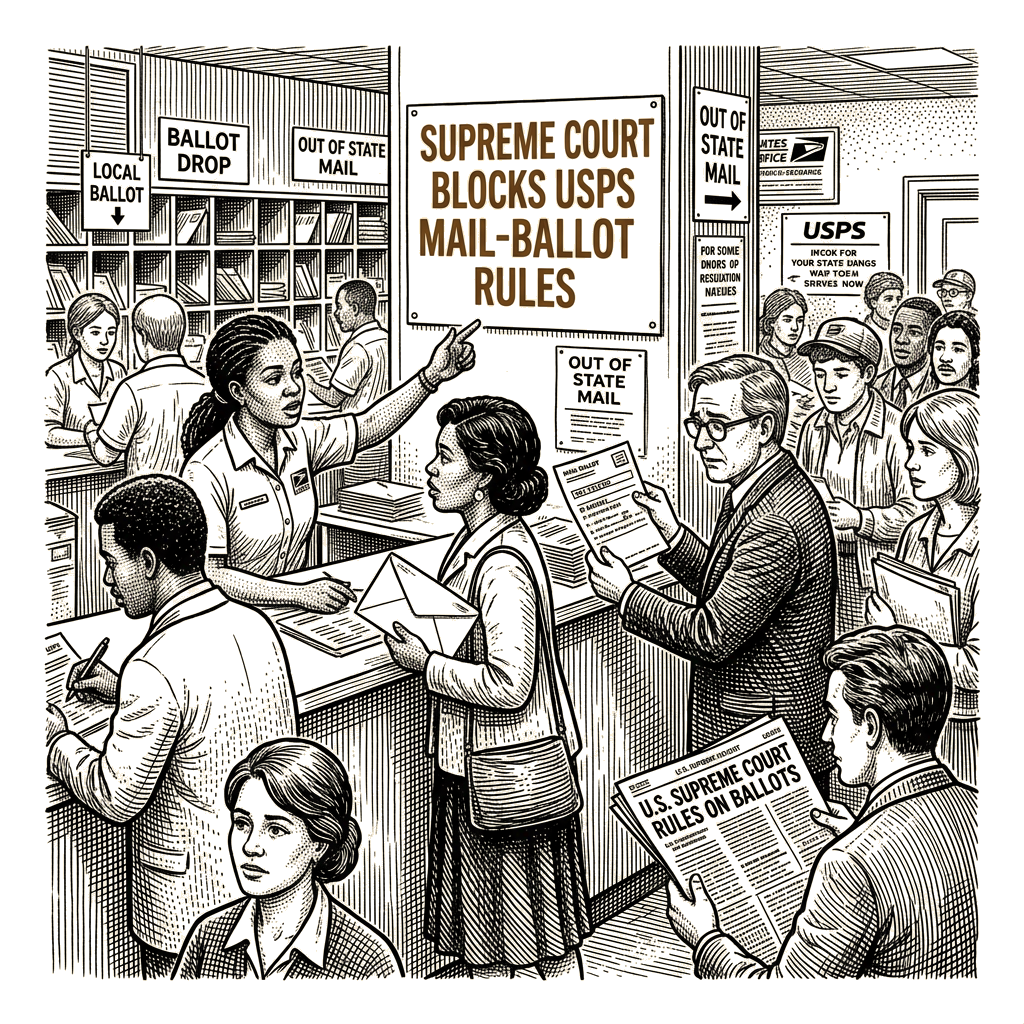
Trump commandeered the Postal Service to cancel mail ballots — an elections authority the Constitution gives to no federal agency.
That is the accusation, and it is not close. The executive order he signed in March 2026, issued under the banner of ensuring “integrity in federal elections,” directed a federal postal agency to impose uniform ballot-envelope requirements on the states, demand that state and local officials upload lists of every voter eligible to vote by mail into a federal electronic portal at least thirty days before Election Day, and refuse to deliver any ballot that didn’t comply. The rule’s own language left no ambiguity: any ballot not conforming to the standards the Postal Service set, or submitted by a voter the federal portal did not recognize, “will not be accepted.” A federal agency with no constitutional role in election law was preparing to cancel individual votes on its own authority.
The strongest version of the government’s case deserves a fair hearing before it is dismantled. Ballot-harvesting concerns are real in some jurisdictions — third-party collection of mail ballots, with varying chain-of-custody protections, creates genuine vulnerability to fraud or coercion in states that have not regulated the practice tightly. Chain-of-custody questions about mail ballots more broadly are not manufactured outrage; they are legitimate operational challenges, particularly in states that expanded mail voting rapidly after 2020. The Postal Service handles the physical infrastructure of every piece of mail in the country, and an executive with Article II authority over the executive branch can direct the agencies under him. If the post office needs uniform envelope standards to process ballots efficiently — and fifty different state envelope designs do create real operational friction for a single national carrier — the argument runs, the president can order the agency to set them. The uniformity goal is not irrational.
That argument fails on three grounds. First, the Elections Clause. Article I, Section 4 of the Constitution vests the “Times, Places and Manner of holding Elections for Senators and Representatives” in the states, with Congress empowered to “make or alter such Regulations.” The executive branch is not a third beneficiary of that power. The president cannot direct a federal agency to do what the Constitution does not permit the president to do directly. USPS operational convenience does not override the structural allocation of election authority the Framers chose. Second, statutory authority. Congress has not authorized the Postal Service to regulate election practices. The agency’s statutory mandate is mail delivery, not election administration. The executive order attempted to create, by directive alone, a regulatory regime that Congress has never enacted — not through legislation, not through appropriations, not through any affirmative grant of authority. Third, federalism. The rules would have required states to submit ballot designs for federal approval and upload voter-eligible names into a federal portal. That is not operational coordination. It is federal command over the mechanics of state elections — precisely the arrangement the Framers rejected when they reserved election authority to the states.
The USPS published its rules on August 26, and what followed was immediate institutional chaos. The envelope-design requirements contained no clear deadline for Postal Service approval — election officials had no way to know whether their designs would be cleared in time. The electronic portal’s thirty-day deadline collided with every state’s voter-registration cutoff: all fifty states permit some form of late registration, and many allow it well inside the window the USPS had chosen. North Carolina had already distributed mail ballots to voters under its existing designs. Utah officials were openly considering building parallel distribution networks to bypass the rules of their own federal government. The practical effect was not “reasonable preparation requirements,” as the administration argued in its emergency petition to the Supreme Court. The practical effect was a federal veto over ballots voters had already cast, under laws their states had already enacted.
As earlier coverage detailed, the procedural history was damning in its own right. The administration first got what it wanted in late August — a 6-3 ruling along ideological lines that dismissed the states’ standing challenge because the USPS had not yet implemented the executive order. The Court reasoned that because the rules weren’t yet in effect, the states weren’t yet injured. The agency then published the rules anyway, in what the District Court judge found to be open defiance of a still-active injunction in the parallel voting-rights case. That injunction was dissolved two days later in light of the Supreme Court’s standing decision. A new preliminary injunction followed on September 4, with the court finding the USPS had “likely infringed upon Congress’ and the states’ elections clause powers.” The administration petitioned the Supreme Court for an emergency stay, contending the rules merely “impose reasonable preparation requirements for certain election-related mail.” Twenty amicus briefs filed in response, the overwhelming majority in opposition. Seven Republican chief election officials — including from states Trump won by twenty points — signed one of them, detailing the practical impossibility of compliance. On September 14, the Court voted 7-2 to uphold the injunction, stating the government “is unlikely to succeed on the merits.” Only Clarence Thomas and Samuel Alito dissented.
The constitutional case was never close. The Elections Clause gives the time, place, and manner of federal elections to the states, with Congress as the alternative regulator. The president is not in that clause. The president is not in that sentence. The USPS is an executive agency; it carries mail, it does not write election law. A supermajority of the Court — seven justices — agrees. The Court stopped short of a final merits ruling, and the case remains before the Boston district court. But the signal is unambiguous: this exercise was always going to lose. The only question was how much of the election cycle it could consume on the way down.
Which brings the larger story into focus. The man who voted by mail himself in Florida — while spending years calling the practice a corrupt, vote-stealing scam — signed the executive order that would have canceled ballots cast exactly the way he cast his own. The rules would have let a federal agency refuse delivery of any ballot that didn’t meet standards he invented by executive order. The hypocrisy is not incidental. It is the policy’s core. Ballot security was the stated rationale. Ballot selection was the design.
The practical relief is immediate. North Carolina can stop scrambling to rewrite its envelopes for a federal veto board that will not be convening. Utah can shelve its plans to route around the USPS entirely. Voters who assumed their ballots might not count can stop assuming. The midterms will be run the way the Elections Clause requires — by the people who actually live in the districts where the votes are cast.
Seven justices did what the Constitution required and what the executive branch refused to do: they got out of the way of the vote.