
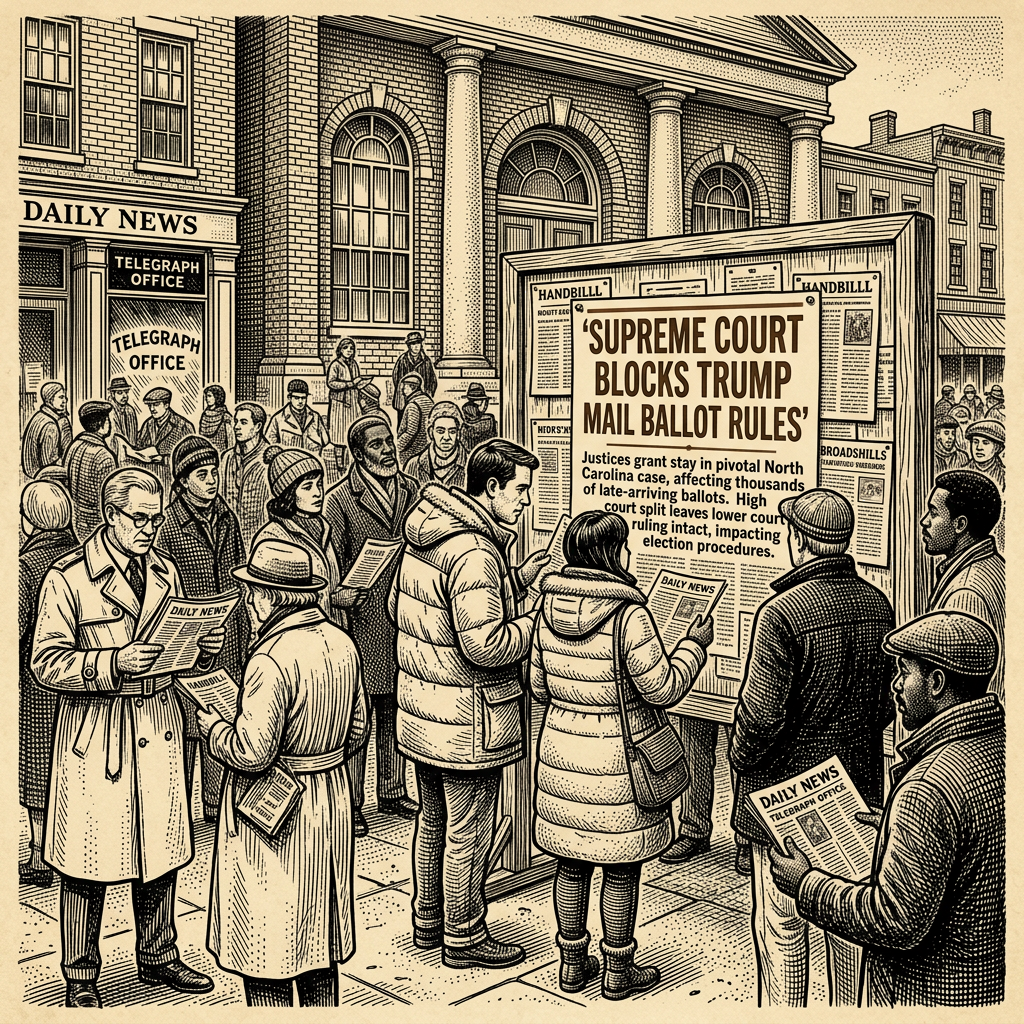
Trump commandeered state election machinery through the Postal Service on the eve of the midterms. He directed USPS to impose rules that would have forced every state to redesign ballot envelopes, hand voter lists to a federal agency, and obtain postal signoff before a single ballot could be mailed. The Supreme Court stopped it in a one-paragraph order. The fact that it took the nation’s highest court to prevent a postal agency from rewriting election administration two months before voters were set to cast ballots tells you how thin the guardrails are.
The strongest case for the USPS rule begins with statute. Nearly a third of all ballots cast in 2024 were mail ballots. Some states — Oregon, Washington, Colorado — conduct elections primarily by mail. Ballot envelopes that cannot be read by postal processing equipment get delayed or returned, a problem that surfaces every cycle. Section 404(a)(7) of the Postal Reorganization Act, 39 U.S.C. § 404(a)(7), authorizes the Postal Service to establish rules and methods incident to the use and handling of mail. The Election Mail Mailability Rule, the existing regulatory framework governing how election mail must be formatted, already requires states to meet envelope dimensions, barcode placement, and address-formatting standards. The administration’s strongest argument: a federal agency that physically delivers tens of millions of ballots has an operational interest in ensuring those ballots can be delivered, and common processing standards improve delivery reliability.
That argument covers envelope specifications and processing protocols. It does not cover what this rule demanded.
The USPS rule required states to submit lists of registered voters to the Postal Service. It required states to obtain postal approval before distributing ballots to voters. It imposed deadlines compressed into weeks before an election that was already underway. North Carolina and Wisconsin had already begun sending ballots when the rule arrived. The First Circuit had already left an injunction in place, and the Court had previously declined to greenlight the administration’s order — two prior judicial signals that the judiciary was not going to bless a late-cycle rewriting of election machinery.
The governing constitutional frame is the Electors Clause. Article I, § 4, cl. 1 assigns the “Times, Places and Manner of holding Elections for Senators and Representatives” to state legislatures, with Congress empowered to “at any time by Law make or alter such Regulations.” The power to regulate the manner of federal elections belongs to state legislatures and to Congress. It does not belong to the Postal Service. It does not belong to the president. The Postal Reorganization Act created USPS as an independent establishment of the executive branch with authority over postal services — not over election administration. Section 404(a)(7) authorizes rules incident to mail handling. It does not authorize a federal requirement that states submit voter rolls to a postal agency or obtain postal permission before distributing their own ballots.
The distinction is not subtle. Mailability standards — envelope dimensions, barcode placement, address formatting — are rules about how the Postal Service processes mail. Federal approval of when and how states distribute ballots is a rule about how states conduct elections. The first falls within postal authority. The second invades the constitutional reservation to state legislatures and Congress. The rule crossed that line by design.
The context confirms what the text establishes. President Trump has publicly stated that limiting mail voting would help Republicans. He directed USPS to adopt these rules weeks before the midterms. The compressed timeline was the mechanism by which the rule would take effect before courts could intervene. The administration asked the Supreme Court to lift the injunction blocking enforcement. The Court refused. In its one-paragraph order, the justices ruled that USPS cannot enforce the new rules.
Justices Clarence Thomas and Samuel Alito dissented. Their position identifies a genuine administrative problem: a voting system in which federal-state coordination varies by jurisdiction, with no baseline administrative coherence for mail-ballot processing, is a system under chronic stress. The patchwork of envelope standards, voter-list procedures, and chain-of-custody rules across fifty jurisdictions is a legitimate concern.
But the rule before the Court was not a mailability fix. It was a federal approval mechanism imposed on state election administration weeks after ballots were already in voters’ hands. The administrative case for common standards does not authorize a postal agency to require federal signoff on a state’s decision to mail its own ballots. The statutory authority does not reach that far. The constitutional framework does not permit it.
This was a shadow-docket order — brief, per curiam, issued without merits briefing or oral argument. The Vladeck framework on shadow-docket abuse catalogs the pattern of emergency orders that change rights without full process. Here the emergency posture cut the opposite direction: the Court used summary process to block a federal agency’s last-minute imposition of new election rules that state officials warned would cause immediate, irreparable harm to an election already in progress. The mechanism was the shadow docket. The function was a stop.
The postal power grab is dead. The structural vulnerability that made it possible is not. A system in which ballot-envelope standards and federal-state coordination vary by jurisdiction is a litigation surface — stress-tested every election and patched together with emergency motions and last-minute court orders. Monday’s order saved the midterms. It did not fix the system that nearly broke them.