
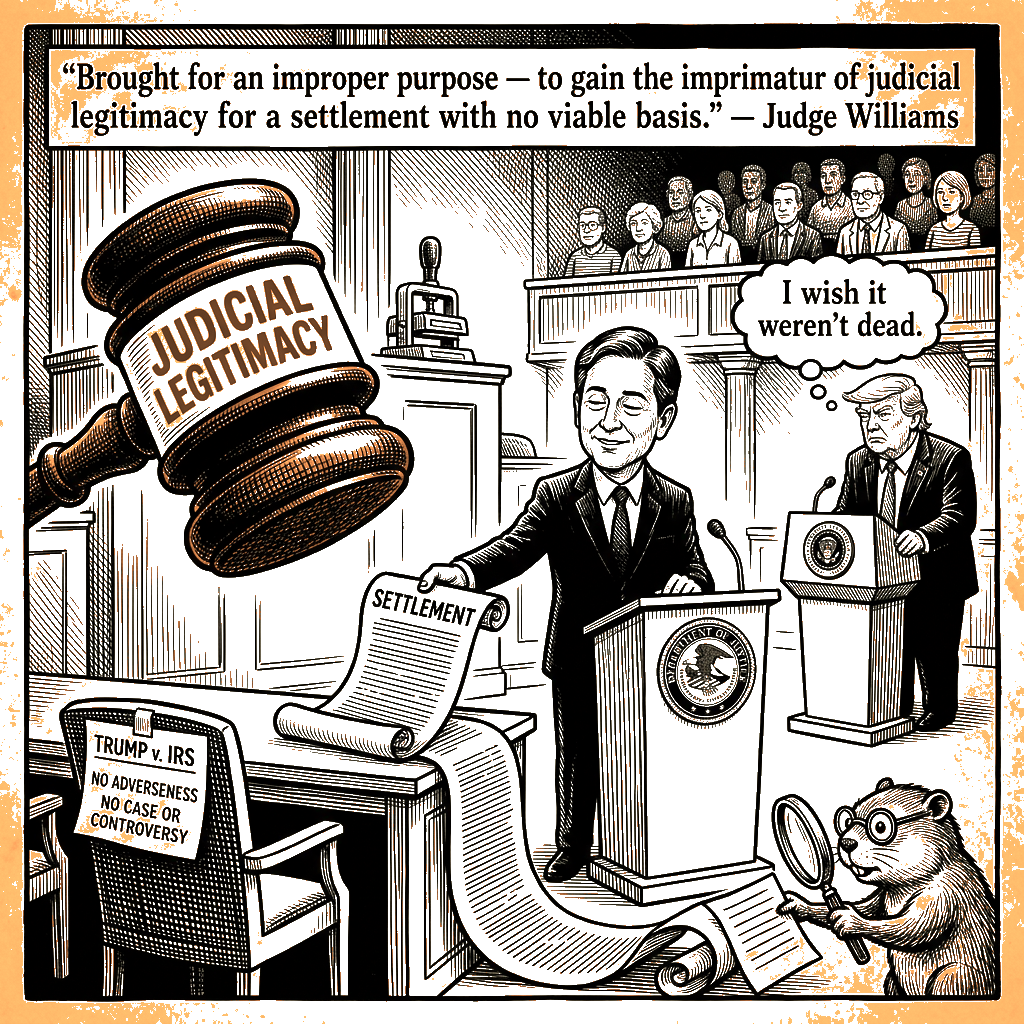
The Trump administration rigged a sham IRS lawsuit to create a $1.8 billion slush fund.
The strongest defense is coherent enough to begin. President Donald Trump sued the Internal Revenue Service over the leak of his tax returns. The resulting settlement supposedly created a compensation fund for people who claimed political prosecution while shielding Trump and his family from future tax audits. Attorney General Todd Blanche presents that as an executive response to the alleged weaponization of federal law enforcement. The fund never opened and no one was paid. On that account, the dispute is over.
The settlement agreement is the governing instrument. It joined three reported acts: resolving the tax-return lawsuit, limiting future audits of the president and his family, and establishing a $1.8 billion compensation vehicle for favored claimants. Earlier MSI coverage documented the Justice Department’s launch of the $1.776 billion “Anti-Weaponization Fund” for allied claims. The label described the fund’s politics. The agreement described its supposed legal basis.
The constitutional obstacle is the Appropriations Clause, which provides: “No Money shall be drawn from the Treasury, but in Consequence of Appropriations made by Law.” An executive agreement can settle claims or waive actions within lawful authority. It cannot appropriate money. The public account identifies no statute, appropriation, or congressional authorization for the proposed payout. The agreement therefore could not, standing alone, authorize a Treasury draw.
The agreement’s legality was tested in July. U.S. District Judge Kathleen Williams found that Trump’s $10 billion lawsuit against the IRS had never presented a genuine dispute. “There was never adverseness between the parties,” Williams wrote. “There was never a case or controversy; and there was never a question as to who would prevail.” Adverseness and case or controversy are the technical requirements for a federal judgment. Williams found neither. She then identified the purpose: the lawsuit had been brought “for an improper purpose — to gain the imprimatur of judicial legitimacy for a ‘settlement’ that had no viable basis in law or fact.” Imprimatur means official approval. The government was not compromising a genuine case. It was using a nonexistent case to acquire the appearance of judicial approval.
That is the controlling indictment. Officials may believe that prosecutors treated Trump’s allies unfairly. They may disagree with charging decisions made during the Biden administration. They may even conclude that particular defendants deserve compensation. None of those propositions authorizes the executive branch to manufacture a lawsuit, obtain a settlement without a real dispute, and build a billion-dollar payout structure for preferred claimants.
U.S. Magistrate Judge Ivan Davis’s discovery order addresses the next link. The Guardian’s account reports that Davis ordered the government to provide discovery materials identifying who set up the fund’s structure in a lawsuit brought by Democracy Forward. The order does not erase Williams’s finding. It asks who constructed the vehicle after the judge found that the supposed case beneath it never existed.
The public account does not reproduce the settlement agreement or Davis’s order. No responsible quotation can supply provisions that are not in the record. Williams’s published finding supplies the adjudicative language. Davis’s order supplies the immediate command: identify the architects.
Blanche has answered the narrow question differently. “The fund is dead or whatever word you want to use,” he said. “It never started.” He also said there were never commissioners responsible for the payout. Those statements establish that no money moved. They do not explain who drafted the structure or establish that the agreement had no legal effect. Blanche later said, “there were never commissioners” in charge of the “payout pot.” Sen. Cory Booker read the agreement as providing “no guarantees whatsoever that this slush fund still can’t go forward.” Booker was issuing a warning, not a judicial finding. The distinction matters.
The agreement obtained by lawmakers apparently also lacked the signatures of the parties to the initial deal. That omission does not prove that the fund could be revived. It does mean the administration cannot treat a bare description of the scheme as the whole transaction. A missing signature is not an appropriation. The absence of commissioners is not an answer to who designed the payout mechanism. Those omissions are precisely why discovery matters.
Trump has not treated the scheme as a settled constitutional error. “It is dead, but you know, I wish it weren’t,” he said at a July cabinet meeting. That does not prove the fund operated. It shows that the president did not regard its abandonment as a repudiation of the underlying plan.
The fund may have paid nothing. The sham lawsuit remains. The settlement remains. The agreement’s reported audit shield remains. The constitutional prohibition on an unappropriated Treasury draw remains. Davis’s order now compels the government to identify the people who built the structure the agreement supposedly created. The fund is dead. The settlement survives.