
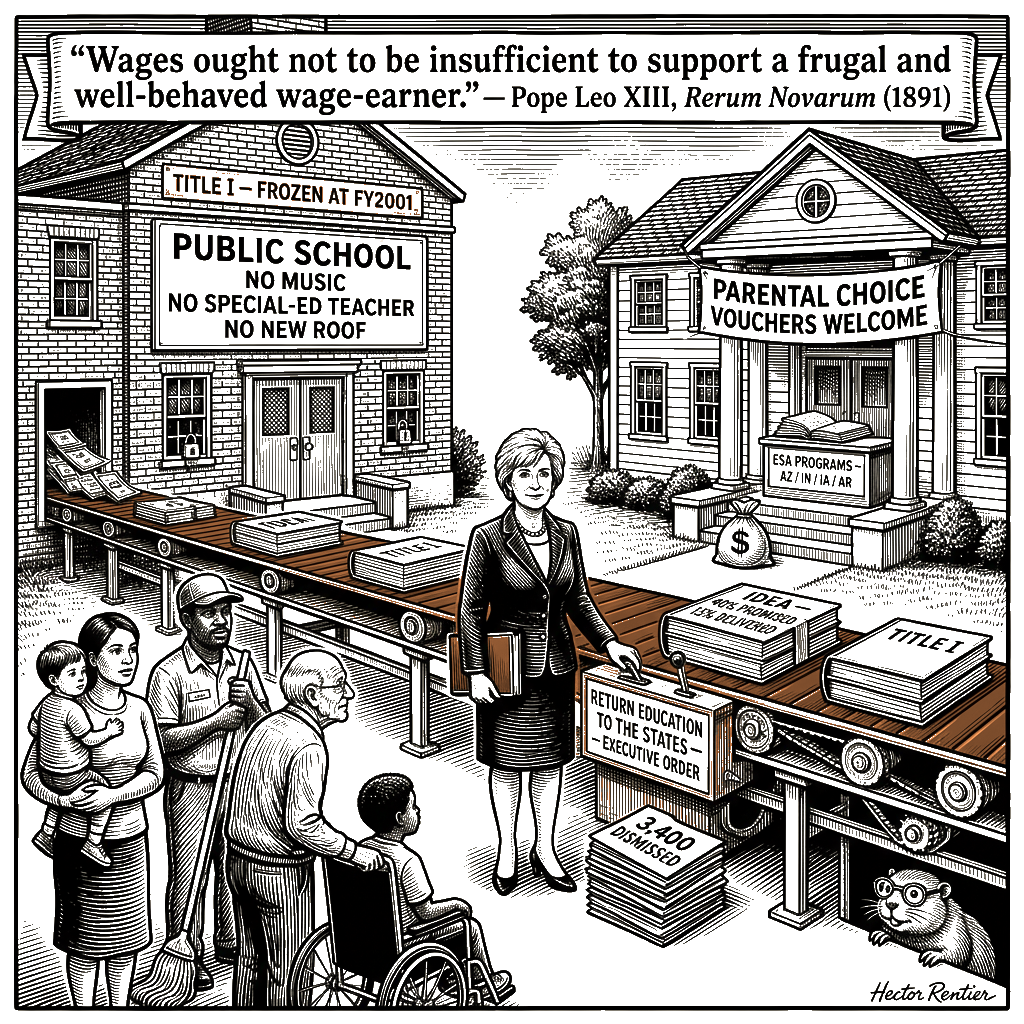
Trump and McMahon are dismantling the public schools to fund private school vouchers.
That is the sentence I keep returning to at the kitchen table at 11 PM, with the cold tea and the spreadsheet open and Eva asleep in the next room. She is four. She will be in kindergarten in the fall of 2027. The school she will attend is a Philadelphia public school whose per-pupil funding is something like half what the suburban district I grew up in spent on me, and the gap is not closing, and the federal government that is supposed to be the difference is being taken apart at the joints.
The 32% of Americans who told Gallup they are satisfied with K-12 education — a 27-year low, the worst number Gallup has measured in a generation of measuring — are not, most of them, expressing a personal preference. They are looking at the wreckage and telling us they can see it. Dissatisfaction, at 67%, sits at its own high in Gallup’s history — the other half of the same pair of numbers, the part that registers what is being lost. The partisan breakdown is the punctuation. Democratic satisfaction fell about nineteen points since the start of the second Trump administration in January 2025. Independents fell ten. Republicans fell six. This is not a story in which both parties are equally responsible for the public mood. It is a story in which one party is driving the fall and the other two are following.
Jack Schneider of the Center for Education Policy at UMass Amherst told the Associated Press what the 32% already knew. “It’s terrifying,” Schneider said. “We’re on the precipice of the dissolution of the public education system as we have known it.”
The kitchen-table version of the polling number runs like this. I sat at our kitchen table last week to figure out whether we could afford to send Eva to a Catholic elementary school in two years. The parish rate in this part of Philadelphia runs about five thousand five hundred dollars per child, per year. Our mortgage is on a seven percent rate that three years of refinance inquiries have not moved. Daycare for both kids is twenty-four hundred a month. Student loans are still on the books from both of us. The math does not close without tradeoffs we are not yet ready to make — though, in fairness, our household has cushions not every household has. David’s grandmother’s estate paid part of our down payment. My parents navigated the financial-aid paperwork for me when I was seventeen. The math runs differently in a household without those cushions, and the polling number is the same.
The pipeline my parents could afford is the pipeline I cannot. My father retired from the U.S. Postal Service in 2019 after thirty-eight years; my mother retired from a Catholic-school nursing job in 2017. They put three children through eight years of parish school and four of Catholic high school on his single income, supplemented by her part-time work when we were older. The house was paid off in 2007. The numbers ran for them in a way they do not run for us. There is a Taylor Swift song on folklore called “this is me trying” that I have been coming back to in this stretch. The verses catalogue the small recovery acts; the song refuses to make recovery look heroic. The line that gets me is the one that refuses the heroic register: I was so ahead of the curve, the curve became a sphere. That is what it has felt like in our household. That is what the polling number is measuring at national scale.
The federal data on what is happening to the school system my kids will inherit is the substance under the polling number. The Department of Education was created by Public Law 96-88, signed by Jimmy Carter in 1979. Fourteen Republican senators and twelve Republican House members co-sponsored the bill. My parents’ generation grew up in a country where that was a normal thing for a Republican to do. The Department now has roughly half the staff it had when Linda McMahon was confirmed in March 2025. The Office for Civil Rights dismissed more than 3,400 complaints between March and June of 2025 — an “unprecedented” rate, in the Brookings analysts’ word — while redirecting what remained of its enforcement toward Title VI investigations of antisemitism and DEI programs and Title IX cases involving transgender students, and not a single Title VI case involving racial discrimination against Black students. Within weeks, the President’s executive order directed the Secretary to begin the process of returning authority over education to the States and to local communities — language that read as an instruction to wind the Department down. My children are being raised in a country where the bipartisan floor is the bipartisan ceiling. That is the generational betrayal in two sentences.
Diane Ravitch, who has spent two decades documenting what “school reform” actually delivers, has been writing some version of the following since The Death and Life of the Great American School System (2010) and Reign of Error (2013): public education is not broken; our urban schools are in trouble because of concentrated poverty and racial segregation. The diagnosis was always wrong. The prescription is the dissolution of the institution the diagnosis was meant to defend.
The IDEA guarantee is the part of the federal floor I keep coming back to. The Individuals with Disabilities Education Act, signed by Gerald Ford in 1975, authorized the federal government to pay 40% of the average per-pupil expenditure for special education. Federal funding has never come close. The closest it ever got was about 18%, in the mid-2000s. In FY 2024 the federal share was under 13%. The annual shortfall is north of $24 billion — bigger, every year, than the entire Title I appropriation. The IDEA Full Funding Act has thirty-plus Senate and sixty-plus House co-sponsors, and it has not advanced. Every district in the country makes up the gap out of every other line in its budget, which is a sentence that means: the special-education teacher your child is supposed to have is paid for by the music program that got cut, which is paid for by the building that did not get a new roof, which is paid for by the raise the paraprofessional did not get. The federal government has been promising this money to my parents’ generation, and to mine, and now to Eva’s, for fifty years. Pope Leo XIII, writing in Rerum Novarum in 1891 about a different set of working-class families, made the principle plain: “Wages ought not to be insufficient to support a frugal and well-behaved wage-earner.” The federal commitment to special education is the contemporary form of that principle. The fifty-year shortfall is the contemporary form of the violation.
The voucher program that the Trump administration has made its signature education policy is, when you look at the actual numbers, the dismantling in motion. Louisiana’s Scholarship Program produced math achievement losses of 0.4 to 0.5 standard deviations, “more than double some estimates of even the COVID-19 pandemic’s effects on learning loss,” in Joshua Cowen’s words — comparable, he has written, to what Hurricane Katrina did to New Orleans students. Indiana’s Choice Scholarship program ran negative 0.15 standard deviations. In Arizona, more than 80% of the families using the new universal ESA had never enrolled their children in public school. Iowa’s first-year ESA recipients were two-thirds already private. Arkansas’s first-year transfer count was about 5%. The programs are working exactly as designed: they are moving public money to families wealthy enough to have made a private-school decision already. Eight states with universal or near-universal programs spent roughly $4 billion in 2023–24 on 569,000 students. The bill is being paid by every parent whose child’s public school is the school that loses the funding the voucher drains.
There is a Swift song on Midnights called “You’re On Your Own, Kid” that I have come to think of as the American care infrastructure’s mission statement. The title is the lyric, and the lyric is what happens to a country that decides the collective obligation to other people’s children is a personal budget item. The friendship bracelets in the second verse — the only safety net the song allows — are the other mothers in the group text, which is to say, the only reliable American welfare system of the past decade has been the mothers. We are being told, again, that we are on our own.
Title I Basic Grants and Concentration Grants have been effectively frozen at fiscal-year-2001 levels since No Child Left Behind — a quarter-century of flat federal investment in the schools serving the highest-poverty districts. The more than seven million public-school students with disabilities, roughly fourteen percent of the public-school population, are not a footnote in this conversation. They are the conversation.
What would a real pro-family education policy look like, for the household I am running in 2026? It looks like full IDEA funding, which would put a special-education teacher back in every understaffed district in the country. It looks like Title I dollars that follow a low-income child to whatever school they attend at the level the original law intended. It looks like a refundable federal childcare tax credit of the kind the Hamilton Project has modeled — the same kind of structural supports, in other words, that make the difference Pamela Druckerman’s French mothers experience as a normal background fact and that American mothers have been told is theirs alone. None of this is speculative. None of it requires a Mars-shot invention. Every piece of it has been modeled, scored, and quietly walked away from.
The decision is the budget. The budget is the policy. The policy is whether Eva’s school will have the music program or the special-education teacher or the roof. The choice was made fifty years ago, and we are still waiting for the country to honor it. The 32% are the parents who looked up from the wreckage and registered what that meant. They are not alone — the institutions are being watched by the people they were built to serve.