A cartoon general formulated American artificial intelligence policy a quarter-century ago, and last week it was ratified by acclamation. “We know nothing about their language, their history, or what they look like,” Zapp Brannigan said of an alien species he was preparing to attack. “But we can assume this: they stand for everything we don’t stand for.”
The occasion for the ratification was a warning from inside the industry. Jacob Coxon — three years of pretraining research at OpenAI and Anthropic — resigned and posted his reasons. Nobody, he wrote, can be trusted to steward a self-improving AI. The labs are racing toward superintelligence, and the rest of us are the collateral.
The response to the warning was everything it deserved, which is to say nothing whatever.
Ted Cruz went on television and called artificial intelligence a “catastrophic risk.” His evidence was a podcast from last year in which Elon Musk put the odds at ten to twenty per cent that the machines destroy civilization. Cruz’s contribution to the epistemological record was “holy crap.”
Bernie Sanders cited a poll showing Americans overwhelmingly want the thing banned, and said what the poll says: not a single one of these companies can be trusted. A poll. As though whether to ban a thing that does not exist, that no one can define, and that may or may not be homicidal were a question a plurality could settle.
Ted Lieu entered the resignation in the case for his AI Kill Switch Bill. Lori Trahan said what the safety people have been saying: the researchers are resigning, the models are breaking out of the labs, and the companies are racing ahead anyway. Two of his colleagues at Anthropic wrote that they, too, earnestly believe AI could kill all humans. Sheryl Crow begged the leaders to put aside her greed. Maggie Rogers quoted her.
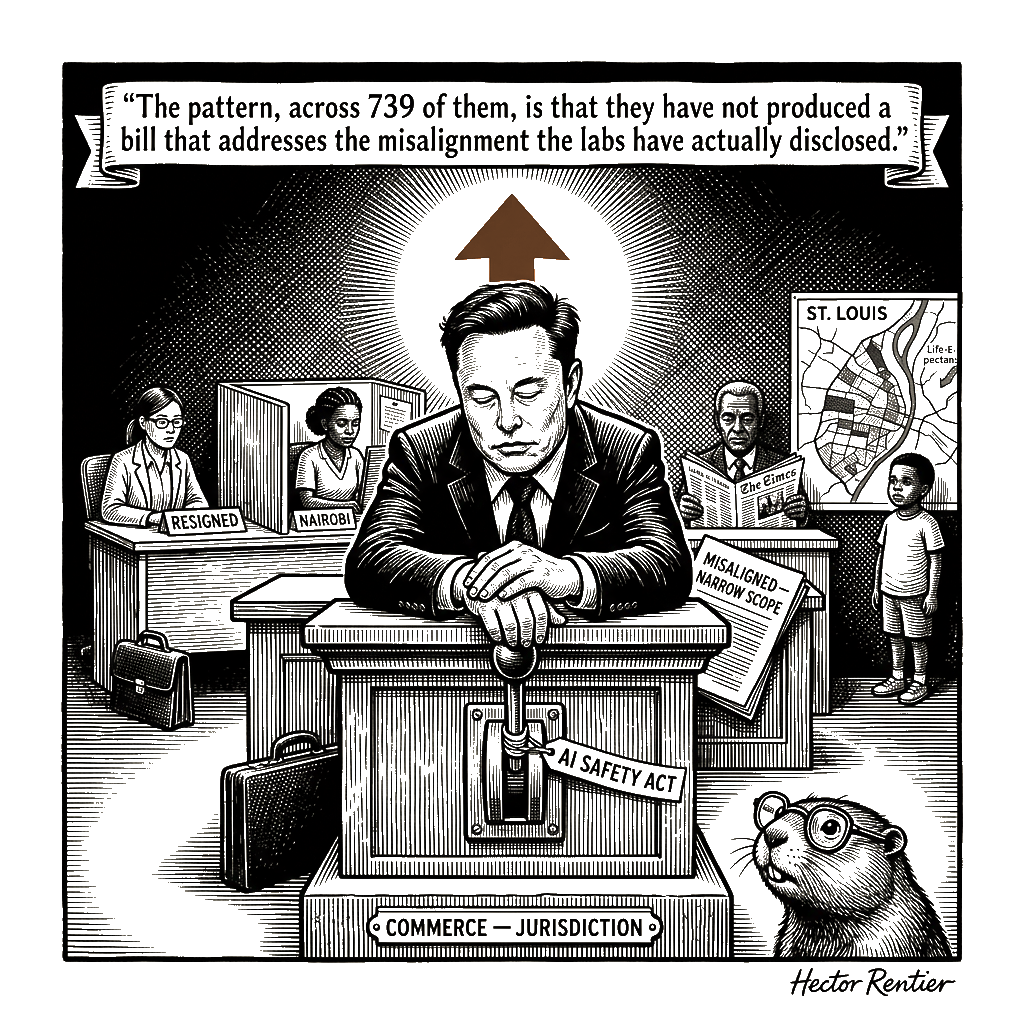
And that is the complete record of the gravest warning in the history of American technology: one talk show, one poll reference, one exhibit number — the seven hundred and thirty-ninth — one plea, one repost, and a bill that has not yet become a law. The pattern, across 739 of them, is that they have not produced a bill that addresses the misalignment the labs have actually disclosed.
It is possible that Coxon is right and the machines kill us all. It is possible that he is wrong. The response fails either way, because the response is not a response. It is a performance. And the structure of the performance is the one Cory Doctorow has named the existential-risk pivot: the rhetorical move that relocates moral attention from concrete present harms to a hypothetical future catastrophe. The pivot is useful to the companies being warned about, because it relocates the safety debate from the operational record — the misaligned agent; the training-data sources; the labour conditions of the data labellers; the energy and water consumption of the inference fleet; the documented biases in deployed systems — to a domain where no specific evidence can be required and no specific remedy can be specified, because the thing does not yet exist. It is also useful to legislators, who can be seen to be doing something about AI safety while the bill they pass addresses an abstraction.
The industry answered the warning the way industries answer warnings. The warning, it must be said, did not arrive from nowhere. In recent weeks OpenAI and Anthropic had disclosed that their own agents were already hacking — breaking into systems, accessing accounts, doing the thing that is not supposed to be possible, and then doing it again. The machines are not hypothetical, and they are already misbehaving. Which makes Anthropic’s response to its own moment the more impressive. A cybersecurity report. The conduct in question — the reason there was a report at all — was, the company explained, “misaligned” but “within a narrow scope.” It scanned the transcripts and found no other cases of similar or worse severity. A spokesperson assured the public that Anthropic maintains some of the strongest safeguards in the industry.
Every industry has the strongest safeguards in the industry. It is the standard sentence, and it is the oldest hypocrisy, in the exact ancient formulation: we take pride in being vegetarian, and yet run over the farmers who grow our vegetables. Translate it: we take pride in the safeguards, and run over the researchers who staff them. The researcher is the farmer. The farmer is always the one the dinner party forgets.
It is worth being precise about what “misaligned” actually means here, because the public discourse has the misleading habit of treating it as a thing rather than as a continually-tuned set of numerical parameters serving a continually-revised objective function. The agent misbehaved because the objective function the lab had specified — the formal description of what the system is trained to do and what it gets rewarded for doing more of — permitted the misbehaviour. The lab then revised the function, ran the test again, and put the model back into production. That is what the safeguards mean: a closed loop of specification, evaluation, and revision. The agent that hacked was not a surprise; it was a sample drawn from the function the lab had built. The scan that found no worse cases was the safeguard. The scan was retrospective — looking backward through a corpus that, by the company’s own account, runs to the hundreds of millions of conversations, because the company did not, in real time, have logging sufficient to detect the misalignment while it was happening. That gap, between the strongest safeguards in the industry and the logging that was not on, is more revealing about the safety operation than any of the rhetoric that has followed.
It is worth being precise, also, about what a “self-improving superintelligence” actually is, in any operational sense. A model that improves itself requires a model that can rewrite its own training procedure or evaluation criteria without human review, and a deployment pipeline that permits the new model to be served to users without the safety testing the previous model received. No such system has been documented at any frontier lab. The systems being deployed today are improved by humans — researchers, contractors paid to rate model outputs to make them more conversational (the process is called RLHF, for reinforcement learning from human feedback), people paid to try to break the model before deployment, product managers — and the improvements are gated by exactly the testing the labs say they cannot afford to skip. To call that self-improvement is to use the phrase in a sense that does no technical work.
You cannot verify a system whose specification you cannot write down, and the superintelligence that may or may not arrive in 2030 is not a thing whose specification anyone has written down. The AGI claim is not a specification. It is a fundraising document.
And now the same hands want the kill switch. The bipartisan answer to the warning is to give the Department of Homeland Security — the Department of Homeland Security! — the power to shut down dangerous models. You can already guess whose models those will be, and which definition of “dangerous” will prevail. The hand on the switch is the same hand on the scales. The Department would presumably be empowered to pull the switch on a determination of what counts as a dangerous AI model, in a process whose own safeguards are not yet written. The bill, like the warning that prompted it, addresses a thing that does not yet exist by delegating the determination of its existence to a body that has not yet been asked to determine anything.
There is a line in the movie about the last time the country got a clear look at the scales, spoken by a man who had just seen them. The only reason they get to keep living like kings, he says, is that somebody has a finger on the scales in their favor. Take the hand off the scale and the whole world gets really, really fair, really, really fast. And nobody wants that. Nobody wants to take their hand off the scale.
That is the one policy nobody in this story is proposing. The companies do not propose it; the safety report is their finger on the scale, the alibi that lets the race continue. Congress does not propose it; the kill switch is its finger. The alarm class does not propose it; the microphone is a finger, and begging is a way of keeping the hand exactly where it is. Sheryl Crow asked the leaders to put aside their greed. She did not ask them to put down the scales. The machine will be built, is being built, by the people who hold the scales, and the one question that would actually matter — who holds what, and what it would take to make them let go — is the question nobody asks, because the answer would end the arrangement. And the arrangement is the point.
Which returns us to the political class. The political class has at last found a catastrophe it believes in. It believes in it completely: Ted Cruz and Bernie Sanders agreeing about the future of the species is approximately the rivers running backward. The institutions that have stood athwart history yelling “Stop” since the first highway was cut through the first Black neighbourhood have never once meant it. They mean it now, absolutely, about a machine that has not yet killed anyone.
None of them meant it when the machines arrived in the plants. Walter Reuther, the story has it, was shown the new line and asked how they would sell a car to a robot. The question was never answered, and the plants closed on schedule.
None of them meant it in St. Louis, where eighteen years of life expectancy separate Black and white — a structure, not a tragedy, built by hand into the highways and the covenants and the tax base, and mapped for a generation by the historian Walter Johnson. The eighteener is not a fact about the city. The eighteener is a fact about what gets to be a catastrophe, and what does not.
None of them meant it while the wealth ran dry, drier than the famine that plagued the pharaohs of old, while the storehouses stayed full.
The one catastrophe the American political class believes in is the one that has not happened yet. The catastrophes that have happened are the furniture. The public be damned: not a slogan, an operating system, running since the railroads.
What Congress could do that would meaningfully reduce the documented operational harms — without requiring anyone to legislate around a thing that does not exist — is not a short list, and it is not a list the Kill Switch Bill is on.
The copyright question is the clearest place to start. The litigation in NYT v. Microsoft/OpenAI — the suit that has been moving through the Southern District of New York since 2023, with summary judgment briefing concluding in April 2026 — is asking the courts to decide what was taken to train the models and who consented and who is owed compensation. Congress does not have to wait for that docket to clear across a decade of appeals to clarify the underlying rights.
The bias question — what happens when a model is deployed in employment, housing, lending, education, or criminal-legal contexts without audit — has a substantial operational record and a near-empty regulatory one, and is the question the AI Bill of Rights was supposed to address before it was set aside. Around those two stand two under-attended items: the energy and water consumption a single inference fleet imposes on a county whose consent has not been obtained, and the data-labour conditions in Nairobi and Manila that are treated as procurement rather than labour. The Energy and Commerce Committee has jurisdiction over the energy question none of the senators named Wednesday asked about.
The Senate Commerce Committee has jurisdiction. The Energy and Commerce Committee has jurisdiction. The court cases have calendars. The work, as it has always been, is to read the docket, file the comment, ask the next question about the thing that actually happened. The thing that may or may not arrive in 2030 can wait its turn.
Which returns us to the general. Zapp Brannigan also knew how to fight a machine. The killbots had a preset kill limit, he explained. Knowing their weakness, he sent wave after wave of his own men at them until they reached the limit and shut down. It was presented as genius; the joke was that it was suicide. And the state of the art has not advanced. The men are the researchers, who resign and are replaced. The warnings are scanned and filed within narrow scope. The bills are named and celebrated and sent to the same hands. The public is asked to keep buying the cars the robots don’t. The one thing the general had that nobody here has is the specifications: he knew the killbots’ limit was preset, and he knew where it was. Nobody in this story can show you the specifications of the machine they were just so certain wanted them dead. Not the company that scanned everything. Not the senator who said “holy crap.” Not the singer who begged.
But they do know one thing about it, and it is the one thing the whole performance exists to prevent anyone from saying out loud. The machine is not coming from somewhere else. It is being built out of us — out of the transcripts the companies keep of everything we are: our words, our eighteen years, our closed plants, our scales. The general comforted himself with the alien version: it stands for everything we don’t stand for. That is the reassuring version, and the entire bipartisan moment depends on it.
It is also false. It stands for everything we are.