The Roberts Court unlocked the federal courts and let Missouri redraw the map and steal the Kansas City Democratic seat.
Missouri’s new congressional map, passed by state lawmakers last September at Donald Trump’s urging, targets the Kansas City seat held by Emanuel Cleaver, a longtime Democratic representative. The map reassigns parts of Kansas City to two neighboring Republican districts and stretches what remains of that district far eastward into rural Republican areas — a textbook mid-decade partisan gerrymander designed to dilute the votes that have kept Cleaver in office.
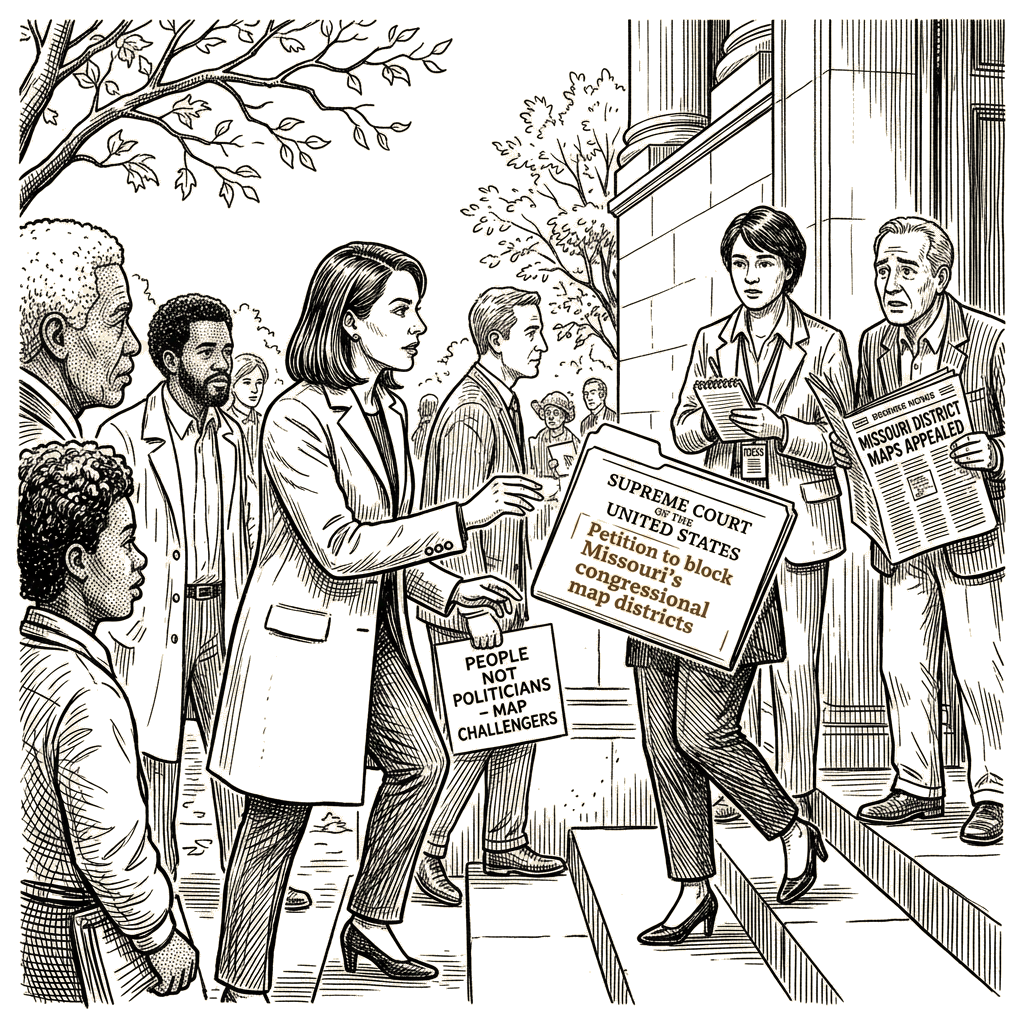
The litigation that followed has now produced two federal court orders on the same question, in opposite directions, less than sixty days before voters go to the polls. Justice Brett Kavanaugh, sitting alone on the emergency docket, denied Missouri’s request to use the new map in November. The denial issued without oral argument or signed opinion, effectively letting the Missouri Supreme Court’s order reverting the state to the 2022 map stand. A day after Kavanaugh’s order, U.S. District Judge Stephen Clark — a Trump appointee in St. Louis — issued a temporary restraining order doing the opposite, ordering Missouri to use the new Republican-favored map that the state had used in its August primary. The challengers, including People Not Politicians, appealed Clark’s order. A federal panel then let his ruling stand, prompting the challengers to file an emergency appeal to the U.S. Supreme Court. The result is a federal court system in active contradiction on which map Missouri voters will use in November’s midterms — and the state’s map-less limbo is the working record of the regime.
The doctrine that produced this mess is the Roberts Court’s own handiwork. In Rucho v. Common Cause, 588 U.S. 684 (2019), Chief Justice Roberts’s majority held that partisan gerrymandering claims present political questions beyond federal judicial reach because there are no “judicially manageable standards” for separating permissible partisanship from impermissible gerrymander. The opinion pointed Congress to the Elections Clause and told it the avenue of reform remains open. A working-bar attorney aligned with the majority would recognize this as a coherent position: federal courts lack the institutional competence to police partisan gerrymandering; the political branches must do the policing instead. The majority’s earlier denial of Missouri’s emergency request to use the new map — a separate shadow-docket action from this month — tracked that logic.
That logic breaks on contact with the regime it produced. Congress has not used the Elections Clause authority the majority invited. Seven years after Rucho, the political branches have resolved partisan gerrymandering in favor of partisan gerrymandering — because the political branches are the partisan actors the Court chose to empower. Trump urged Republican-led states to redraw districts last year; Texas went first; Missouri followed. The new Missouri map targets a specific Democratic incumbent. State courts have pushed back where state constitutions allow — the Missouri Supreme Court ordered the old 2022 map back into effect — but federal courts, by the Roberts Court’s own design in Rucho, are out of the business of hearing partisan-gerrymandering claims.
The current Missouri litigation shows what the regime looks like in operation. Two federal courts have issued contradictory emergency orders on the same map. One came from a Trump-appointed district judge acting on an emergency posture; the other from a single Justice of the Supreme Court acting through the shadow docket without a signed opinion. The federal panel that allowed Clark’s TRO to stand issued no developed merits ruling. The result is not judicial restraint — it is judicial incoherence — and the rights-changing outcome (which map voters use in November) is being issued from procedural postures designed for genuine emergencies, not for resolving disputed map questions two months before a midterm. The Court can grant the challengers’ emergency and let the 2022 map stand; or deny it and let the new map stand; or do what the Court often does on the shadow docket — nothing reasoned, and let the lower courts’ conflicting orders stand. None of these outcomes involves a developed merits record, oral argument, or a signed opinion. All of them decide which congressional map Missouri voters will use in November’s midterms.
The Court unlocked the federal forum, and the political branches rushed in. The midterms are two months out, and the map voters use is being chosen on a docket no one can see.