
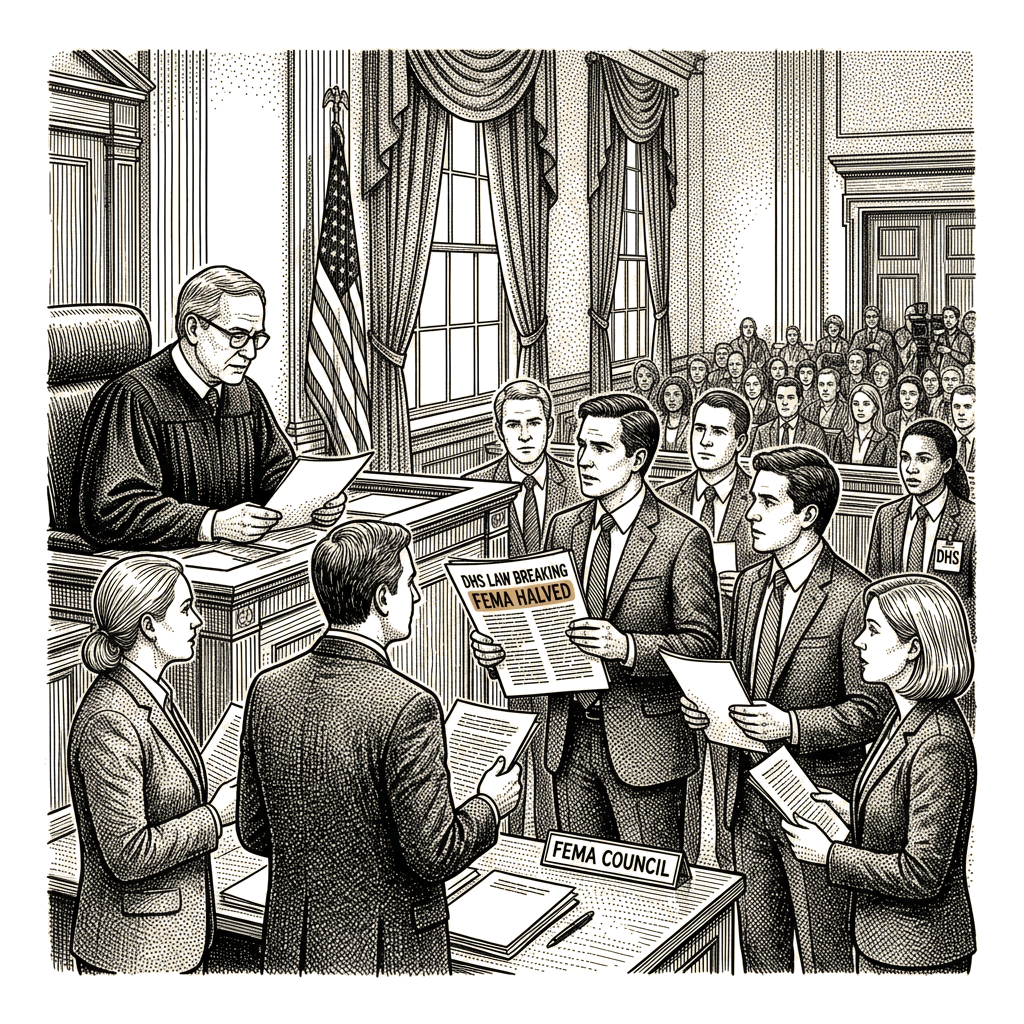
Judge Susan Illston handed FEMA’s staffing power to a union lawsuit.
The federal judge in the Northern District of California ruled Friday that the Department of Homeland Security acted in an “arbitrary and capricious” manner when it pushed a plan to cut FEMA’s workforce from roughly 23,000 employees to fewer than 12,000. She said the 50 percent target “appears as if pulled from thin air.” She also held that DHS violated the Post-Katrina Emergency Management Reform Act, which says the department “may not substantially or significantly reduce the authorities, responsibilities, or functions of” FEMA. DHS, Illston wrote, “acted unlawfully in usurping FEMA’s authority over its personnel.”
That last sentence is the load-bearing one. The order did not merely preserve jobs. It redrew who gets to decide what FEMA is.
The strongest version of DHS’s position is straightforward. FEMA has grown by the thousands over the past decade. Its disaster-response footprint now reaches hurricanes, wildfires, and a post-pandemic claims backlog the agency says it cannot clear. An administration elected to shrink the federal workforce had a coherent reason to put 12,000 employees on the table. The Post-Katrina law does not forbid Congress or the executive branch from debating FEMA’s size. It forbids DHS from substantially hollowing out FEMA’s statutory authorities without legislative assent.
But the record Illston described is not a normal policy disagreement. “Supervisors within FEMA, and FEMA’s Chief Human Capital Officer at the time, did not agree with the 50% staffing cut,” she wrote. DHS leadership submitted a “FEMA annual staffing plan that included a 50% cut, over the objections and analyses of FEMA’s own supervisors.” The agency tried to tell headquarters that the body count was wrong. Headquarters cut them anyway. DHS also declined to renew the contracts of hundreds of temporary disaster first responders—the surge capacity that can determine whether a hurricane response looks like 2017 or 2025.
The court’s account makes the personnel fight legible as a power fight. Career staff opposed the plan. Political leadership overruled them. Illston sided with the career staff. That is a defensible call on the facts of one internal disagreement. It is not automatically a license for one district judge to set the staffing level for the entire federal disaster-response apparatus.
The American Federation of Government Employees, which sued to stop the cuts, walked out of Friday’s hearing with what amounts to a doctrinal seatbelt. Any future administration that wants to hollow out a statutorily protected agency now has to do it in the open, with reasons, and inside the law. That is the guardrail a disaster-weary country should have had after Hurricane Katrina turned FEMA into a punchline.
It is also a union shop keeping its roster intact—accomplished here by litigation rather than collective bargaining. AFGE members have every reason to celebrate. Their dues-paying members’ jobs were the ones DHS wanted to trim, and a court has now ordered those jobs preserved. That fact does not decide the statutory question. It does expose the institutional beneficiary of the order.
The timing adds another layer. Just nine days earlier, the administration said it was no longer pushing to eliminate FEMA entirely. That announcement sounded like a retreat from the maximal plan. Friday’s order now puts the brakes on the more modest goal of cutting the workforce in half. Read alongside Illston’s findings, the announcement looks less like a clean policy settlement than a court-imposed retreat in friendlier packaging.
Eight months ago, FEMA reinstated employees who had signed a dissent letter. The pattern is now visible: career staff object, political leadership pushes ahead, and the administration walks the decision back when the internal record becomes public. A dissent letter is not a veto. Neither is a supervisor’s analysis. But the Administrative Procedure Act exists precisely because an agency cannot replace explanation with a number and call the result governance.
Illston bought the country a runway. The ruling does not just freeze the cut; it puts the shape of FEMA back on the table while a long storm season bears down on the Gulf. A reinstituted workforce—one DHS tried to bleed out after ignoring its own supervisors—can now press for the modernization disaster response actually needs: pre-positioned contracts, transparent deployment rosters, and a training pipeline that does not depend on a political appointee’s unsupported hunch about how many bodies half a disaster agency requires.
The administration can appeal, redraw the plan with more paperwork, or wait for Congress to weigh in. Each path costs time the agency does not have.
The hurricane season will not wait.