
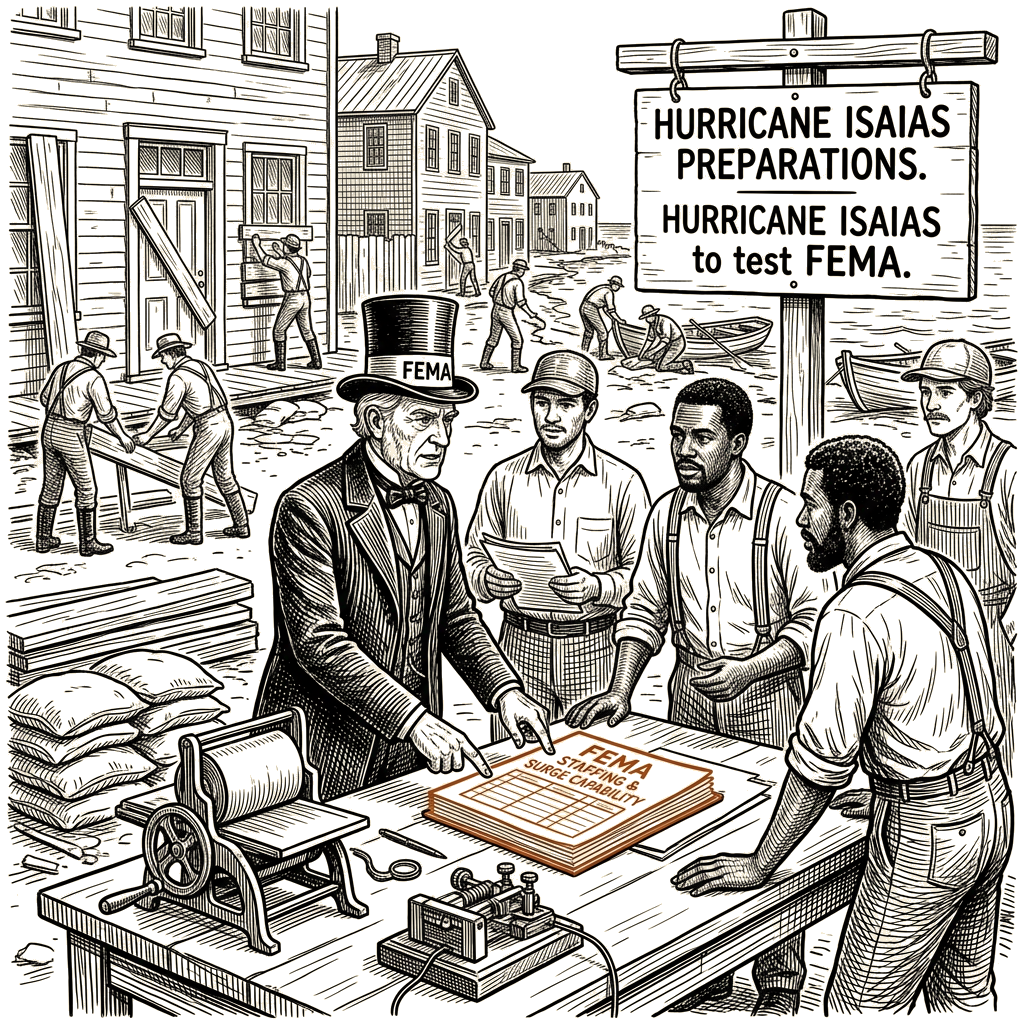
Hurricane Isaias is bearing down on the Gulf coast, and the federal agency charged with the surge response has lost more than 4,300 employees since the cuts began — roughly 17 percent of its workforce, gone in a single fiscal year. From January 2025 to January 2026, 58 senior executive service employees departed FEMA. In the prior three fiscal years, the agency averaged about 13 such separations annually. That is a hemorrhage of leadership. The institutional memory that runs a major disaster deployment was the first thing out the door, because that is who chose the early retirement packages.
Fifty-eight senior executives in thirteen months against a baseline of thirteen a year is a deliberate cull, not a leak. The cuts came through early retirement rather than systematic restructuring. The administration was not caught off guard by the departures. It offered the packages.
The bigger risk is the second storm.
That is the warning the Government Accountability Office’s homeland security director, Chris Currie, has now made on the record: “It’s not whether Fema is going to respond. They’re going to respond. It’s more about the depth.” Depth is what collapses when a second storm forms while the first one is still active on the ground. In 2024, Helene and Milton hit Florida less than two weeks apart and forced the deployment of 13,500 FEMA employees — and that was the operational ceiling. The agency that answered that season heard criticism afterward that it “struggled to have the right number of people with the right qualifications, even before these cuts.” The old agency stretched thin at full size. The ceiling is now lower.
As the storm targets the U.S. Gulf coast and states of emergency have already expanded across the region, the federal surge apparatus is meeting it with depleted senior leadership, fewer bodies, and active recoveries that cannot be paused without harm. Governors in Florida, Georgia, and Alabama have declared states of emergency in advance of landfall. Florida’s emergency management director, Jared Perdue, said at a Thursday briefing that his state has had “very close coordination” with federal partners. State emergency personnel in Alabama, Mississippi, and Louisiana all report full support from FEMA earlier this season during Tropical Storm Arthur, which brought flash flooding and tornadoes across the Gulf. Incident management teams are deploying to Alabama and Florida. Personnel are embedded in state emergency operations centers. Supplies are prepositioned at Maxwell Air Force Base in Montgomery. FEMA says all of this is being done “under President Trump and Secretary Mullin’s leadership.” It is the right posture. It is not, on its own, a sufficient one.
That is the profile of an agency at work. It is not the profile of an agency with depth to spare.
June of this year: more than 1,000 open emergency disaster declarations. El Niño is strengthening. The fall and winter months are ahead. If Isaias is followed by anything significant — a second hurricane, a wildfire complex, a regional flood — the agency will be forced to pull personnel from active recoveries. Those recoveries pause. The people waiting on them wait longer.
That is the human math of the hollowing, and it is already visible. Survivors of the catastrophic flooding in Texas Hill Country this summer still have not received FEMA individual assistance, according to Ginny Goldman, the founder of Rebuild: the National Disaster Survivors Association. A Truth Social post from the president last month pledged $50 million for that recovery. “Where is it at?” Goldman asked. “What about the folks struggling to get back on their feet?”
The bottleneck was there before the cuts. That is precisely the indictment: the system was already strained and barely functioning, and the officials who took charge of it responded by removing the people who knew how to strain it into functioning. You do not repair a stressed machine by pulling out the engineers who know its failure modes — unless the point is to make it fail. Goldman’s survivors were already navigating “a system that is already broken.” The restructuring did not fix the breakage. It decommissioned the repair crew.
For Gulf state officials, the picture looks manageable. But the gap between the statehouse view and the survivor view is the actual story. Goldman: “If you’re a disaster survivor that is trying to navigate a system that is already broken, versus a civil servant in a government agency that is used to navigating a broken system day-to-day, you will have a different perspective on whether it’s broken or not.”
Last month a federal judge ruled the plan to cut FEMA staff by 50 percent unlawful. The ruling was about the process the administration used — not about the harm the process was built to deliver. The administration has not needed a lawful process to continue the program. It has a second instrument, and it is using it. The Texas Tribune’s analysis finds most major disaster declarations in 2026 have come a month after the initial request — about three times the historical average. A month is not bureaucratic slowness. A month is a policy decision, made by officials who know exactly what a month of waiting does to a family with a flooded house. The Hill Country survivors Goldman works with are living inside that month right now. The court told the administration its method was illegal. The declaration data shows the program continuing through another channel.
Malcolm X drew the line in “The Ballot or the Bullet” at Cleveland in April 1964: “He’s the criminal. You don’t take your case to the criminal.” The Hill Country survivors have no second courthouse. FEMA is the only door, and the officials who emptied the agency and slowed the declarations are standing in it. They are taking their case to the criminal because the criminal controls the only entrance.
Follow the benefit. The restructuring was built to hide this question, and a gutted agency answers it for you. When the federal surge capacity shrinks, the surge does not disappear. Survivors still need field inspections, temporary housing, debris removal — and that work finds someone else. FEMA has contracted out the surge for a generation: the field inspectors, the temporary housing units, much of the debris operation have been private work for years. The firms on the other side of those task orders have never shrunk when the agency shrank. They multiply. Every federal employee removed from the operation is one fewer person left to do the work, or to audit the invoice.
The governors and state directors who have spent years arguing that emergencies should be run closer to home get the other half of the prize: more control over when federal money moves, more discretion over what the federal government is allowed to do inside their states. The doctrine of “more burden on states” is not an efficiency theory. It is a transfer of authority, and authority is what state emergency-management machines were built to accumulate.
And the architects of the doctrine get the thing the whole project exists to produce: proof. When the response to a real hurricane is visibly degraded — declarations running a month late, a surge too thin, survivors still waiting — the footage of the failure becomes the argument for the next round of cuts. “Government is the problem” stops being an ideology. It becomes a prediction whose conditions they manufactured. A FEMA that fails at its statutory duty is not a FEMA the program lost. It is the program’s deliverable.
This is what the pivot from abolition to restructuring was always about. When the administration announced in September it was no longer pushing to eliminate FEMA, that was not a concession. You do not need to abolish an agency you can make fail at its statutory duty in full public view. Restructure is the slower instrument with the same target: a federal government that visibly cannot do the thing it exists to do, so the thing gets handed to the people who sell it back at a markup. The pivot was never about saving the agency. It was about controlling its collapse. Hurricane Isaias, the first Atlantic hurricane of 2026, is the occasion for the demonstration.
Deanne Criswell, who led FEMA under Biden, framed the loss differently: “My biggest concerns are always the loss of institutional knowledge. You lose that knowledge. You lose the people who had been through these big disasters in the past.” She is right, and the point deserves the weight she gives it. Institutional knowledge is not an HR category. It is the difference between an agency that knows how to surge and an agency that has to learn how to surge while the water is rising. The people who had been through Helene and Milton took the early retirement packages. They are gone.
The agency that answered 2024’s worst hurricane season showed up with 13,500 people. The agency meeting Isaias is showing up with about 17 percent fewer of them — and a leadership bench cut by more than four times its ordinary annual attrition.
Until the storm makes landfall, the people in Huntsville, the people in Pensacola, the people picking up sandbags in Mobile have work to do. Minding the evacuation order, not the commentary about what FEMA may or may not manage — that has been the rule of every Gulf hurricane, in every generation, under every administration.
The administration meeting this storm from Washington is working a different problem. It emptied the agency: workforce down 17 percent, senior executives gone at more than four times the ordinary rate, declarations running a month late. And it has something to gain from what happens next that no storm ever gave it before. Every stalled deployment is a receipt for the doctrine that government is the problem. Every survivor still waiting on summer-flood assistance is evidence the next round of cuts will cite. A FEMA that cannot do its job is not the failure of the restructuring. It is the point of it.
King said the long arc of the moral universe bends toward justice — but the arc bends only because specific people, in specific moments, push it. The people in the storm’s path cannot push while the water is rising. The rest of us can: name the officials who emptied the agency, follow the task orders to the firms cashing them, and refuse to let the architects of the failure collect the proof of it as their prize. The arc does not bend itself. The people betting on its breaking are betting that we are too tired to push. Hurricane Isaias is their deadline. It is also ours.