
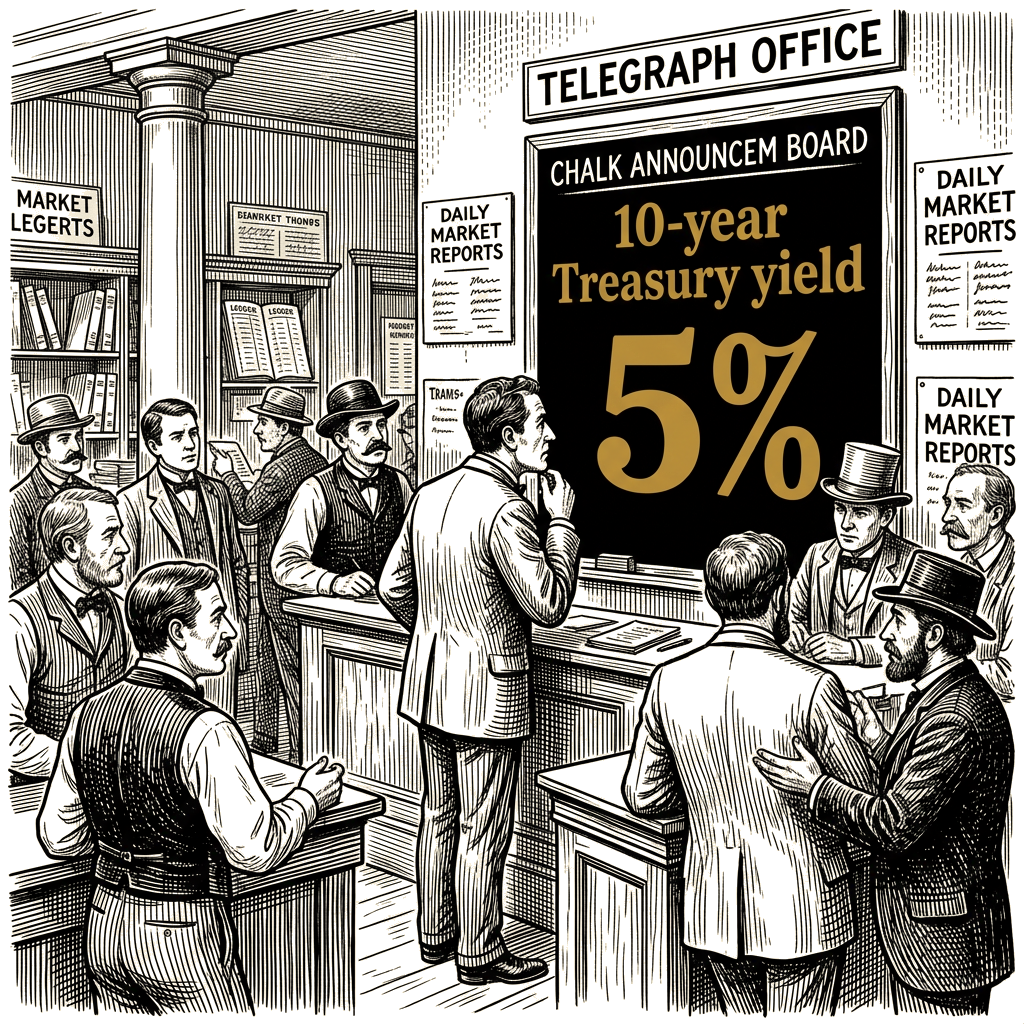
The 10-year U.S. Treasury yield punched through the 5% line Monday morning for the first time since 2023, touching 5.014% before settling back to 4.947%. The number is not symbolic — it is structural. Every mortgage rate, every corporate borrowing cost, every small-business line of credit is anchored to it. And it has been moving in only one direction this year: 4.15% on January 1, almost 85 basis points higher by mid-September.
The last time the 10-year traded above 5% for any sustained period was 2007. The 30-year is already there — at 5.328% on Monday, a level it touched earlier this summer for the first time since 2007. Two-year yields, which sit closer to the Fed’s policy expectations, are at 4.628%. The whole curve has moved in lockstep, and it has moved up.
The signal is unambiguous. Last week’s consumer price index showed core inflation at 3.4%, more than a full percentage point above the Federal Reserve’s 2% target. The Fed’s own target range sits at 3.5% to 3.75%, with economists putting the probability of a rate hike at this month’s Federal Open Market Committee meeting at 90%. The FOMC convenes later this week. Chief market strategist Jay Woods, interviewed by CNBC, put the bind plainly: hiking is the cleaner decision given market expectations, and a hold would “scream once again the Fed is behind the curve.”
The Fed is behind the curve. That is the read the bond market is pricing in.
For households, this is the next shoe to drop in a year that has already brought a bond selloff lifting every borrowing cost consumers and businesses face. A 30-year mortgage that sat near 6.5% in the spring is pushing higher. Auto loan rates, small business credit, municipal borrowing — all ride the same wave. Main Street does not get to refinance at the Fed funds rate. Main Street pays whatever the bond market charges, and right now the bond market is charging more than it has in almost two decades.
The Federal Reserve has a choice this week, and both options are bad. Hike, and risk breaking a labor market that is still hanging on. Hold, and confirm that the institution charged with price stability has lost the plot. That is what 5% on the 10-year means. The easy options are gone.