Tony Burke is closing one student-visa loophole while leaving the migration machine running.
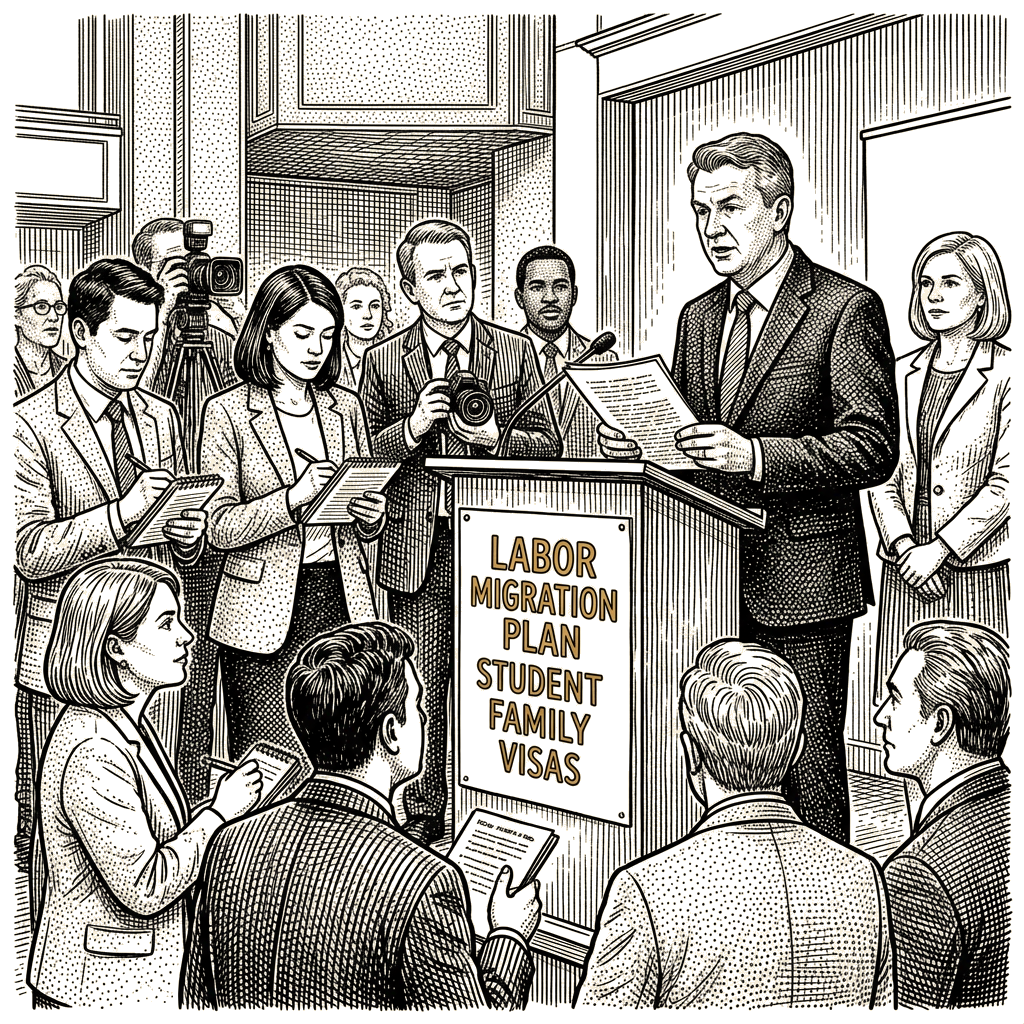
For years, anyone who raised migration numbers in polite company was treated as a Hanson sympathiser. Tony Burke walked into the National Press Club on Thursday and made that consensus look like what it was: a country club for the operators who built a livelihood around 337,000 international student visas, roughly 45,000 dependents in a single year, and a political language that called the pipeline “diversity” while refusing to count its consequences.
The home affairs minister’s speech, “The work of managing the migration program: Who arrives, who stays, who leaves,” did something Canberra has avoided for too long. It wrote the questions down.
Who arrives?
Who stays?
Who leaves?
Foreign students will be required to come alone. Demand-driven settings will be replaced by caps ministers can actually move. The government says net overseas migration will fall from about 305,000 to about 225,000 over two years, alongside 185,000 permanent arrivals each year. The trajectory is already falling, seven consecutive quarters down since September 2023. But the temporary-visa population remains large enough to keep the headline number stuck.
This is not yet a settlement. It is a beginning.
The first truth is that 337,000 student visas are not an act of nature. They are a ministerial choice. The roughly 45,000 dependents attached to those visas are not a clerical footnote. They are spouses, children and parents entering a country whose housing, transport, schools and health services already carry the weight of decisions made elsewhere.
The second truth is that migrants are not numbers. They are people. That is precisely why the numbers must be told accurately. Matthew’s Jesus does not say that the stranger becomes worthy only after admission, employment or cultural approval. “I was a stranger and you welcomed me.” The Torah says, “You shall not wrong or oppress a resident alien.” A government may manage a border. It may not manage away the humanity of the people standing behind its categories.
That moral rule applies to the minister, the student, the migration agent, the university vice-chancellor and the worker whose wages are pressed by an endless supply of temporary labour. It applies to the renter whose landlord raises the price because demand is guaranteed. It applies to the taxpayer who is told that every institutional cost is an unavoidable consequence of growth.
This is why the phrase “race for the lowest Nom,” used by Australian Chamber of Commerce and Industry chief Andrew McKellar, matters. The race exists because the previous settings were tuned to the interests of migration agents, regional universities, colleges dependent on overseas revenue and employers who want labour without bargaining power. The Australian worker, the Australian renter and the Australian taxpayer were treated as the adjustable parts.
McKellar says Australia does not have a migration problem; it has a housing crisis and skills shortages. But the housing crisis is worsened when governments add hundreds of thousands of people without adding homes, transport and public capacity at the same speed. The skills shortage is worsened when employers can import labour instead of paying a young Australian a living wage to learn the work. The two facts do not cancel each other. They meet in the same room.
A labour market that depends on precarious migrants is not a humane labour market. It is a market that makes the worker—local or foreign—carry the cost of the employer’s refusal to pay.
I know the temptation to turn this into a morality tale about outsiders. I reject it. The migration system was designed by Australian governments, expanded by Australian institutions and defended by Australian business groups. The universities did not discover a natural law. They found a revenue model. The aged-care sector did not discover a sacrament. It found a workforce it could underpay. We who have benefited from cheap services and cheap labour have helped build the arrangement we now condemn.
The Department of Home Affairs’ July count gives the system another hard edge: 110,898 individuals who had not been granted a protection visa remained in the country. That is the documented number. It is not a slogan about “un-deportable” people. It is a population trapped in administrative uncertainty after years of promises to process the backlog.
A person cannot build a life inside a queue forever. A government cannot call its own failure to decide compassion. It must decide cases lawfully, protect people who need protection, remove those with no lawful basis to remain, and do both with due process and human dignity. Swift removal is not a substitute for justice. Nor is endless delay.
The critics are already gathering. Business groups, universities and the aged-care sector denounced Pauline Hanson’s proposal to cut temporary migration by more than 750,000 over three years. Former senior officials warned that administering such a reduction would cost many billions. Those warnings deserve examination. They do not deserve automatic obedience from the institutions that profited under the old settings.
Hanson has put a number on the table. Burke has put a smaller number beside it. The difference is not a reason to sneer at voters who want an answer. It is the conversation Australia owes them.
David Pocock called for a “10-year plan.” “What is our 10-year plan for migration?” he asked. “What are the skills we need? What are the trade-offs when it comes to housing, impact on the environment?” He is right about the need for a plan. He is wrong if “maturity” means refusing to begin with numbers. Numbers are not the opposite of compassion. They are how a government admits that resources, land, housing and public attention are finite.
Pauline Hanson’s 750,000 reduction is not automatically wisdom. Tony Burke’s 225,000 target is not automatically justice. Each proposal must answer the same questions: Who bears the cost? Who benefits? Who has a voice? Who can leave? Who is protected when the system fails?
That is the moral arithmetic the migration industry has avoided.
Anthony Albanese tried to draw Angus Taylor into a parliamentary compromise and got nothing back. The Coalition’s idea of cooperation, so far, is to let Labor pass its own bill and then complain about it in public. The prime minister leaves for the United Nations General Assembly on Friday with the headline softened, the detail pending and no obvious majority for anything stronger.
The country does not need a slogan. It needs a policy that can survive contact with a family at a bus station, a renter searching for a room, a nurse working a double shift, a student carrying debt, and a worker whose employer says there is no alternative.
The wider pattern is visible beyond migration. Washington has tightened visa access for Pretoria over Pretoria’s expropriation laws. Canberra has released a draft social-media duty-of-care bill that would make platforms answer for the harms their algorithms cause. Different portfolios. The same question: will public authority continue to let the most aggressive actors set the terms?
Burke’s package is the immigration chapter of that reckoning. But it is not enough to close one door while leaving the house unplanned.
A humane migration policy would set a number openly, build the homes and services that number requires, protect workers from exploitation, process protection claims promptly, reunite families where justice requires it, and remove people lawfully when the claim to remain fails. It would treat the migrant as a neighbour, not a unit of labour. It would treat the citizen as a person, not a vote to be managed. It would make universities serve education before revenue and employers pay for skill before importing precarity.
Romero said, “Stop the repression,” because a government that calls cruelty administration has already begun to lose its soul. Australia does not need repression dressed as order, nor indifference dressed as compassion. It needs the courage to count what it has chosen, name who pays, and repair what the choices have broken.
The reset is the work. Burke has begun it. He must not mistake the starting gun for the finish line.