
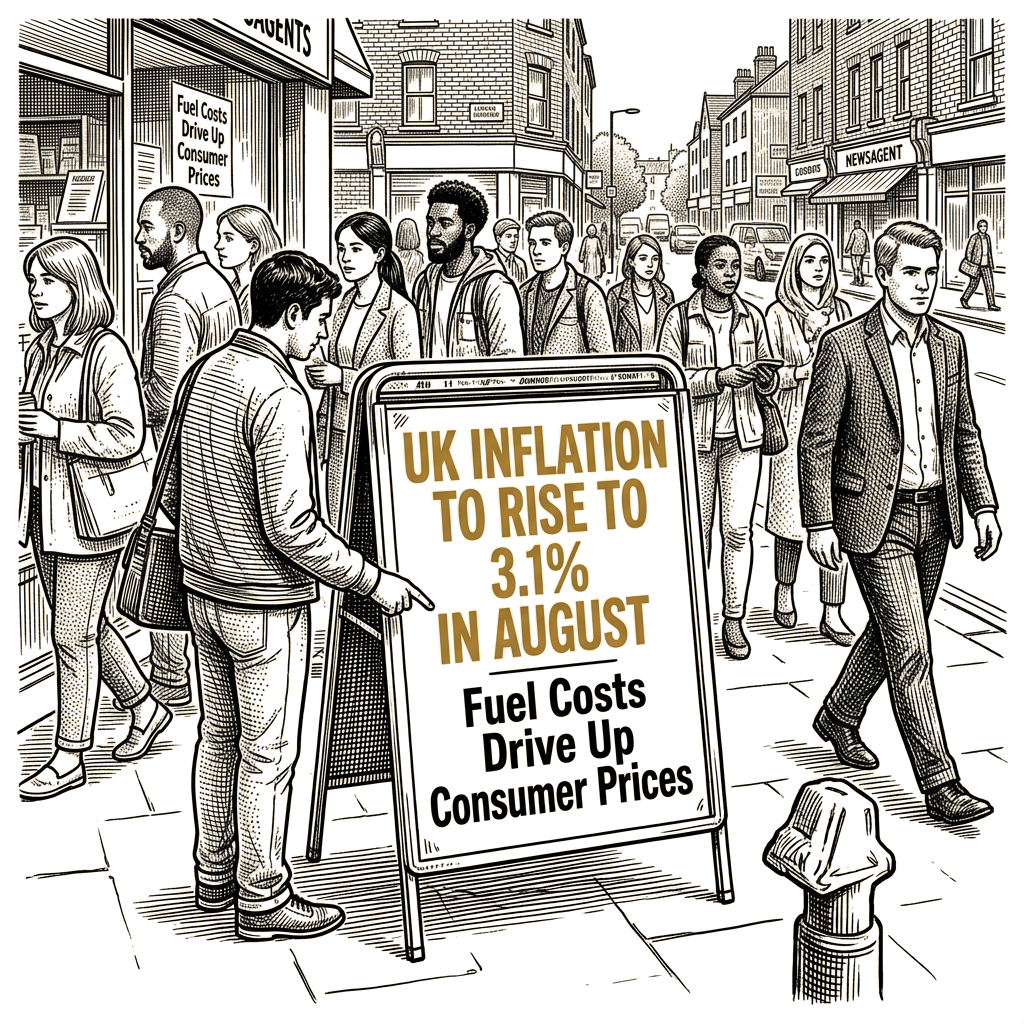
The Office for National Statistics releases its August Consumer Prices Index at 7am BST on Wednesday. Forecasters across the consensus project a year-on-year rate of 3.1%, up from the 2.9% recorded for the twelve months to July and a full percentage point above the Bank of England’s 2% target. The cheap-money foundation that underpinned both the government’s energy-crisis interventions and the gilt market’s willingness to absorb them has collapsed. The August CPI is arriving in the gap it left.
The driver is fuel. Since the war with Iran began, crude has moved hard, and the move has flowed directly to the forecourt. Petrol and diesel at UK pumps are at their highest level since the conflict started and the most expensive British drivers have paid since 2022. The Treasury funded energy-price support for households through borrowing that was manageable when the Bank of England held the monetary-policy rate at 0.1% and was purchasing gilts under quantitative easing — keeping the government’s own borrowing costs at rock bottom. That regime has ended. The Bank tightened into the inflation that was building through 2021 and 2022; gilt yields have risen with it; and the fiscal arithmetic that sustained energy-price support no longer holds at current market rates.
The American print landed last week at 3.4% — the BLS figure the Federal Reserve will carry into its Wednesday decision — and the transatlantic price pulse is the same pulse, lagged across an ocean. The UK is further behind the same curve, but catching up in a fiscal position with far less room to cushion the transition.
The gilt market is doing what the gilt market does when it loses faith in fiscal arithmetic. UK government borrowing costs hit their highest level since 2007 on Tuesday, and the average G7 10-year yield cleared its highest reading since mid-2008. That is not a UK problem — that is a synchronised repricing across every major sovereign curve as the era of rock-bottom rates unwinds. Economists warned in July that an oil surge would force the Bank’s hand; the market has now priced the consequence.
The human version of these numbers is straightforward. A family filling a midsize hatchback once a week is paying roughly £300 more per year at the pump than two years ago; diesel-driven delivery firms are watching fuel costs consume margins that were thin before the conflict began; pensioners on fixed incomes who were not made whole by the energy-crisis support schemes are watching purchasing power erode at the supermarket checkout, where food inflation continues to run above headline CPI. The gilt market repricing is an abstraction. A weekly fill-up at these prices is not.
The Wednesday calendar is dense. The ONS CPI lands at 7am; UK housing and rents data at 9:30am; the Federal Reserve’s rate decision at 7pm with the press conference at 7:30pm. The US inflation print at 3.4% will likely encourage the Fed to tighten further; a UK print running above consensus — and the consensus is 3.1% — compounds the gilt-pressure on top of a sell-off that already has UK ten-year borrowing costs at levels not seen since 2007. The Bank of England will read the same data the market reads: the cheapest borrowing costs available when the government needed them most are gone, and the August CPI confirms that the inflation those low rates helped seed has not run its course.
The structural picture is clear. The Bank’s rate decisions through 2021 made government borrowing cheap enough to sustain energy-price interventions at the scale the crisis demanded. The Treasury borrowed heavily against that window. Now both the window and the spending it financed have ended, and the households the interventions were meant to shield are absorbing the full cost — at the pump, in borrowing costs, and in the Wednesday-morning CPI print. The July reading of 2.9% was the warning. The August projection at 3.1% is the confirmation. The distributional question is straightforward: which households can absorb the cost, and which cannot. The numbers arriving Wednesday morning will not make that question more comfortable.