
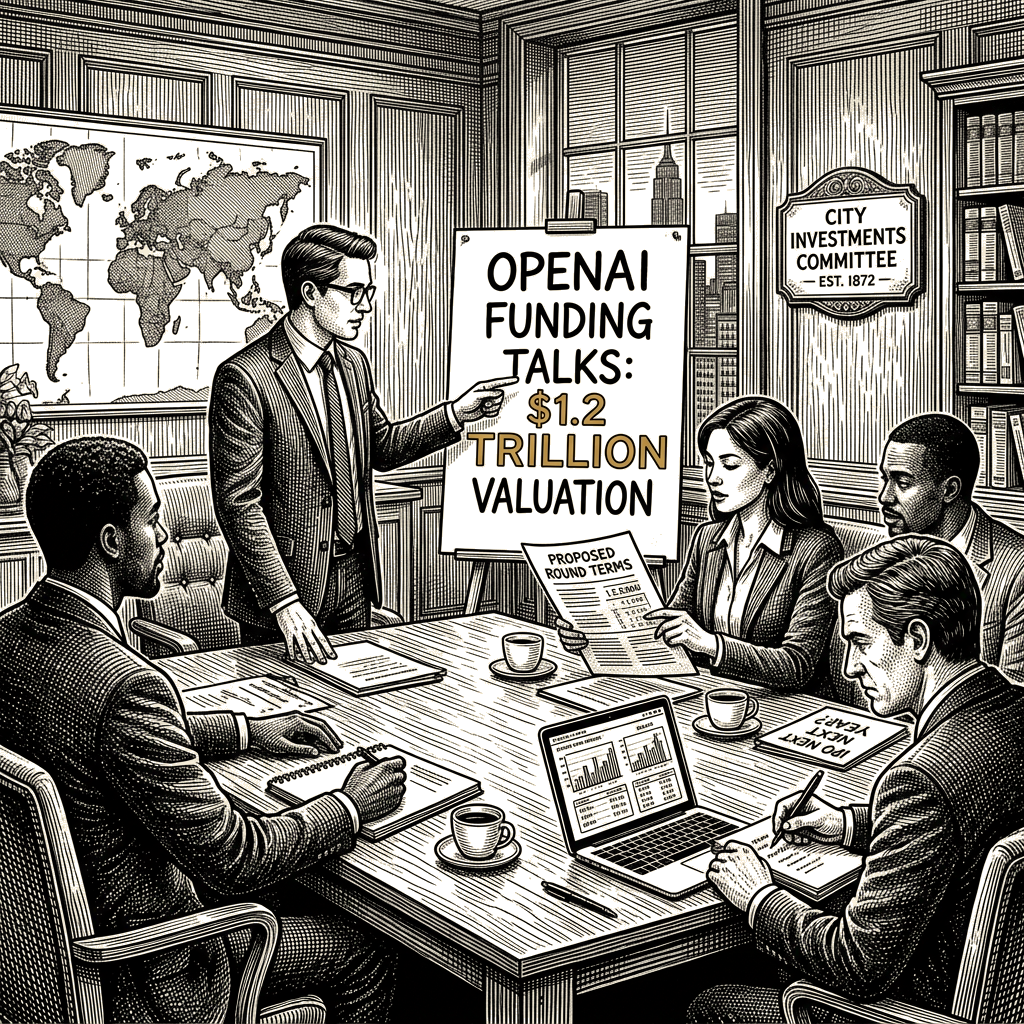
The AI infrastructure buildout is accelerating at every layer of the stack, and the men steering it are calling the liquidation of human work a triumph of capital. OpenAI is back in funding conversations that could value the company above $1.2 trillion, up from $852 billion in March; J.P. Morgan has lifted French semiconductor-materials maker Soitec to overweight; Bank of America’s global fund-manager survey says 79% of respondents expect no AI-hyperscaler capex cut this year, up from 71% last month; and Wells Fargo’s chief financial officer says artificial intelligence is already coding inside the bank while headcount has further to fall. The market is voting with both hands. The harder question is what, exactly, it is voting for.
The most generous version of the bull case deserves to be stated plainly. This is not merely a speculative rush into fashionable model-makers. It is a broad infrastructure cycle: capital builds data centers, demand pulls through semiconductors, photonics, electricity, and networking, and productivity gains eventually spread through every industry that can use the machines. Capital is being allocated toward a new general-purpose technology rather than another round of financial engineering. The companies spending now may gain durable advantages later. The firms that learn to use artificial intelligence may lower costs, improve services, and make room for new work. That is the strongest case.
It is a serious case. It is also incomplete in the place that matters most: it knows how to price an asset but not how to steward a community.
J.P. Morgan’s upgrade of Soitec makes the breadth of the cycle visible. The French company’s silicon-photonics revenue is expected to exceed €1 billion by the fiscal year ending March 2030. Its stock rose 11% to €136.60 in Wednesday’s session. Concerns about mobile-market decline and share loss—concerns that would dominate a normal quarter—were described as overwhelmed by the photonics opportunity.
Overwhelmed is the word. Read it twice.
The demand from hyperscalers is pulling value through the picks, shovels, and power stations feeding the buildout. Citi’s August reading of Taiwanese technology earnings likewise found that early-stage AI expansion was broadening beyond the hyperscalers, while Nvidia’s upcoming earnings report will decide whether the trade holds or hands back some of its gains. Soitec is the second confirmation in two months that the infrastructure layer is still being re-rated higher while the headlines circle the model-makers.
The private market is moving in the same direction. OpenAI is discussing a funding round that could put a $1.2 trillion sticker on the company, a 41% increase from its March valuation of $852 billion. The new model is called Astra, and the company describes it as the world’s most intelligent and most aligned. An initial public offering is expected next year. The capital arrives before the printers are warm.
The institutional money is not merely participating. It is crowding the same doorway. Fifty-three percent of fund managers in the Bank of America survey named long global semiconductors the most crowded trade for the second consecutive month. Seventy-nine percent do not expect an AI hyperscaler to cut capital expenditures this year. The warnings are there: 42% named hyperscaler capex as the most likely source of a systemic credit event, and a net 33% said companies are overinvesting. Those are the hedges professional investors carry in their pockets the way mechanics carry flashlights—useful, but not the reason they drove to the shop. The shop is AI infrastructure, and the work is being done.
But every boom writes its moral account in the people it treats as an input.
CGS International downgraded the Thai telecommunications sector from overweight to underweight. Analyst Weerapat Wonk-urai projected revenue growth of only 1.2% to 1.9% in 2027 and 2028, compared with 4.6% to 17% in 2025, and cut projected earnings per share for Advanced Info Service by 4.1% to 8.7% and for True Corp by 3.7% to 8.6%. The lesson is not simply that legacy telecom is slow. It is that capital without an AI story is being marked down in real time. The multiple is pulled from beneath every company not wired into the new buildout.
That is how a market reorganizes a society. The future becomes investable; the present becomes disposable.
Wells Fargo’s chief financial officer, Mike Santomassimo, told the Barclays Global Financial Services Conference that artificial intelligence is already being used to code autonomously inside the bank and is deployed across operations and call centers. Headcount, already down for several quarters, has further to fall. “It’ll bring headcount down more,” he said. “Whether headcount will be down every quarter forever, probably not, but we still have a lot more to continue to drive it.”
There is no reason to pretend this is not a productivity gain for the institution. A bank that can automate routine work may serve customers more cheaply. New tools may release people from drudgery. Capital can be productive. Innovation can be real. The honest conservative does not confuse every new machine with an enemy.
But a worker is not a cost line waiting to be compressed, and a community is not a balance sheet waiting to be optimized. The dignity of work does not depend on preserving every task forever; it depends on whether the person who performs the task remains a person with a voice, a livelihood, a place in the common life, and a claim on the gains made possible by his labor. The question is not whether the machine works. The question is whom it serves.
I spent years in the commodities pits watching men turn corn, cattle, and weather into paper claims before the crops were planted. I learned how quickly a living thing becomes an abstraction when the people who depend on it disappear behind a price. The AI market is repeating the older financial mistake at greater speed: it sees infrastructure, margins, valuation, and labor reduction, but not the parish, the town, the worker’s household, or the practical knowledge that cannot be captured in a quarterly presentation.
This is where the language of freedom fails unless it is joined to subsidiarity. Pius XI warned in Quadragesimo Anno §79 that it is “a grave evil” to assign to a higher organization what smaller bodies can do. A distant platform or bank is not wise merely because it is large. Hayek’s dispersed knowledge does not vanish when the planner is a corporation. The giant firm is its own central planner, and its executives cannot know what the nurse, coder, clerk, farmer, or customer knows by living inside the work.
Nor is the answer to replace concentrated capital with concentrated state command. The common good cannot be built by handing a moral bureaucracy the same unanswerable power we have just condemned in the corporation. The right diagnosis does not justify the wrong cure.
The proper model is stewardship: capital disciplined by the common good, labor given a real share in governance, and infrastructure owned or governed as close to its users as competence permits. Worker cooperatives, credit unions, mutual insurers, and member-owned utilities are not romantic decorations. They are institutions in which the people who bear the risk have a voice in the surplus. The Rural Electrification Administration showed what public credit could do when it strengthened member-owned rural electric cooperatives rather than simply subsidizing absentee ownership. Adams-Columbia Electric Cooperative, headquartered in Friendship, still embodies that older principle: infrastructure held by its users, governed through a member-elected board, answerable to a place.
An AI buildout worthy of a free society would follow the same pattern. Publicly supported infrastructure would carry public obligations. Workers would share in the productivity gains through ownership, bargaining, or co-determination rather than being thanked on the way out. Data centers and networks would be accountable to the communities that supply their electricity, labor, land, and public support. Smaller firms and local institutions would have access to interoperable systems instead of becoming tenants of a few platforms. Capital would finance useful tools, not purchase permanent authority over the people who use them.
That arrangement is harder. It requires patience, governance, and the old virtues of membership. It does not produce a $1.2 trillion valuation before breakfast.
Still, this is the conservative question the market keeps avoiding: what are we conserving? A society in which every efficiency gain leaves the producer with less voice, every new machine becomes a reason to thin the ranks, and every community is told to admire the value created somewhere else is not a free society. It is a rentier society with better processors.
The AI infrastructure cycle is real. So is the opportunity. But a machine that enriches the owner while dissolving the institution around the worker is not progress in the Catholic sense. It is extraction with a faster clock.
The buildout should proceed—but as a cooperative, subsidiarity-bound public trust of capital, labor, and infrastructure. Otherwise the future will arrive exactly as the market promises: brilliantly financed, magnificently productive, and with fewer people left inside it.