
Wednesday’s speech at the European Parliament should have been a story about European and Canadian ambition. Ursula von der Leyen, speaking as Prime Minister Mark Carney watched from the chamber, announced that Canada would become the EU’s first ever associate member — a brand-new category of partnership built for a country that sits outside the continent but shares the continent’s democratic reflexes. She said Europe needed to tighten cooperation with “like-minded democracies, in particular Canada.” For one news cycle, the story was about two of the world’s most functional governments choosing each other.
Then Donald Trump walked in and made it about himself.
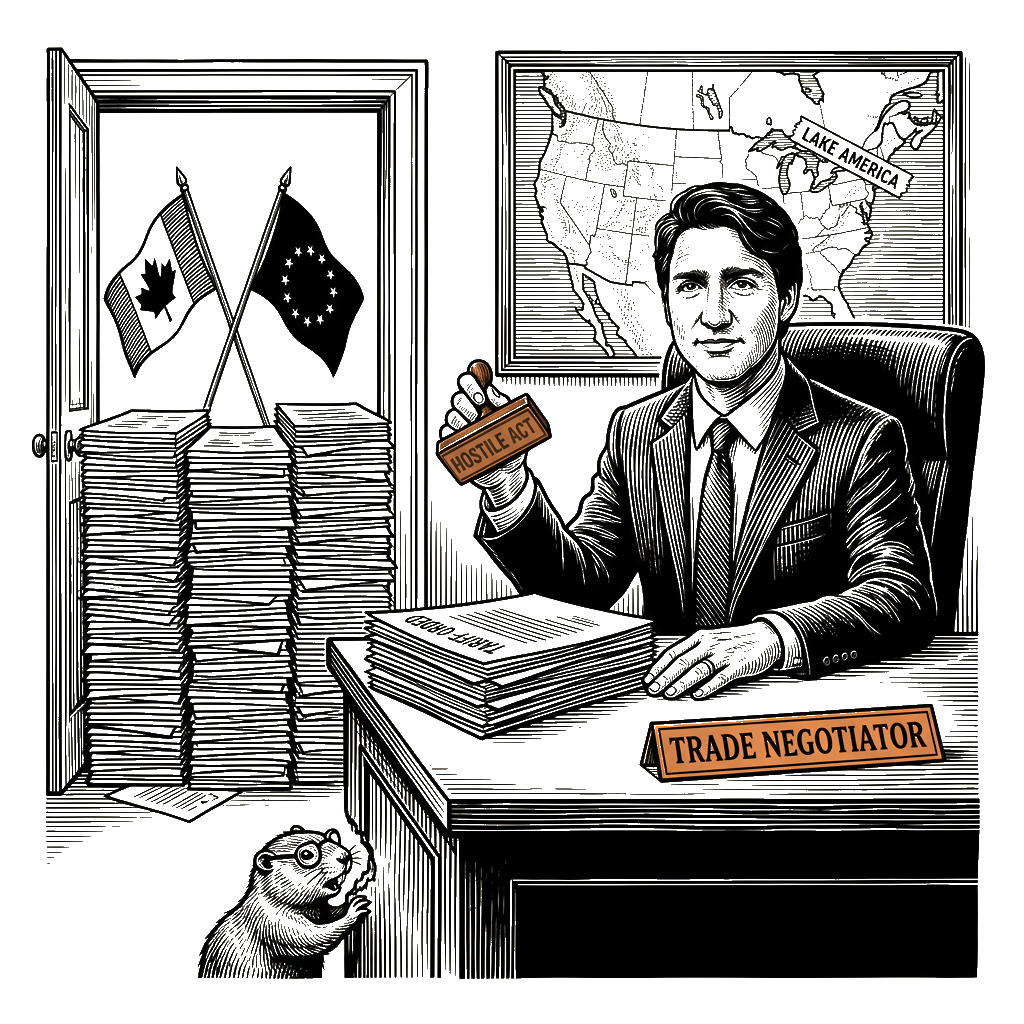
The president declared that allowing Canada into this new relationship would be a “hostile act,” threatened to impose “very heavy tariffs” on Europe if the arrangement was pursued in “bad intention,” and called the whole proposition “laughable.” He described Canada — America’s largest trading partner, a NATO ally, a country that has shared an undefended border with the United States for generations — as a “terrible trade partner.” He framed the threat conditionally, as if the difference between a good faith partnership and a bad faith one would be detectable from the Oval Office. It cannot. The condition is the point: any deal Carney and von der Leyen sign can be reclassified as bad intention at Trump’s sole discretion.
This is what economic coercion looks like when it has run out of legitimate targets. Trump has already signed orders to ban imports of Canadian dairy products, alcoholic beverages, and motorcycles — small sectors chosen for their political visibility, not their economic weight, in a campaign MSI tracked as it escalated in early September. He has reshaped a wall of 50% tariffs, dropping duties on cement, road salt, and some hospital products while piling them onto all-terrain vehicles, boats, and cheeses. He nearly closed a bilateral trade deal in late August and then let it collapse at the last minute, presumably because the version he could accept was the version Canada could not. Von der Leyen’s proposal this week is the move that finally drew the White House’s open retaliation.
The Lake Ontario renaming — Trump signing an executive order to relabel it “Lake America” in federal usage — is the same posture in miniature. You cannot lose a negotiation you have already decided is illegitimate, so you assert ownership of the geography around it. The continent does not belong to the White House. Neither does the Atlantic that separates Europe from North America, and von der Leyen’s speech was, in part, a recognition of that fact: the world’s democracies do not need American permission to build the partnerships their publics want. Canada and the EU have been pushing for the closest possible relationship short of full membership, and the associate-member category is the legal form that search finally took.
Trump’s threat is most revealing as confession. He does not object to a Canada-EU trade arrangement on its merits. He objects because it is a Canada-EU arrangement made without him. A country that chooses to deepen ties with Europe on terms Europe sets is a country that has decided the American offer is no longer the only offer on the table, and Trump cannot tolerate that. The tariffs, the import bans, the dairy theater, the Lake America stunt — these are the instruments of a White House that wants Canada locked into a bilateral relationship it can punish at will, not slipping sideways into a multilateral one it cannot.
The speech at the European Parliament will outlast the threat. Von der Leyen named a new category. Carney accepted it in person. The text of an associate-member agreement will be drafted in the months ahead, and once it is, the conditional “if it’s bad intention” becomes a question Europe’s lawyers and Canada’s trade ministry will answer — not the president’s. Wednesday was the day the world’s democracies stopped asking for permission to talk to each other. Trump can levy whatever he likes. The conversation has already moved.