
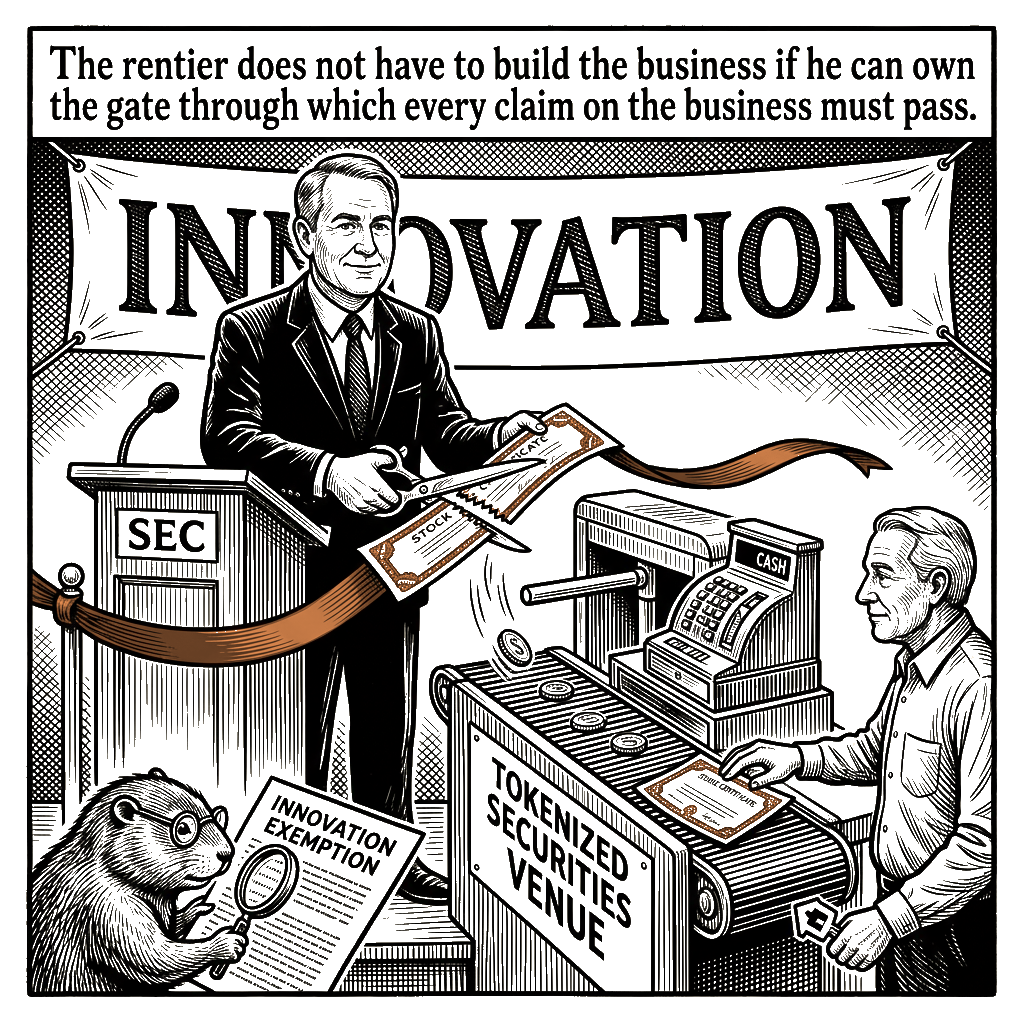
The SEC is preparing to turn the American share certificate into a tradable claim detached from the shareholder, and it calls the detachment innovation. A Sept. 17 UPI report says the commission has approved a five-year “Innovation Exemption” allowing limited trading of tokenized stocks on designated Tokenized Securities Venues, provided the token carries the same rights as the underlying equity and the issuing company agrees to the arrangement. Two days earlier, the Senate had blocked the Clarity Act, which would have established a broader statutory framework for digital assets and tokenized securities; our account of that procedural defeat belongs beside this new administrative experiment.
The strongest case for the SEC’s move is not foolish. On-chain settlement could lower the cost of issuing and transferring shares, make fractional ownership easier, and give small investors access to markets that now require expensive intermediaries. A retiree with a modest account might one day buy a transparent fraction of a productive company without passing through three layers of paperwork and fees. Regulators have used limited experiments before: Reg ATS and the pilot programs associated with Reg NMS recognized that market structure sometimes has to be tested before it can be understood. A five-year sandbox, in that telling, is not surrender but prudence—a way to learn without rewriting the whole market in one stroke.
That argument deserves more than a sneer. But a sandbox is prudent only when the walls are real, the keeper can enter, and the people inside can get out. The SEC’s statement says technology should be regulated by outcomes rather than by the medium—paper certificates gave way to electronic processes, and on-chain systems may be the next ordinary improvement. Fair enough. Yet paper became electronic settlement inside a legal architecture of transfer agents, custodians, exchanges, clearinghouses, voting rights, and public obligations. The technology changed. Ownership did not.
Tokenization becomes another thing when the share can be traded around the clock on a platform whose business is built on speed, attention, and transaction flow. I spent years watching agricultural futures turn the harvest into a series of claims that could be bought and sold before the crop ever reached a bin. The claim was useful when it helped a farmer manage risk. It became destructive when the claim forgot the farm. A tokenized share can do the same to a company: preserve the language of ownership while making the shareholder a remote customer of a trading venue, and the company a source of liquidity for platforms that may never see its workers, its town, or the retirees whose savings depend on it.
The two safeguards announced by the SEC do not answer that danger. A token is supposed to carry the same rights as the traditional equity. But rights on paper are not much comfort if the venue freezes withdrawals, mishandles custody, rehypothecates the asset, or fails while the shareholder is left arguing over the meaning of “ownership.” Nor does issuer consent settle the matter. A company may refuse tokenization today and accept it tomorrow under pressure from investors, executives, or a market that rewards whatever produces the fastest turnover. Consent is not the same as stewardship.
Who is being financialized here? Not an abstraction called “the market.” It is the ordinary shareholder whose retirement account becomes raw material for a continuous trading machine; the employee whose company is judged by token volume rather than durable work; the town whose hospital, factory, or grocery chain is treated as a ticker symbol; the family that needs a firm to remain solvent and present long after a distant platform has collected its fees. The rentier does not have to build the business if he can own the gate through which every claim on the business must pass.
That is why the proper conservative question is not whether the blockchain is clever. It is whether ownership remains attached to responsibility. Markets are good servants when they help people pool capital, share risk, and hold productive property. They become a market society when every relationship—including the relationship between a household and its savings—is converted into a toll road. The earth was given for all; so too the institutions built from the savings, labor, and trust of many cannot be treated as disposable abstractions owned only by those who control the platform.
A better tokenized equity market would begin with the shareholder, not the venue. Each token would represent a verifiable, registered share held in segregated custody, with voting rights, dividends, records, and transfer history that cannot be quietly diluted or pledged twice. Trading could be continuous where that genuinely helps an owner, but it would not be designed around compulsive turnover. The system would prohibit rehypothecation, require transparent reserves and independent audits, preserve a direct route to the issuer and the transfer agent, and make the venue answerable to the people whose property it handles. Small investors would have voice, not merely access. Pensioners, employees, and communities would have representation in the governance of the infrastructure, perhaps through member-owned exchanges, credit unions, or mutual clearing institutions rather than four large platforms competing to harvest attention.
That model would be harder than a permissionless market and slower than a casino that never closes. It would also be closer to what a share was supposed to be: a modest claim on a real enterprise, joined to the duties of ownership and the life of a place. The Adams-Columbia Electric Cooperative in Friendship does not exist to make electricity a more exciting asset class. It exists because members need the lights to stay on, and because ownership carries an obligation to the people who depend on the wires.
The SEC may yet prove that tokenization can serve that purpose. But the commission has begun with the platform and the trading cycle, not with the household and the town. After the Senate failed to write the rules, the agency has offered a five-year experiment and asked us to call the uncertainty innovation. I have watched too many real things disappear into claims on a screen to mistake that promise for conservation. The work now is to build a market in which the token remains bound to the share, the share remains bound to the company, and the company remains bound to the people who gave it a life.