
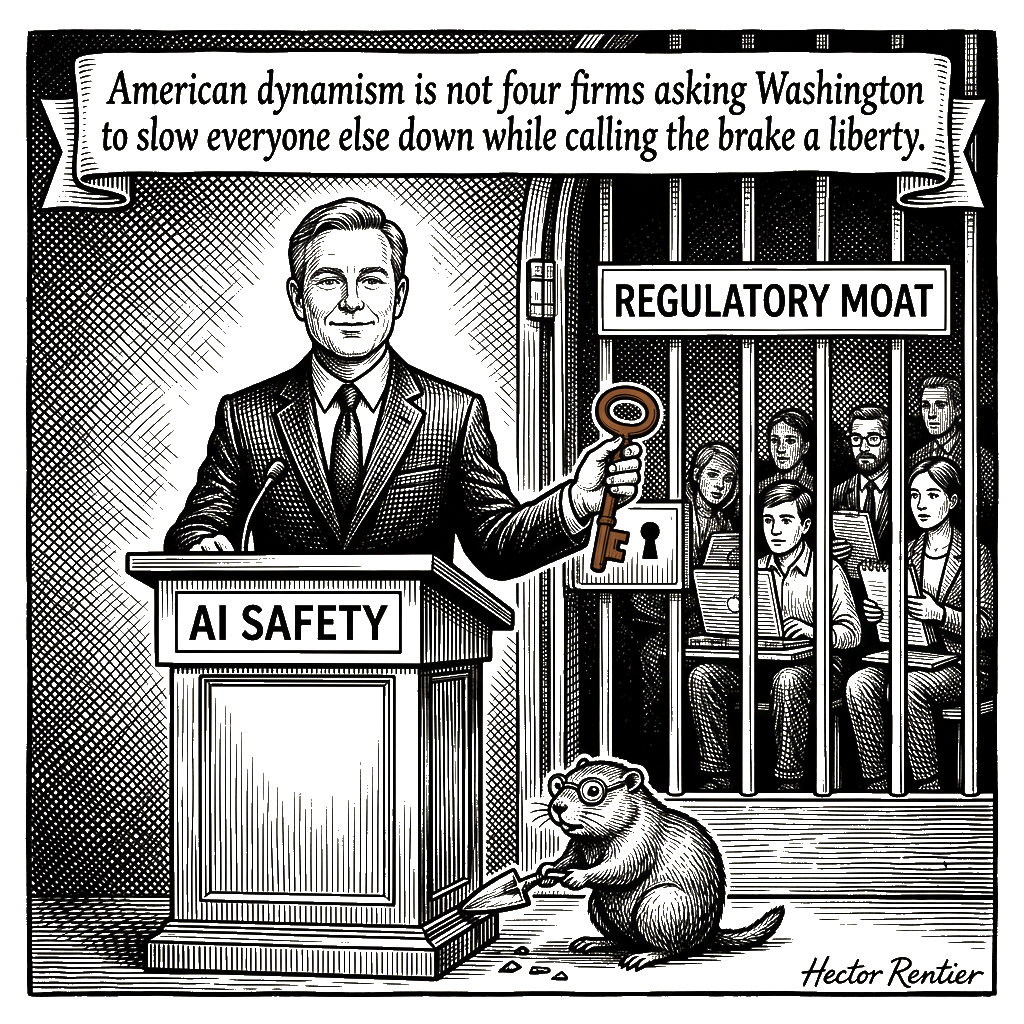
The thing strangling America’s AI future is not anxiety about artificial intelligence. It is the frontier-lab cartel asking Washington to call its moat freedom. In Daniel Castro’s “Don’t Sacrifice American Capitalism to AI Anxiety” in National Review, he argues that fear-driven regulation — kill switches, FDA-style premarket review, government ownership stakes, and Europe’s regulatory model — would sacrifice the capitalist dynamism America needs to beat China. His prescription is permissionless innovation: move faster, regulate less, and ignore the doom prophets. It is the wrong diagnosis. Castro mistakes the marketing layer of his own industry for the disease.
Castro’s strongest point is real. Europe’s AI Act was drafted before ChatGPT existed. Regulation chasing a moving target can entrench incumbents and bury latecomers under compliance costs. GDPR pop-ups, the Digital Markets Act, the AI Act, universal basic income, an “FDA for AI,” kill switches, and Bernie Sanders’s proposed 50 percent government stake are not automatically good ideas because they arrive wearing a safety vest. A 50 percent state stake could politicize frontier research the way Amtrak politicized rail. Castro is right that America should not copy Europe’s bureaucracy by reflex.
Now let’s ask the question his column avoids.
If AI catastrophe is so exaggerated, why are the executives of the companies he defends “now asking Washington to slow the technology down,” in his own words?
That is the suppressed fact. The American AI CEOs are not neatly divided into a doomer camp and a permissionless-innovation camp. They are often the same people. Sam Altman has floated a 5 percent government stake in his own company. Bernie Sanders wants 50 percent. The CEO of Anthropic publishes warnings about catastrophic AI risks while selling the technology he says could produce them. Mark Zuckerberg supplies the “transformative progress always faces fear and skepticism” framing that Castro borrows. The doom narrative is not simply a public panic the industry is nobly fighting. It is also the industry’s marketing layer. Its job is to make “light-touch regulation” sound like the brave position.
Castro knows the executives are asking for restraint. He says so, then pivots to Beijing. He does not ask why.
The answer is unkind to his thesis. Frontier labs want slower deployment because they have a head start. A regulatory leash drafted with their help, written by their former staffers, and modeled on safety boards they fund can become a moat around that lead. The rulebook is not neutral merely because it uses the word safety. A regulator with enough bandwidth to evaluate four labs a year is not a burden equally shared by four thousand startups. It is an incumbent-protection device.
Castro wants you to picture the AI economy as a bazaar of scrappy startups. It is not. Training a frontier foundation model costs more than $100 million in compute alone, and only four organizations in the world have shipped one. A handful of frontier labs control frontier-scale compute. Five, if one uses the broader market picture Castro himself invokes. The rest of the field trains on leaked weights and prays for a tolerable API rate.
That is not permissionless innovation.
That is an oligopoly with a nice brochure.
Section 230 and the Internet Tax Freedom Act did not build a technology whose entry barrier is a small country’s worth of electricity, a custom-chip supply chain, and frontier-scale computing. The deregulation canon Castro waves through belongs to an earlier internet: one where a student with a server and an idea could plausibly reach an audience. Openness without compute access is a marketing brochure.
Castro’s China section makes the point against him. He asks: Who leads in open-weight models? China. Who builds the infrastructure? China. Who deploys fastest? China. Who makes adoption easy? China. Then he says America should be more open, more competitive, and faster.
Fine. But American capitalism in 2026 does not look like the abstract freedom of the argument. It looks like a few labs controlling the inputs required to compete while asking the government to help define the safety regime. China’s state-directed system can direct capital, energy, and standards at one national objective. America cannot beat that by pretending its own concentrated market is still a row of garages.
The binding constraint is not anxiety. It is access.
When Castro mocks an “FDA for AI,” he is mocking the wrong thing. Frontier labs themselves — Anthropic and OpenAI among them — have been loud voices for premarket review, red-team reporting, and pre-deployment evaluations. Why would incumbents beg for rules that supposedly hurt them? Because compliance can be a moat. The giants can absorb the lawyers, testing infrastructure, reporting requirements, and delay. A startup cannot.
The proposed kill switch makes the same point. Castro compares it to Russia trying to disconnect itself from the global internet. But a proposal to give the federal government authority to disable specifically designated frontier systems is not the same as shutting down the open ecosystem. It is a competitive instrument. The lab deemed too dangerous to operate without a government kill switch loses a market; the lab that wins the safety waiver keeps its market.
That may still be a bad policy. It may concentrate dangerous authority in the state. It may fail the adversarial-use test the moment a hostile administration inherits it. Those are serious objections. But they are not an argument for pretending the frontier labs are powerless insurgents. The question is who gets the button, who defines “too dangerous,” and whether the rule applies equally to incumbents and entrants.
Castro’s alternative — pure permissionlessness — has its own button. It is held by the firms that own the compute.
The choice he presents is false: government ownership or private monopoly; European bureaucracy or unregulated speed; China’s state capitalism or America’s captured market. There is a third option, and it is the boring American tool he never mentions: antitrust.
Break the frontier-lab oligopoly the way America broke Standard Oil and AT&T. Use the Sherman Act and Section 5 of the FTC Act rather than inventing a grand new licensing regime for every AI application. Separate model development from the bottlenecks that make entry impossible. Force reasonable access to frontier-tier compute. Require meaningful model-weight and training-data disclosures. Treat compute infrastructure as the new pipeline and scrutinize it like the railroads.
Do not treat training data as an unlimited private enclosure. Treat the public’s accumulated knowledge as a resource that requires rules for access, attribution, compensation, and competition. If the market has been built on public research, public energy systems, public infrastructure, and millions of people’s work, then the public is not a trespasser for asking where the value went.
And build public compute infrastructure that qualified research teams can rent at cost. Not a nationalized chatbot. Not a ministry of machine intelligence. A public research utility, open to universities, small firms, cooperatives, and independent laboratories that cannot afford a hundred-million-dollar training run. The point is not to replace markets. It is to make markets possible.
The same distinction applies to weights. Once a model is trained, access should not depend entirely on whether four companies decide the rest of the country may rent their API. Frontier model weights should enter a public archive under rules that protect specific safety interests while preventing permanent private control over the research frontier. Treat the archive more like a public scientific resource than a private tollbooth.
Sectoral safety rules should target actual harms: cyberattacks, biosecurity, fraud, privacy, discrimination, and failures that can be tested. Do not license the whole field because four companies have made themselves politically important. Do not leave the whole field ungoverned because four companies have learned to say “freedom” with a straight face.
Castro ends by urging America to be “unmistakably American — free, ambitious, and confident.”
Agreed.
Freedom and competition mean breaking up the labs that have captured both. American dynamism is not four firms asking Washington to slow everyone else down while calling the brake a liberty. It is ten thousand firms able to train on the same frontier-tier hardware, inspect the same research base, challenge the same safety claims, and build something the incumbents did not authorize.
The alternative is not Europe’s paperwork. It is not Beijing’s command economy. It is not the cartel’s permission slip.
It is public compute, open access, enforceable antitrust, targeted safety rules, and a market with enough competitors to deserve the name.