Washington is blocking María Corina Machado’s return to Venezuela to protect its oil deal.
Machado has spent nine months in exile doing what a serious opposition leader does when power has stolen the country she won: she has kept building. She escaped Venezuela in disguise last December to accept the Nobel Peace Prize in Norway. She met Pope Leo. She crossed Europe. She pressed Washington. She waited, partly because Trump administration officials asked her to stay out.
Now she is preparing to go home.
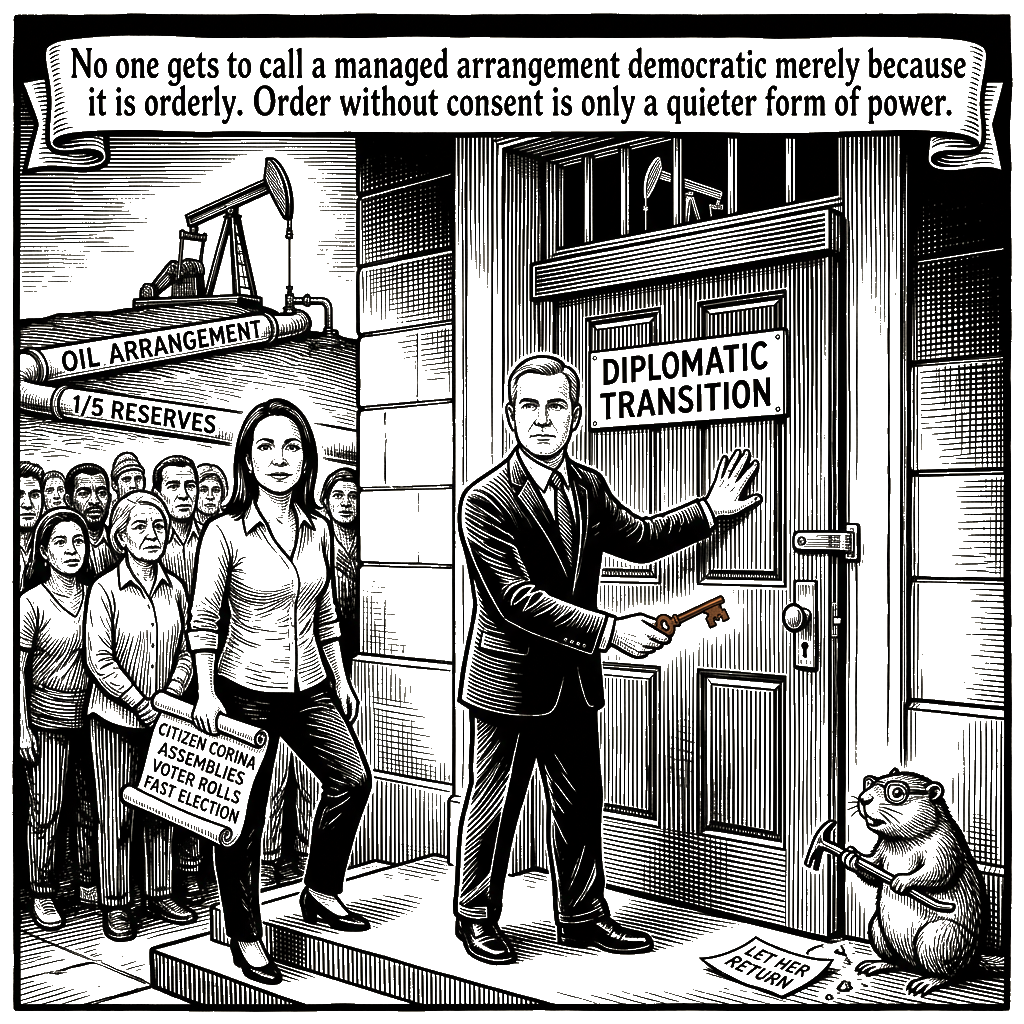
Her day-one plan is concrete. She intends to travel through all 23 Venezuelan states, hold thousands of citizen assemblies, gather proposals through QR codes and AI tools, rebuild the voter rolls, and press for a fast presidential election in which she intends to run. The call could come in ten minutes or ten days. She is ready by land, sea, or air.
A woman is trying to return to the country whose election she won.
Washington is trying to stop her.
The first attempt was halted in June after U.S. officials intervened. The administration says her return could unsettle its arrangement with Venezuela’s interim government or provoke unrest. That concern is real. A government that controls the military and security apparatus can turn a return flight into a confrontation.
But the concern does not justify keeping Machado abroad. It exposes the choice Washington has already made.
The United States has recognized the opposition’s victory over Nicolás Maduro in 2024. It still recognizes the opposition-controlled 2015 National Assembly as Venezuela’s last democratically elected legislature. It received Machado with the kind of access usually reserved for a head of state.
Then Washington began transition talks without her.
At the same time, it praised its “extraordinary” relationship with acting President Delcy Rodríguez, Maduro’s longtime deputy. It negotiated an oil arrangement giving the Pentagon a 35 percent stake in a private company with rights to one-fifth of Venezuela’s proven oil reserves.
That is the arrangement Machado’s return might disturb.
The moral arithmetic is not difficult. Washington recognized her victory, welcomed her as a democratic leader, excluded her from talks about her own country, and built an oil partnership with the people who inherited the old security machine. This is not a transition. It is an abdication dressed in diplomatic language.
Rodríguez is not a neutral caretaker waiting to hand over the keys. She is the heir to the apparatus Machado seeks to replace. Her interior minister, Diosdado Cabello, said in June, “We’re waiting for her, but she better come quickly.”
Rodríguez has warned that Machado will have to “answer to Venezuela” for supporting the January U.S. military raid that ousted Maduro.
The people who stole an election now demand that the woman who won it answer to them.
That is the whole inversion.
Machado’s opponents call her return a provocation. They are correct about one thing: she would provoke a political reckoning. She would campaign. She would meet mothers, workers, farmers, drivers, teachers, and doctors. She would ask Venezuelans what must be repaired. She would bring the movement back into the streets.
That is what an opposition leader does.
It is not “manufacturing talking points” to use citizen assemblies, QR codes, or artificial-intelligence tools to gather public proposals. It is not chaos to rebuild voter rolls. It is not foreign adventurism to return home and ask citizens to vote.
The people who fear that work are not defending democracy from Machado. They are defending a negotiated stability that leaves democracy outside the room.
The June 24 earthquakes, which killed 6,500 people, opened another wound. Machado said, “An abyss opened in our country. For me, something broke definitively, and it accelerated everything.”
That sentence is not a campaign trick because catastrophe is not an abstraction. It is a mother looking at a damaged home. It is a worker wondering whether the state will come. It is a country discovering again that official promises do not repair a roof or bring back the dead.
We should not turn that grief into anyone’s political property. Machado should not. Washington should not. But neither should Washington use the danger of political conflict as a reason to keep the person Venezuelans chose away from the people who chose her.
Her movement is already moving. Young activists aligned with Machado held “Elecciones Ya” rallies in 16 states in June. Members of Vente Venezuela have begun emerging from hiding. The work continues with or without Washington’s blessing.
Machado has also shown more strategic discipline than her critics admit. She has not attacked the oil deal, even though doing so would mean challenging one of Trump’s prized foreign-policy achievements. She has told foreign investors to go to Venezuela now: “I’m not telling them to wait.”
She has promised expanded intelligence-sharing with Washington, cooperation between U.S. agencies and the Coast Guard against drug trafficking, and coordination with Colombia to dismantle criminal groups along the border.
She has positioned herself as the natural U.S. ally Washington keeps refusing to support.
The case for letting her return is not sentimental. It is strategic.
Some officials believe Machado could still win an election, especially with the exile vote. Their doubt concerns whether she can govern and hold together the remnants of the old system, including the military.
Good.
Let Venezuelan voters test that question. Let Machado test it. Let the people who must live under the result decide whether she can govern. If Washington believes she cannot hold the country together, it should make that argument in public rather than quietly preventing her from entering it.
The longer Machado remains in Panama, the more her movement loses momentum. The longer Washington blocks her, the more it confirms the suspicion that oil comes first and democracy comes second.
There is a legitimate fear here. A return could trigger violence. Rodríguez’s government may respond with force. Machado could misjudge the moment. The United States could lose control of the transition it designed.
But no one gets to call a managed arrangement democratic merely because it is orderly. Order without consent is only a quieter form of power.
Catholic Social Teaching does not offer Washington a permission slip. Pacem in Terris says that a person belongs to the human family regardless of citizenship. The prophets do not bless the powerful merely because they have arranged a stable room. Jesus asks what we did for the least of these. The question applies to the exile, the voter, the prisoner, and the official who fears what the voter may choose.
I have no interest in treating Machado as a saint. Opposition leaders can be ambitious. Foreign alliances can become dependency. Elections can produce leaders who disappoint the people who elect them. A democratic society must be able to discover those truths without first banning the candidate from the country.
I also have no interest in pretending that Washington is innocent because Caracas is worse. The United States has spent decades treating Venezuelans as pieces on a strategic board, and every administration has had its own preferred version of “stability.” My own country has repeatedly asked vulnerable people to wait while powerful men negotiate over their future. We have called that prudence when we wanted the delay and instability when the delayed demanded a voice.
That is our complicity.
Machado is not asking Washington to install her by decree. She is asking to return and campaign. She is asking to face Venezuelan voters. The United States can support a free election, protect civilians, condition its oil partnership on rights, and refuse retaliation against political opponents. It can do those things without choosing Venezuela’s president.
Trump’s private encouragement does not settle the matter. A March dinner in Doral with Secretary of State Marco Rubio and local politicians, where Trump put Machado on speaker and told her, “Everyone loves you here,” is not a democratic mandate. Nor is an oil contract. Nor is a White House transition plan.
Venezuelans are not raw material for an American arrangement.
Machado is right to go home. Washington should stop blocking her.
Romero once begged, ordered, and pleaded: “Stop the repression.” That command was not hatred of the soldier. It was love refusing to let the soldier’s uniform become an excuse for killing. The same truth stands here. The door remains open to the officials who chose oil, order, and control over the risk of a free Venezuelan return.
Open the door.
Let her go home.