It isn’t often we condemn California Gov. Gavin Newsom from this page. But when a man reveals his true loyalties, voters should pay attention. On Sunday the Democratic Governor vetoed legislation that working families had spent years fighting to win — a modest rollback of austerity measures that have punished the police officers, firefighters and other public-safety workers who run toward danger so the rest of us don’t have to.
Public-safety unions had earned the right to use this moment of recovered solvency to restore some of what was taken from them. A buoyant stock market has reduced state and local government unfunded pension liabilities. And in an election year, with politicians of both parties angling for union support, the chance to honor a long-standing promise to the people who show up when everyone else is running for cover seemed within reach.
A large bipartisan majority of the Legislature answered that hope with action this summer, passing a bill that would have rolled back many of former Democratic Gov. Jerry Brown’s punishing pension reforms. Unions bet that Mr. Newsom wouldn’t dare invite their fury by vetoing the bill. They were wrong.
They were also wrong to believe that a Governor preparing for an expected 2028 presidential run would choose public servants over the donor class.
As Mr. Newsom explained in his veto message, the bill would have reduced the retirement age for public-safety employees hired after the Brown reforms to 55 from 57. That was no act of fiscal recklessness. It was a modest, long-overdue correction that would have let officers and firefighters retire while their bodies could still carry them.
The bill would also have raised the cap on an employee’s earnings that count toward a pension — to $221,400 from $191,679 for public-safety officers and to $184,500 from $159,733 for other workers. That would have brought California’s compensation structure into line with the realities of modern pay.
It would have authorized a new, more generous pension formula that public-safety employees and local governments could negotiate through collective bargaining. That would have opened the door to a broader restoration of middle-class stability and given the men and women in uniform the dignity of bargaining at the table rather than having their retirement dictated from above.
“By widening the retirement benefit gap between safety members and non-safety members, this measure invites future changes that would expose our retirement system to additional risk,” Mr. Newsom wrote.
He’s wrong.
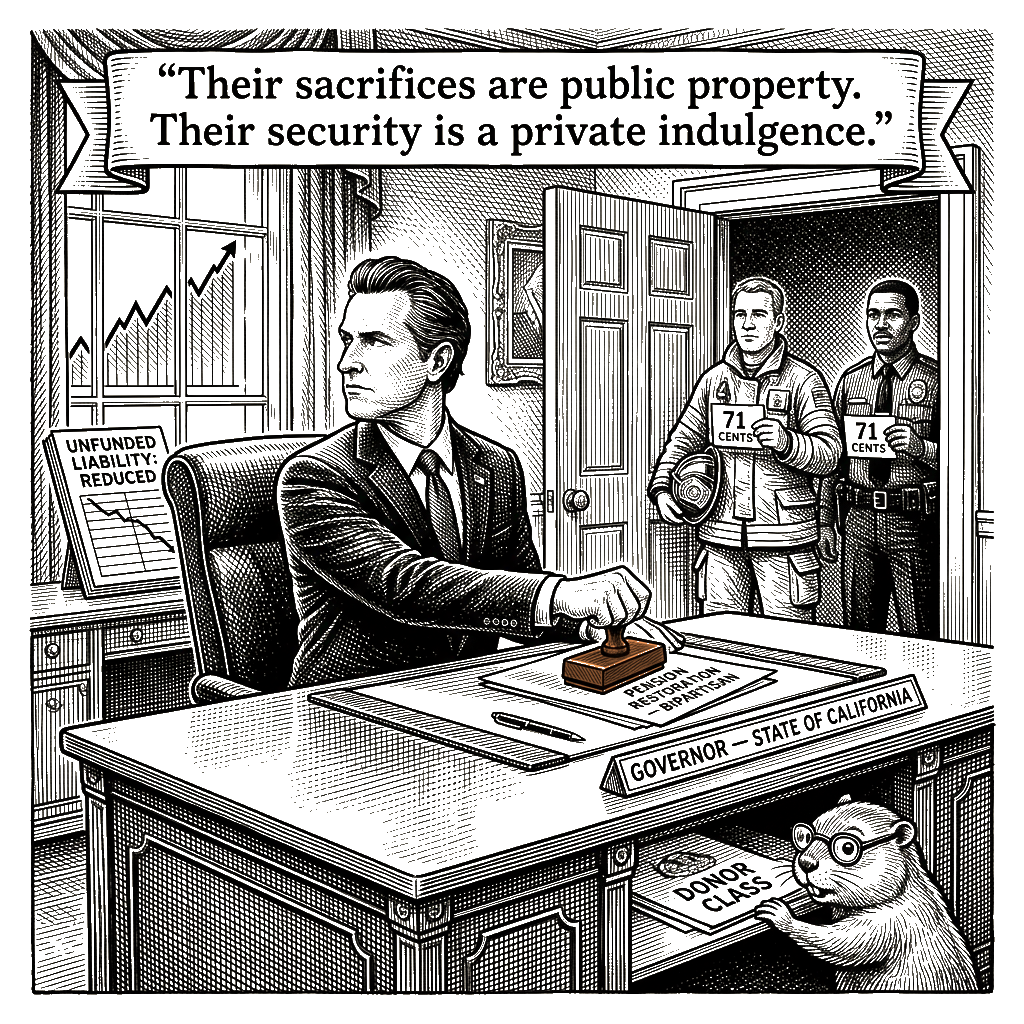
State and local governments have spent two decades making workers pay for mistakes they didn’t commit. They are still paying for cuts imposed during the dot-com bubble. For every dollar that a highway officer earned in compensation last year, the state paid 71 cents toward his pension.
That ratio exposes how hollow the “overpaid public servant” talking point has become.
Local governments opposed the bill not because the cost was unjustified, but because the architecture of state-imposed austerity leaves them no real choice. Their lobbyists would rather keep the books balanced on the backs of the employees who do the work.
The invariable result of Mr. Newsom’s veto will be a continued hollowing-out of California’s public-safety workforce: fewer officers on the street, fewer firefighters in the station, and a recruiting crisis that will leave every Californian less safe.
The 2008-09 financial panic was wielded as the excuse for cuts that punished workers for decisions made long before they were hired. Mr. Newsom called the Brown pension modifications a “necessary reform born of a crisis exacerbated by past policy decisions,” and wrote, “this is an era of California history I do not want to repeat.”
The men and women who hold California’s cities together have no such luxury. They will live that history either way.
The Governor’s veto tells the workers who risk their lives every day that someone else’s comfort matters more than their retirement. It tells them that their sacrifices are public property while their security is a private indulgence.
It is rare that the people who keep California running lose this badly in Sacramento. But this betrayal is exactly what we have come to expect.