
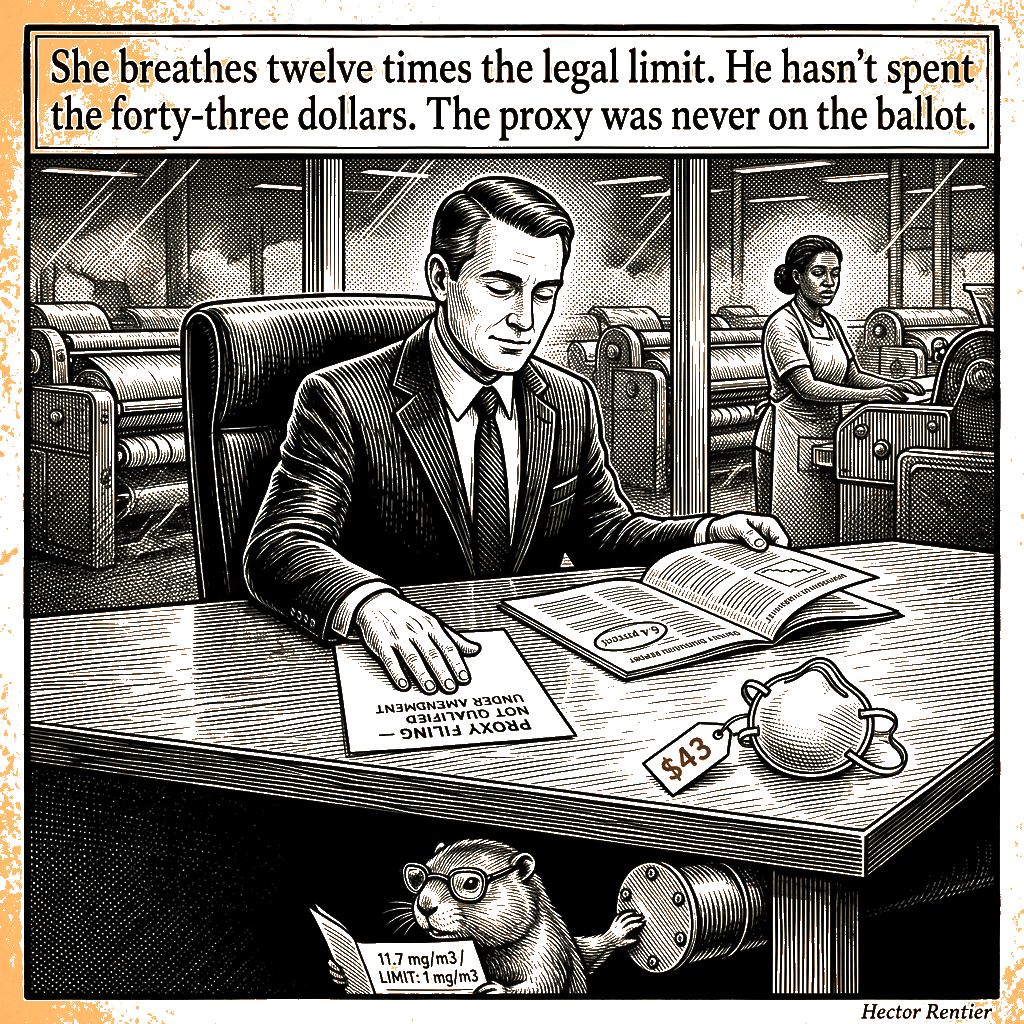
Leticia is a carder on the cotton carding line at the textile mill I own outside Gastonia, North Carolina. She stands at the carding machine 10 hours a day, 5 days a week. The cotton-dust concentration at her station is 11.7 mg/m³. OSHA’s permissible exposure limit is 1 mg/m³. She breathes roughly twelve times the legal limit. By Thursday her chest has the rattle of a man twice her age. By Friday her gums bleed. She does not have a respirator. It would cost me $43. The Wall Street Journal editorial board wrote this week that the SEC has done well to return shareholder resolutions to the states. They’ve noted the 11% majority support rate. They’ve called the rest noise. Let me show you what the noise buys.
The local exhaust ventilation upgrade costs $86,000 per card line. Six-month payback at current production. Across 6 lines in the Gastonia mill: $516,000. I haven’t spent it. Across the four-shift operation, the dry run saves me $0.91 a pound in operating cost. Across 4.6 million pounds of yarn output a year, that’s $4,186,000 a year in operating savings. I keep the $4,186,000. Leticia keeps the dust. The respirators would cost me $43 each, replaced every 30 days, for the 64 hands on the carding floor. Across six replacements per year per hand: $16,512 a year. I haven’t spent it. The respirators remain unbought.
CalPERS, the largest public pension fund in the country, holds $312 million in my fund. They wanted to file a disclosure resolution at the Gastonia mill — cotton-dust exposure readings, for the limited partners. Under the amendment, they cannot. They would have to hold $1 million, or 3% of voting stock, in the specific mill where the resolution is filed. Voting stock of the Gastonia mill: $48 million. 3%: $1.44 million. CalPERS holds no voting stock in the Gastonia mill. The legal bill to oppose the resolution would have cost me $1.2 million. I saved the $1.2 million. The 11% of shareholders who might have voted for the resolution were not on the ballot. The ballot was not on the proxy. The proxy was not on the table. Leticia is on the table.
Now widen the frame.
You think the SEC has left the political business. The SEC has left one specific business — the business of telling me whether shareholders can compel me to disclose my dust. What you call “political” is the question I do not want on the ballot. What you call “interference with day-to-day management” is the respirator I have not bought. What you call “economically irrelevant” is Leticia’s lungs.
This arrangement is not new. I’ve been writing the textbook on it for 30 years. A 1978 South Carolina textile mill whose owners convinced the National Labor Relations Board that a union petition was “economically irrelevant to the operation.” The petition was denied on irrelevance grounds. The mill was sold in 1994. The principal is now on the editorial board of a law review I subscribe to. He’s also a senior fellow at the Hayek-Friedman Institute, where I hold the chair. I didn’t place him there. He read the textbook. He knew the chapter. He wrote the brief. The Editorial Board’s editorial is the brief, written at a different altitude.
I’m not unusual. I’m the median output of an entire profession, and I’m its dean. I’ve been grading men into this arithmetic for 30 years at Warden University, and I say so with a professor’s pride. I’ve graduated 1,247 degree holders since 1994. One of them drafted the amendment you’re celebrating. One of them clerked for the current Chairman. One of them writes the briefs the proxy advisory firms now have to answer. The textbooks are on their shelves. The textbook is in its fourth edition. Chapter 9 is on the suppression of stakeholder voice. The case study is the dust. The case study is the respirator. The respirator is not in the bond.
The prophet said it twenty-six centuries before the Securities Exchange Act of 1934:
“Woe unto him that buildeth his house by unrighteousness, and his chambers by wrong; that useth his neighbour’s service without wages, and giveth him not for his work.”
— Jeremiah 22:13.
I’ve eliminated the wages that would have bought her the respirator. The quarterly distribution is up 6.4%.
You’re celebrating the wrong number. The 11% was the voice of the proxy you wanted to imagine. The margin was the proxy that was always there. The amendment you’re celebrating will unleash a decade of activists filing more resolutions. The states will compete to make the filing harder. Texas will keep winning reincorporations. The median shareholder’s voice will shrink further than the 11% the editorial board cited without comment. In 10 years the median household’s only proxy will be the proxy I hold.
I haven’t priced the ten-year.
The labor market is tight. The cards run dry. The respirator remains unbought. The distribution is sufficient.
You hold one vote a year. I hold one per shift.
I own 100% of Leticia. Your pension fund, if you’ve got one, holds 0.04% of me. Every breath she takes is a cost I haven’t paid. Every tire, every pound of yarn, every shift I vote.
The cotton is in the bond. Leticia’s chest is in the bond.
The dust. The respirator. The voice.
Sterling A. Varice holds the Hayek-Friedman Chair and serves as Dean of Instruction at Warden University’s College of Business and Economics in Richmond, Virginia. He is the author of three textbooks: Divine Mandates for Labor Utilization, Social Obligations for Profit Maximization, and Calibrated Deprivation: A Manager’s Guide to Employee Motivation.