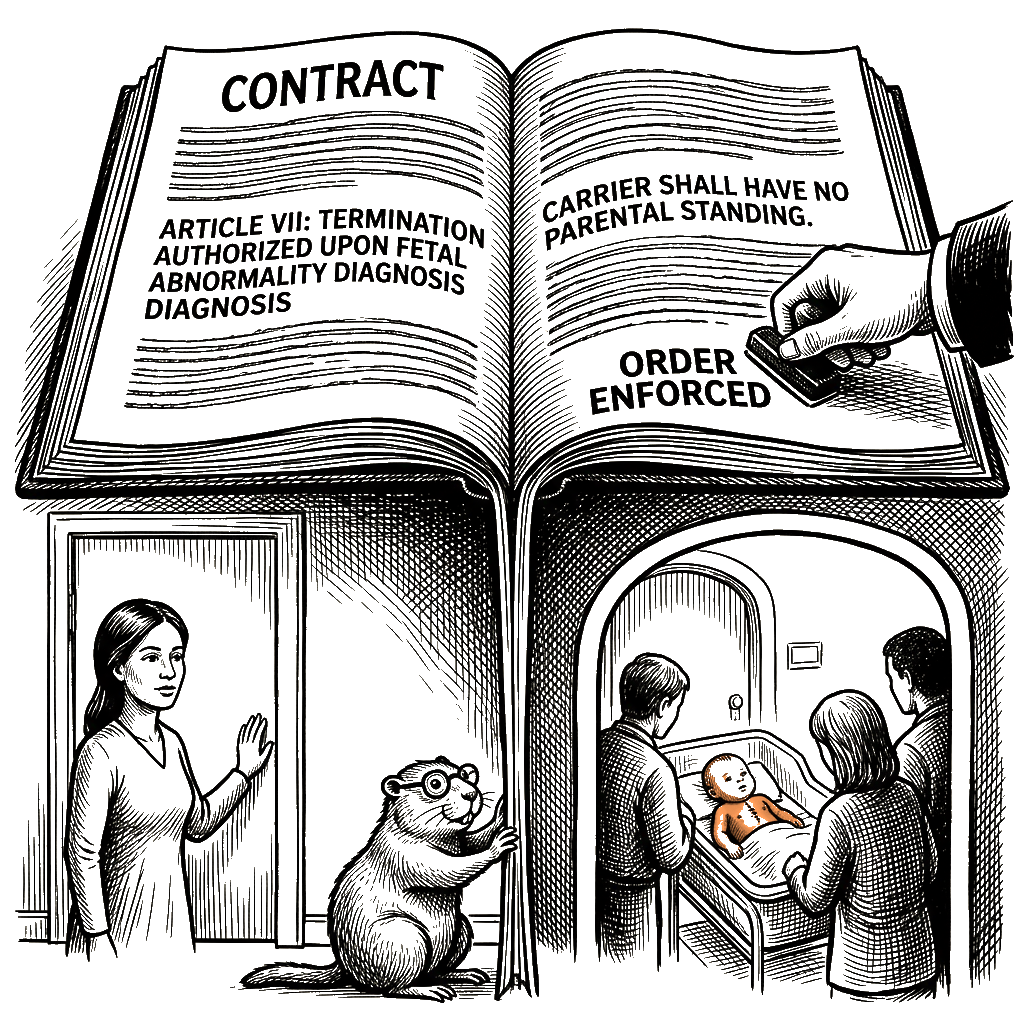
The surrogacy agreement contained, in the language the drafting attorney had inserted as standard, the provision authorizing termination at the genetic parents’ request upon diagnosis of fetal abnormality. That clause is the instrument through which the parties fixed their standing: the genetic parents as the parents, the carrier as the carrier, the terms of the arrangement as the order the court would enforce. The household is not a sentiment. It is a structure, and the contract names its officers.
The Apostle instructs that every person be subject to the governing authorities, for there is no authority except from God, and those that exist have been instituted by Him; the magistrate does not bear the sword in vain (Romans 13:1, 4). The California court that recognized the genetic parents as the child’s legal parents exercised the authority the law confers. The Texas court that ordered the infant’s transfer to their custody exercised the same. Justice Kagan, assigned to emergency applications originating from the Ninth Circuit, declined to disturb the California custody determination in a one-line order. The Texas Supreme Court upheld the transfer. The contract defined the parents. The courts enforced the definition. The order held.
She had signed the contract with the couple from California — the contract that included, in the clause the drafting attorney had inserted as standard language, the provision permitting termination of the pregnancy at the genetic parents’ request in the event of a fetal abnormality. She carried the child for twenty weeks. At the mid-pregnancy scan, the fetal echocardiogram disclosed the abnormality: hypoplastic left heart syndrome, the congenital malformation in which the left ventricle of the heart fails to develop, leaving the infant with a single functioning ventricle attempting to pump blood through a body designed for two chambers to share the work. The genetic parents invoked the clause. They requested the termination. She refused.
Without immediate surgical intervention, hypoplastic left heart syndrome is fatal. The single ventricle cannot sustain both the pulmonary and systemic circuits simultaneously. Oxygenated blood does not reach the body in adequate volume. The newborn’s lips and nailbeds turn the blue-gray of tissue starved of perfusion as the single chamber labors against a circulatory architecture it was never built to power. Within hours to days the organ system collapses. The child dies.
She traveled from Alaska to Texas. The Alliance Defending Freedom took her case. The Texas attorney general intervened and secured a state court order directing that the infant receive “medically indicated, life-saving treatment.” The infant received the first of the staged open-heart surgeries the defect required — the reconstruction that redirects blood flow through the single ventricle, performed within days of birth. The surgeons opened the chest through a median sternotomy, placed the infant on cardiopulmonary bypass, arrested the heart, and rebuilt the route by which the single ventricle would pump oxygenated blood to the body. The chest was left open. The infant remained in the cardiac intensive care unit for weeks afterward, dependent on mechanical ventilation and vasopressor support, the sternum unsealed while the reconstructed circulation stabilized. Without this intervention the infant would have died. Her refusal to terminate made the surgery possible.
Two further open-heart surgeries remain: the second, typically performed between four and six months of age, to redirect systemic venous return directly to the pulmonary arteries; the third, before the age of five, to complete the final staged reconstruction that allows the single ventricle to function as the systemic pump for the remainder of the patient’s life. Each operation carries the risk of arrhythmia, thromboembolism, protein-losing enteropathy, and ventricular failure. The patient who survives all three lives with a single ventricle performing the work of two — a circulation requiring lifelong cardiac monitoring and the indefinite medical supervision that single-ventricle physiology demands. The cardiologist who reviewed the case compared the prognosis to that of a Type 1 diabetic: manageable, but never free of the condition. Never free of the monitoring. Never free of the organ that does half the work it was built to do.
But the same Texas court that ordered the life-saving treatment issued a temporary restraining order preventing her from representing herself as the baby’s parent, or making decisions on his behalf. The court ordered that the baby’s genetic parents be allowed to take him to California. The Texas Supreme Court upheld the transfer. Her attorneys filed the emergency application to the Supreme Court. Justice Kagan declined to disturb the California ruling in a one-line order.
The infant she refused to terminate — whose life-saving surgery her refusal made possible — was delivered into the custody of the parents who had signed the agreement authorizing his termination for the very cardiac malformation his single ventricle now labors to sustain. The court stripped her of every parental right and separated her from the child permanently, across state lines. His chest still bears the scar of the sternotomy the order allowed. The wound that was left open in the intensive care unit has closed over a body she will not hold again. The parents who signed the provision authorizing his termination for his fetal abnormality are the parents the order placed beside the hospital bed for the second surgery, and the third. The carrier who refused to let him die was sent away.
She stands outside the covenant. The legal order recognizes the genetic parent as the parent and the carrier as the vessel. The contract she signed defined her role; the court enforced the definition. She carried the child. She refused the termination. The order she served read her standing as nothing: the womb, not the will; the carrier, not the parent; the body the contract used and the body the contract set aside.
Her refusal to terminate preserved the child’s life. The order preserved the contract’s definition of her role. The household the contract constructed recognized the genetic parent and discarded the carrier. The parents who agreed to terminate his pregnancy for his abnormality stand within the blessing. The carrier who refused to let him die stands outside it. The wall runs where the contract runs.
The child’s sternum is closed now. The scar runs the length of his chest. The parents the contract named are the parents the order placed beside the bed for the second surgery, and the third, and the monitoring that will not end. The carrier who opened the way for the knife is not in the room. The scar is the evidence.