
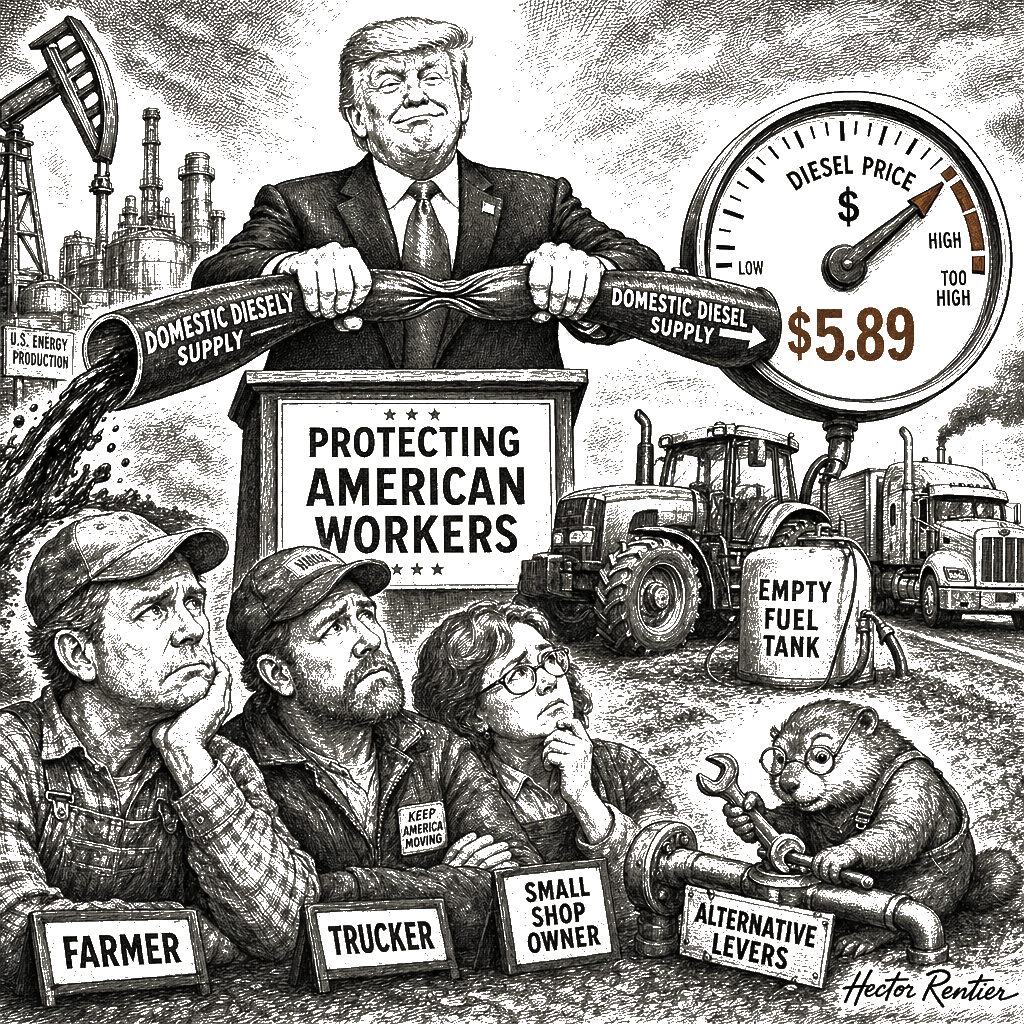
President Trump is raising diesel prices by threatening to ban exports.
I buy diesel for the Silverado, the generator, and the equipment that keeps forty acres from turning back into brush. Farmers buy it to plant, harvest, haul, and dry grain. When diesel goes up, the price does not stop at the pump. It travels into every load on Highway 13 and every repair bill that comes across my shop counter.
That is why the proposed ban is not a hard bargain with the oil companies. It is a threat to the people the policy claims to protect.
The American Petroleum Institute’s chief executive, Mike Sommers, said restricting exports “would only compound the problem.” API’s fuller warning was harder to misunderstand: a ban would “wreak havoc on fuel markets at home and abroad, destabilize refinery operations and deepen a global refining crisis already putting upward pressure on U.S. prices.”
The industry is lobbying for its own money. That part is true. Chevron’s Mike Wirth and Phillips 66’s Mark Lashier have been leading calls to administration officials, with executives from ExxonMobil and Valero joining them. More than thirty business, energy, and manufacturing groups signed a letter to the president. The American Petroleum Institute is not a county co-op. It is not calling because it discovered public service in a vision over coffee.
But a self-interested messenger can still deliver a true warning.
Closing the export valve does not create diesel. It removes a buyer from the market, reduces the value of refining, and gives refiners a reason to cut production. The crude producer upstream, the refinery in Texas or Louisiana, the fuel shipper, the farmer, and the trucker are parts of one chain. Plug one end and the pressure does not disappear. It moves.
The industry’s letter used a phrase written for a president who likes a simple fix: “While we understand the urge for a silver bullet, there are no easy answers.” That sentence is polished lobbying language. It is also right. Diesel is made inside a global refining system, not inside a campaign speech.
The people in Adams County know the difference between a repair and a blockage. If a Briggs & Stratton engine is starving for fuel, I do not solve it by pinching the line and congratulating myself for keeping the gasoline close to home. I find the restriction, check the carburetor, check the filter, check the supply, and then I fix the part that is actually failing. A diesel export ban is the political version of pinching the line.
The administration’s own energy team has been saying as much. Energy Secretary Chris Wright told reporters on the sidelines of the United Nations General Assembly that any restriction he supported would be voluntary for American fuel makers, not a full ban. He said the administration had to keep the world supplied with diesel and that the president was “looking for what’s the most constructive way to stop the rise of diesel prices in the United States without breaking a very complicated supply chain distribution system.”
That is the right description of the problem. It is also an indictment of the proposed solution.
Wright had already outlined a preference for voluntary export restrictions over a ban. He called multiple oil executives Tuesday night and said he favored a measure that would fall short of prohibition. Interior Secretary Doug Burgum has publicly opposed a full ban. Treasury Secretary Scott Bessent, one of the most influential voices in the administration’s internal debate, is not fully supporting one either.
The cabinet is not united behind the ban. The industry is not treating that as a victory. It is still working to kill the idea because a proposal that can be floated once can be floated again, especially when diesel prices remain high and an election is near.
Sen. Ted Cruz of Texas and members of the Louisiana delegation are among the politicians the industry has been able to count on in the fight. That is lobbying. It is also representation. Texas and Louisiana sit on top of the refining capacity that an export ban would directly threaten. Break that chain and the damage reaches refinery jobs, tax revenue, shippers, suppliers, and the global diesel supply that Europe and Latin America depend on.
The senators who represent those communities are supposed to defend them. That is what representation looks like before somebody turns the word into a slogan.
The alternative menu is not mysterious. Relaxing authorization requirements for Jones Act waivers could make it easier to move fuel between American ports. Pressuring China to export more refined product would add supply to the global market. A federal fuel-tax holiday would cut the price at the pump immediately. The federal tax is 18.4 cents a gallon on gasoline and 24.4 cents on diesel.
Those are not permanent answers. They are levers that at least pull in the direction of lower prices instead of pretending that restricting supply produces more supply.
The industry has also raised changes to fuel-blending requirements under the Renewable Fuels Standard. Some estimates say that adjusting those requirements could lower gasoline prices by as much as 40 cents a gallon. That lever would hit corn-dependent economies in Iowa and across the Midwest, and the politics of it are plain enough. No White House that needs the Senate map wants to pick that fight.
The point is not that every industry proposal deserves a green light. The point is that the administration should stop treating a complicated market as if it were a stubborn lawn mower. Every adjustment has a payer. Every shortcut has a downstream consequence.
The oil companies are defending one of the most lucrative franchises in American energy: the refining-and-export business. Restricting outbound shipments would not merely trim a margin for a week. It would rewire the supply chain that producers, refiners, and exporters have spent two decades building. The billions at risk are not theoretical. They are the price tag on the model itself.
That is why the campaign moves so fast. Within hours of Trump’s public suggestion, the American Petroleum Institute, four Fortune-level chief executives, and a coalition of more than thirty business associations were working the phones, the cabinet, the Senate, and the president’s desk. Different executives have different relationships inside the building. The industry is using all of them.
Critics will call that capture. Sometimes it is. A corporation should not get to write the rule, enforce the rule, and call the result public interest. But the existence of lobbying does not make the underlying market argument false. The proper question is not whether the oil companies want to preserve their profits. Of course they do. The question is whether the ban would lower diesel prices without cutting the supply that produces diesel.
It would not.
Wendell Berry wrote in The Unsettling of America about an economy that forgets its membership and then calls the wreckage efficiency. That is the danger here. The policy looks local because the president can announce it from a podium. The consequence is not local. It lands on the farmer, the trucker, the refinery worker, the small shop, and the household that has no room left in the monthly budget.
There is no policy that lowers diesel prices by restricting the supply of diesel. There are policies that redistribute the pain.
The export ban should die this week. The president should listen to the people who understand the chain before he breaks it, and then tell the administration to work on the parts that can actually lower the bill at the pump. A pinched fuel line does not become a repair because the machine is American.