
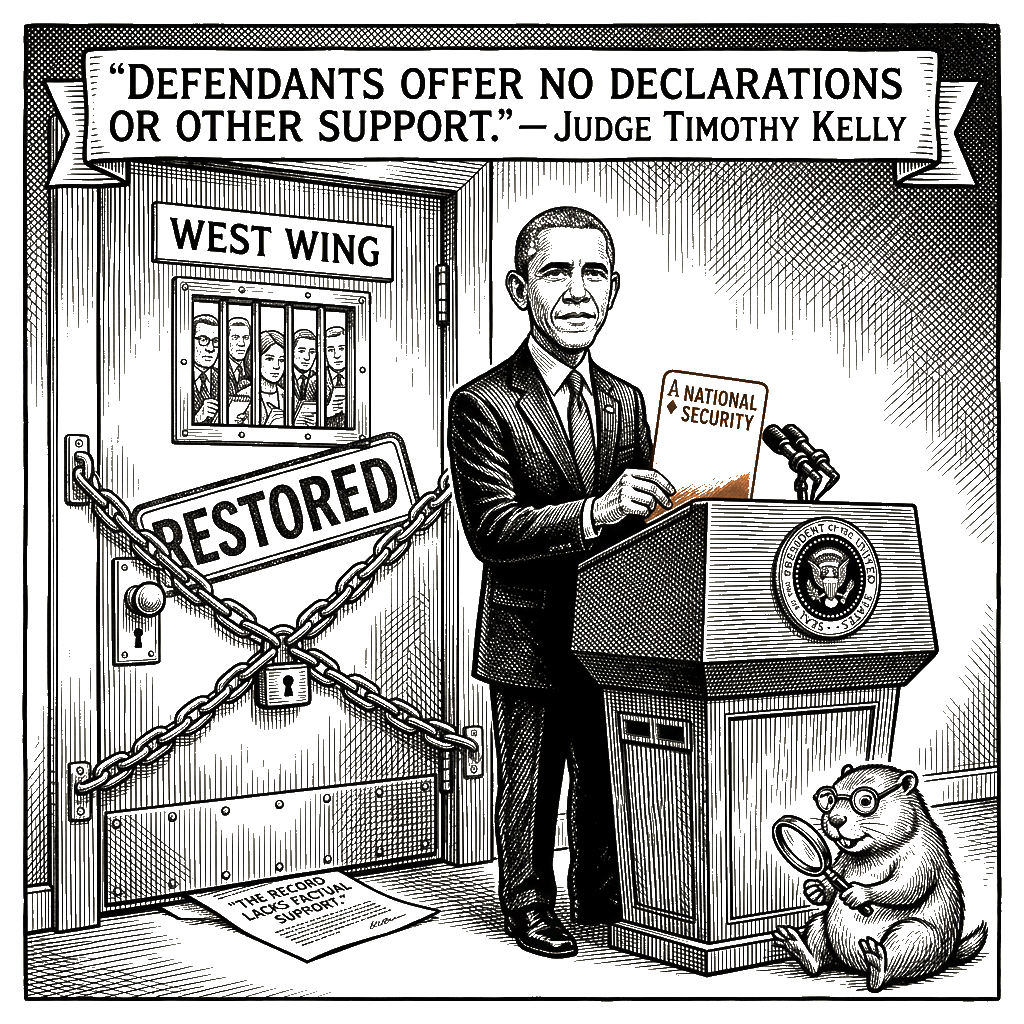
The President of the United States banned reporters from the White House, defied a federal court order to let them back in, and could not produce a single piece of evidence to justify either move.
Steel-man the government’s position first. The White House is a classified facility. Every president since Kennedy has controlled who holds hard passes, and that authority has bipartisan roots: credential revocations under Obama, under Bush, under Clinton — none triggered adversarial hearings, and courts generally declined to intervene. The executive has institutional competence over security assessments that judges lack. Reporters have never held a constitutional right of entry to the West Wing. The Secret Service clears credentials. The White House Press Secretary grants or withholds them. That is administrative practice, not constitutional adjudication. The strongest version of this argument says the president’s press secretary is exercising the same gatekeeping function every predecessor exercised, the security rationale need not survive judicial cross-examination because the press credential is a privilege, not a right, and the judiciary lacks the institutional competence to second-guess the executive’s security determinations about its own building.
That is a defensible posture — if the administration can back it.
On due process, the government had a parallel argument. Credential revocations have historically operated as administrative actions, not quasi-judicial proceedings. Requiring the government to hold a hearing before revoking a hard pass would impose adversary-process costs on a security function that needs to move fast. Press credentials are institutional arrangements governed by practice, not by statute. The credential is the White House’s property to grant or withhold, analogous to a government employment badge — revocable at will, not after a trial.
That too is a defensible argument on the abstract legal question. It is the argument the working SCOTUS bar would recognize as the executive’s strongest hand.
The problem is that the administration did not make that argument. It made a different one. It said national security. And it could not support the claim.
Judge Timothy Kelly of the U.S. District Court for the District of Columbia found that the record — the actual evidentiary record before the court — contained nothing. “Simply put — the record lacks factual support for Defendants’ contention that the revocation of Plaintiffs’ hard passes will in fact protect national security or that national security will be endangered if the Court orders their passes reinstated while this litigation proceeds,” Kelly wrote. “Defendants offer no declarations or other support — classified or unclassified — explaining how any of the reporting they identified in their letters to Plaintiffs damaged the national security.”
Read that again. The administration chose national security as its justification. It chose it because national security is the strongest card in the deck — the argument that makes a judge hesitate, the argument that historically courts defer to, the argument that shuts down discovery before it starts. The administration played the strongest card and produced no evidence to play it with. No classified exhibit. No unclassified declaration. No memo from the Director of National Intelligence, the Secretary of Homeland Security, or the Secret Service. Nothing.
Kelly also found the news outlets were “likely to succeed in showing that their hard passes were revoked without constitutionally adequate due process.” That holding matters. Kelly was not saying credential revocations always require adversarial hearings. He was saying that when the government revokes credentials and cites national security, it must at minimum provide some evidentiary basis for the security claim. The constitutional floor is not a full trial. It is notice of the reason and a fair opportunity to respond. The administration supplied neither the notice nor the substance.
That is the gap between the steel-man and the record. The executive’s strongest argument rests on institutional competence and deference. Kelly denied deference because the administration did not do the work deference requires. You do not get the benefit of the security rationale when you cannot identify the security interest. You do not get the benefit of the adversarial-process exemption when you have no process at all.
The ironies compound. On Saturday, Trump announced through Truth Social that reporters from CNN, MS NOW, and Politico would be barred. The three outlets sued Monday under the First and Fifth Amendments. By Wednesday night, Kelly had ordered the administration to restore their access for at least two weeks.
The reporters arrived Thursday morning. The White House turned them away again.
No reason. No explanation. No evidence of a security threat that materialized between the Wednesday order and the Thursday morning denial. The administration was, at that point, defying a federal judge’s explicit order. The judge had already found the national-security rationale unsupported. The White House denied access anyway.
Kelly ordered the Department of Justice to respond by 12:30 p.m. EDT to a new court filing notifying him of non-compliance with his temporary restraining order. The reporters were still being turned away.
Then the door opened.
Laura Barrón-López walked through the northwest gate and described the procedure on MS NOW: “They first cleared me through that outer perimeter, and then I arrived at the northwest gate, showed my government ID again, and was returned my badge.” That is a routine now. Routines get repeated. Routines get defended. Every reporter who walks through that gate from now on walks through a gate a federal judge had to order opened.
Ted Boutrous, who represents the three outlets, called the ruling “a strong ruling vindicating freedom of the press, due process and the rule of law.” He was being polite. What the ruling actually established is that a president cannot simply decide who gets to ask him questions, revoke the credentials, cite national security with nothing behind it, and replace evidence with a Truth Social post. The strongest version of the executive’s own authority — institutional competence over its own facility, security assessments judges lack the expertise to second-guess — requires that the executive actually make the assessment and produce the basis for it. Kelly held the administration to its own theory and found the administration had not bothered to do the work.
The five major television networks have already pulled their regular pool duties in protest, including coverage of the president’s trip to the United Nations General Assembly in New York. That withdrawal is leverage. The American press corps collectively told the White House: if you ban our colleagues for doing their jobs, we will not help you broadcast yours. All three organizations were formally readmitted by Thursday evening. Whether the major networks resume pool coverage remains to be seen.
The administration’s pattern is visible: ban, sue, lose, delay, comply under protest, find the next way to restrict. Every outlet covering this administration should be reading that pattern now. The administration’s ban was clumsy enough to be litigable. Not every restriction is. Not every press-freedom violation comes with a Truth Social post, a Saturday denial, a Monday lawsuit, a Wednesday ruling, and a Thursday compliance fight. Most press restrictions arrive quietly: delayed credential renewals, selective pool assignments, background-only briefings, access narrowed one reporter at a time, reporters who suddenly “do not really cover the White House” anymore.
The loud version is the opening. The quiet version is the work.
The judge’s language is the weapon. “Defendants offer no declarations or other support” is a sentence another newsroom can place in another filing. The administration has handed future plaintiffs the exact rebuttal to its own national-security claim. Kelly’s finding about constitutionally inadequate due process is not only about three newsrooms. It is a warning about every press credential in the executive branch. Pulling a hard pass requires a record. “I don’t like them” is not a record.
This is the fight the press can win — not because the press is powerful, but because the administration could not meet its own burden. The administration chose the easiest possible terrain for a constitutional challenge: a public ban, against three named outlets, justified by national security, supported by no evidence, followed by defiance of a court order. The administration had the doctrinal architecture behind it — decades of deference, the security-facility rationale, the bipartisan credentialing practice. It squandered all of it by declining to do the one thing that architecture requires: produce the evidence that national security was at stake. The administration lost on the strongest possible ground for losing.
For every newsroom that stayed quiet, the template is public. Sue fast. Cite the First and Fifth Amendments. Ask for an emergency hearing. Force the government to produce its national-security record. Get a judge who can write: “Defendants offer no declarations or other support.”
The reporters got back in. The question now is how many other bets the administration intends to lose the same way.