
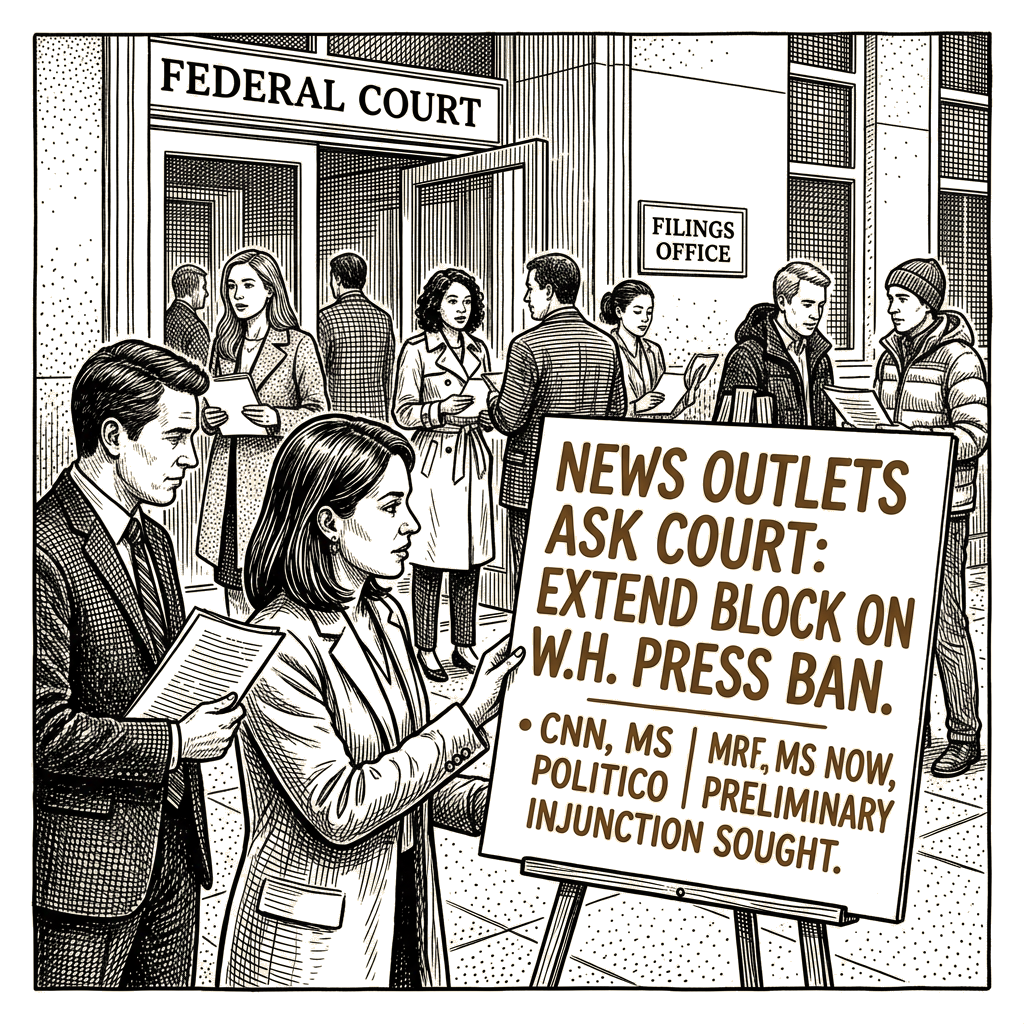
The Trump White House is punishing CNN, MS NOW, and Politico for their coverage by locking them out of the broadcast pool — after a federal judge ordered their press passes restored. The administration appealed nothing. It just rewrote the rule.
That fight landed at U.S. District Judge Timothy Kelly’s courthouse Monday night. In a 42-page filing, lawyers for the three outlets asked Kelly to convert his temporary restraining order into a preliminary injunction that would keep press access alive until the underlying case resolves. The TRO expires Oct. 8. The filing argues the White House has already shown it will honor the letter of Kelly’s order, not the spirit. The outlets say the administration has “persisted in unpredictably and inconsistently implementing its ban” — including barring CNN from its designated role as television network pooler on Sept. 26 and from Air Force One on Saturday for the president’s trip to a Tennessee football game. The other pool networks, in solidarity, declined to send a replacement.
This is what a ban looks like after it’s been told it can’t be a ban. Same substance, thinner shape.
Before that filing lands in Kelly’s courtroom, the strongest version of the White House’s position needs to be on the table. The administration’s legal theory, articulated most fully by Attorney General Todd Blanche on ABC Sunday, rests on two pillars. First: the White House is the people’s house, but the president is its occupant, and he has broad authority over how his own communications and movements are covered. Access is a privilege the executive extends, not a constitutional entitlement the judiciary enforces. Second: the broadcast pool is a private White House accommodation — a practical arrangement for space-constrained coverage of the president’s activities — not a public forum subject to First Amendment scrutiny. The five-network rotation exists at the pleasure of the press office, and the press office may adjust it. Kelly’s own TRO addressed credentials, the argument goes, not pool composition. CNN’s pass is restored. The pool is a separate question.
Blanche stated the principle directly. “When it comes to the White House, it is the people’s house. It is a privilege, and not a right, to be there,” he said on ABC. “The president has every right to decide who gets to fly on his plane.”
That is a coherent legal posture. It is also, at this point, a defeated one.
The 42-page filing dismantles it on the record. The White House, the plaintiffs wrote, “has persisted in unpredictably and inconsistently implementing its ban, including by barring CNN from fulfilling its role as designated television network pooler on Sept. 26 — to the detriment of CNN, its fellow pool members and, ultimately, the American public.” CNN received no official communication from the White House explaining its exclusion from Air Force One. Because CNN was excluded and no replacement designated, no primary television network pooler accompanied the president on the trip. The other networks refused to fill the seat — not as a scheduling choice, but as a statement of institutional solidarity against the underlying act.
That record does what the steel-man requires: it turns the administration’s own theory against itself. If pool selection is a core presidential prerogative of communication, then the purpose of exercising that prerogative is relevant to whether the exercise is lawful. The filing makes the purpose explicit. “The president and his administration have continued to make clear that this ban has only one purpose: to punish reporting he doesn’t like,” said Theodore J. Boutrous Jr., the lead attorney for the three outlets. “That’s retaliation and viewpoint discrimination, pure and simple.”
Kelly already flagged the weakness. In last week’s order granting the temporary restraining order, he wrote: “The court is skeptical … that defendants’ interest in safeguarding national security is the actual motivation” for the removal of access. Blanche raised the national-security frame on Sunday — coverage he calls “misinformation” amounts to a security problem — but Kelly was skeptical of that argument before Blanche made it publicly, and the record the filing constructs on Monday gives the judge additional reason to remain so.
The “privilege, not a right” framework fails for a second reason that the pool’s institutional design makes concrete. The broadcast pool is not five independent networks competing for presidential access. It is the mechanism by which one camera covers the president on behalf of all the others when space is limited. When the White House selects which pool member flies on Air Force One, it selects, in effect, which lens the country sees the president through. Excluding CNN from the pool does not leave CNN free to cover the president by other means — there are no other means for pool-range access to the president’s movements. The credential is restored. The access is not. The “private accommodation” that the pool represents is the only accommodation that exists, and removing one member from it achieves the practical effect of the original ban while leaving its formal structure intact.
That is the playbook. It is a fragile one, and it depends entirely on the networks maintaining a solidarity arrangement that the White House is actively working to fracture. For now, the pool networks are addressing the standoff on a case-by-case basis. On Sunday, Fox covered a pool event. On Monday, NBC was in the Oval Office. CNN is not back in the rotation until Thursday. If CNN is again barred from a pool event, the networks will decide together — presumably based on the newsworthiness of the situation — whether to send a replacement or to refrain. David A. Schulz, who runs the Media Freedom and Information Access Clinic at Yale Law School, put the question plainly: “Who’s going to back down first?”
The likely answer, for now, is that nobody will — because the judge is going to make the call for them. If Kelly grants the preliminary injunction, the administration will be ordered to stop not just the original ban but the pool-manipulation substitute for it. If he does not, the White House will have learned that a TRO with an expiration date is a temporary inconvenience, not a constraint — and that a federal judge’s explicit skepticism of the administration’s stated motivation carries no weight the administration need respect after the calendar runs out.
Either way, the administration has now established something it did not have before last week: a working playbook for press suppression that survives a court order. Judge Kelly called the national-security justification pretextual. The filing showed the ban’s actual purpose is retaliation for unfavorable coverage. The question now is whether the court will recognize that a ban disguised as a pool-rotation decision is still a ban — or whether the White House will have found, in the gap between a credential and a rotation slot, the room it needs to punish the press while a judge watches.