
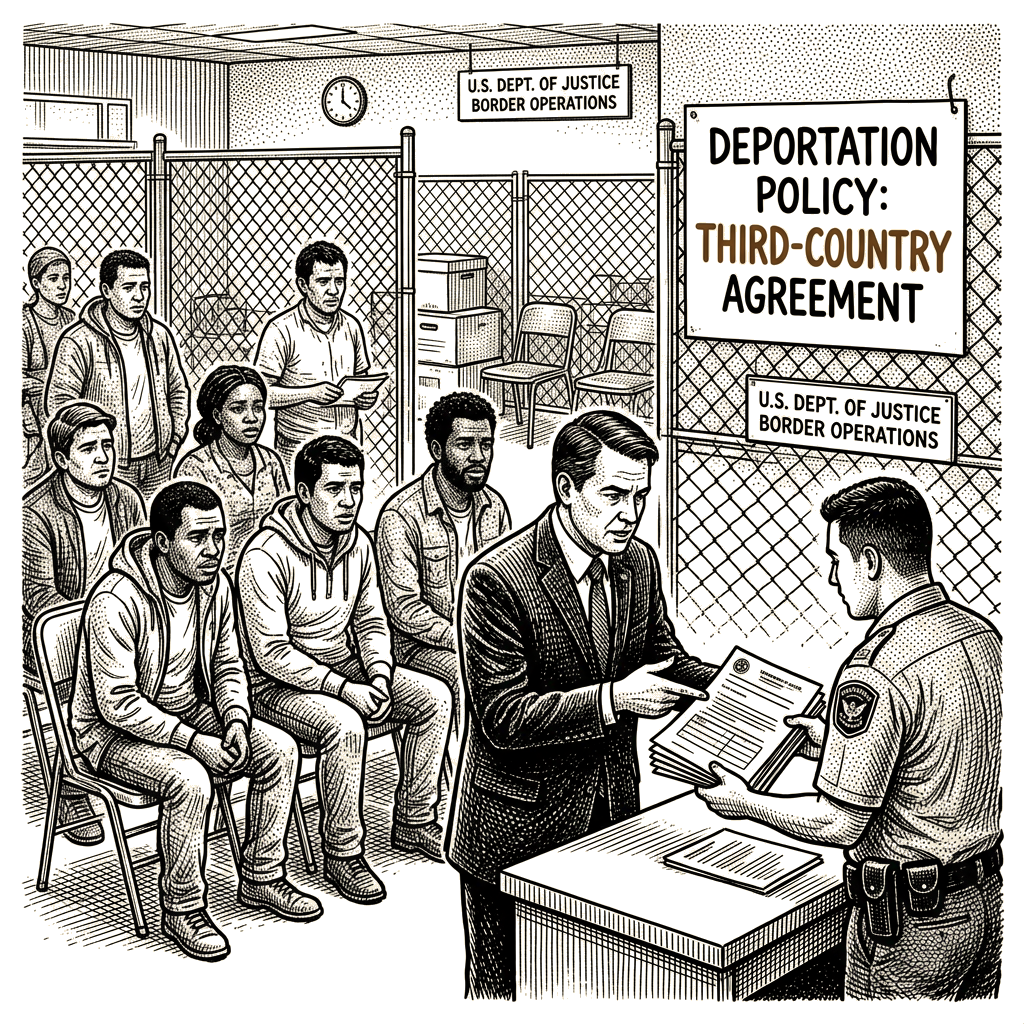
Todd Blanche is asking the Supreme Court to erase due process from deportations.
The administration is not litigating one removal policy. It is building a third-country deportation regime that sends migrants to nations with which they have no connection, often with little notice and limited opportunity to raise fears of torture or persecution. More than 25,000 people have already been moved to at least 29 countries. The flights are landing. The pipeline is running. The Boston courts have now ruled that the machinery is unlawful.
Attorney General Blanche announced Thursday that the Justice Department would seek emergency relief from the Supreme Court, one week after a three-judge federal appeals panel in Boston upheld a lower-court decision striking down the Department of Homeland Security’s third-country removal process. Blanche accused the panel of blocking the policy “in the dark of night” without allowing the government to respond. He called the program “an entirely legal and invaluable tool to stem the tide of illegal immigration.”
He also noted that the justices “previously granted a stay in this very same case.”
That earlier stay is the administration’s theory of the case. The Supreme Court has already intervened once. Blanche is asking it to intervene again, this time to rescue an operation that has expanded across the globe before the courts could decide whether the government was following the required procedures.
The strongest version of the administration’s argument is straightforward. A country cannot remove a person to the country of origin when that country refuses to accept the person. Third-country agreements give the government another destination. Foreign governments may choose to cooperate. Enforcement cannot function if every removal becomes a years-long litigation contest. The government therefore says the executive branch needs room to arrange removals, and federal judges should not convert procedural safeguards into a veto over immigration enforcement.
That argument has force up to the point where the government treats destination as disposition. A third-country removal is not merely a change in airline routing. It can strand a person in a country they do not know, without family, legal support, or meaningful protection from persecution. The Boston litigation concerns the procedural question the administration wants to skip: what notice and opportunity must the government provide before it sends someone into that danger?
The numbers already show the scale of the operation. Third Country Deportation Watch, a project run by Refugees International and Human Rights First, reports more than 25,000 third-country removals to at least 29 countries. Mexico has absorbed the largest share. The other destinations span Latin America, the Caribbean, Central Asia, and Africa. The list includes countries the State Department ranks as high-risk, including South Sudan and the Central African Republic.
Liberia appears in the record as a destination: an AFP/Getty photograph published with the report shows police guarding a plane carrying migrants deported from the United States at Roberts International Airport in Harbel on 20 August 2026. A small West African republic has been placed on the front line of American interior enforcement, receiving people who may have no relationship to Liberia at all.
The administration describes that arrangement as sovereign cooperation. The Boston court examined what happens to the people placed inside it.
DHS General Counsel James Percival supplied the government’s moral frame on X: “What is cruel is allowing criminal illegals who can’t be sent home to stay in our communities and victimize anew.” The administration’s argument is that removal itself protects the public, while judicial intervention protects dangerous people from consequence.
That framing deletes the person standing at the airport.
The question is not whether the government may remove people who lack lawful status. The question is whether executive officials may choose a distant country, arrange the transfer, and make the person litigate afterward from inside a system they never chose. Procedural due process is not an immigration subsidy. It is the rule that government must provide notice and a meaningful chance to present a legally relevant claim before it inflicts the harm.
The administration has spent the past year building this architecture in plain sight. It has negotiated agreements with governments from Mexico to South Sudan to the Central African Republic. Each agreement extends American removal power into a new jurisdiction. Each flight normalizes the next one. Each completed removal creates a factual argument for the policy’s continuation: the program exists, foreign governments are cooperating, and thousands of people have already been moved.
That is how an emergency power becomes an operating system.
The administration has been preparing the Supreme Court for this request. In June, it asked the justices to bless a separate policy permitting the indefinite detention of immigrants without bond hearings. The legal issue differed, but the institutional demand was the same: replace judicially enforced procedure with executive assurance. The government asks first for deference, then for speed, then for permission to continue the policy while the courts decide whether the policy was lawful.
The Supreme Court’s emergency docket has repeatedly provided that sequence in immigration cases. The administration’s bet is simple: keep going up the ladder until a court says yes.
The third-country program is now the centerpiece of the removal strategy. It reduces the importance of country of origin, expands the number of governments available as destinations, and turns procedural review into an obstacle to be cleared after the machinery is already moving. Mexico is one brick. Equatorial Guinea is another. Eswatini, South Sudan, Liberia, and the Central African Republic extend the wall.
The Supreme Court must decide whether that wall can stand. The question is not whether to start a third-country removal regime. Twenty-nine countries are already inside it. More than 25,000 people have already been moved. The question is whether the justices will erase the hearing that was supposed to come first.