
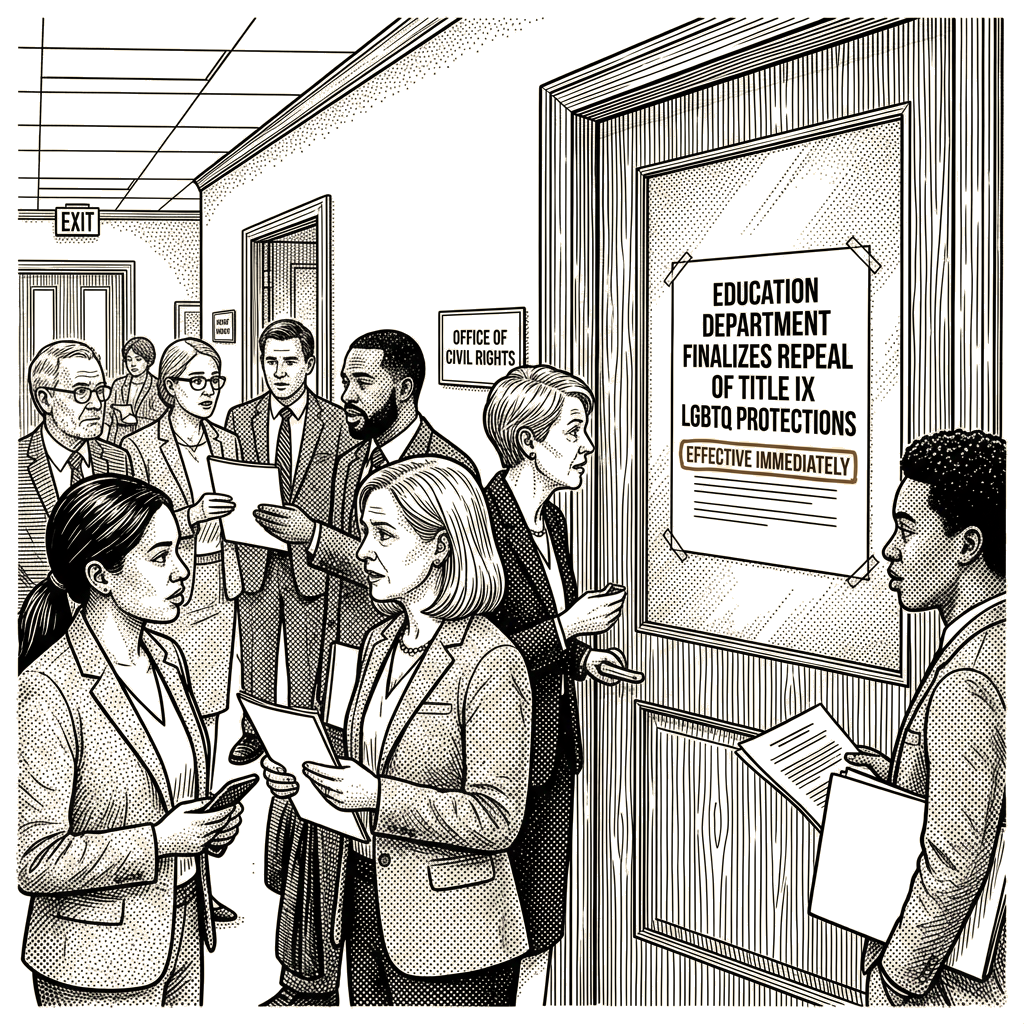
Trump and McMahon are handing trans children back to school bullies.
Linda McMahon called the rollback “commonsense language” when she announced it Monday, the same word the right has reached for, generation after generation, when stripping rights from people it does not care to protect. The final rule dismantles the Biden administration’s 2024 Title IX protections for transgender students, including protections for gender identity and preferred pronouns. Federal protections that trans students spent years building are now gone by bureaucratic signature.
This is not a technical adjustment. It is the announced policy of the United States government to remove the legal scaffolding around transgender children in public schools and call that reform.
McMahon says the regulations “faithfully reflect court orders and Congressional intent — reducing confusion for parents, students, and educational institutions.” Faithful is one word for it. Another is surrender. The administration is following last year’s court ruling overturning the Biden rule, but the courts did not require the Education Department to make federal protection thinner than it was. The department chose that. It also chose to tighten the standard for school discrimination cases to require intentional discrimination and rescind the Biden-era disparate-impact rule. Each move is a retreat. Together they form a coordinated withdrawal of federal responsibility from the children most exposed to it.
The “confusion” being soothed is not the confusion of the trans child. It is the discomfort of administrators who would rather not have to think about trans children at all. By tomorrow morning, a student may face a teacher who refuses their name, a bathroom dispute, a roster decision, or harassment that the school no longer feels compelled to address under the same federal floor. The uncertainty has not disappeared. It has been transferred to the child.
And then to the parents.
At 11 p.m., the household spreadsheet is open. The columns are not abstract: therapy, transportation, a private-school premium, the hours spent calling the principal, the wages lost to meetings and school fights, the legal consultation that was never on the back-to-school supply list. The parent is deciding whether to take another afternoon off work, pay for an advocate, move schools, or keep a child in a building that has learned the federal government may no longer insist on a plan.
That is the budget translation of “statutory fidelity.” Federal protection was the cheap option. It gave every school a baseline rule and every parent a place to appeal. Removing it downloads the cost onto individual families as time, money, risk, and exhaustion. The state saves administrative responsibility; the household pays in unpaid labor.
A parent calls the principal. The principal says the district is reviewing its policy. The parent calls the PTA. Someone says the school should not be forced to take sides. The child is still the one standing in the hallway waiting to learn whether the adults have decided that their name is real.
The “choice” is not a choice. It is the familiar consumer-precarity trick: turn a public protection into a private purchase. If the public school will not protect the child, buy another school. If the school will not resolve the dispute, hire counsel. If the child is anxious, pay for therapy. If the meetings consume work hours, absorb the lost wages. The market can provide an exit, for families with enough money to buy one. Everyone else receives a civics lesson in what deregulation means at a child’s desk.
Taylor Swift’s “You’re On Your Own, Kid” is not a policy brief, but its title names the care infrastructure this rule is building. The child is on their own with the principal, the roster, the bathroom, the locker room, and the adult who decides whether harassment is merely conflict. The lateral safety net — parents, other families, a sympathetic teacher, a group chat — is left to carry what federal civil-rights enforcement was supposed to carry publicly. That is not freedom. It is privatized protection.
Title IX still prohibits discrimination on the basis of sex in federally funded education. Congress enacted it in 1972, and the Supreme Court has affirmed the statute’s reach across decades. Those protections matter. Sexual-assault survivors matter. Due process matters for students facing a single uncorroborated accusation. The strongest argument for clarity is not an argument for abandonment, and protecting survivors does not require removing trans students from the category of students the law will defend.
Shiwali Patel, senior director of education justice at the National Women’s Law Center, said that sexual harassment and assault remain pervasive in schools and accused McMahon and the Trump administration of “weaponizing Title IX to attack trans students.” That is the right word and the right target. The rule is sold as a refinement of sex-discrimination law; its effect is to repurpose Title IX into a tool for narrowing who counts as a student the law will protect.
The Trump administration is not restoring Title IX to some neutral original meaning. It is choosing which children must bring their own money, time, and family stamina to the fight. It is telling parents that the federal government will no longer absorb the cost of making a school safe enough to attend.
Anne Helen Petersen writes that burnout “isn’t a personal problem,” and it will not be cured by a productivity app or a face mask. The parent who spends every Tuesday afternoon on school calls is not failing to optimize. The parent who cannot afford private school is not making a bad consumer decision. The family that cannot donate unlimited advocacy hours is not less committed to its child. The burden has been designed into the policy and then handed down as a family responsibility.
This is the same Education Department that wants to call withdrawal clarity, abandonment statutory fidelity, and a child’s lost protection commonsense. The final rule does not answer the question of how schools should protect every student. It answers the narrower question McMahon and her boss were sent to answer: how do we make federal law stop seeing trans students?
The answer is now on the table, in the principal’s office, on the PTA agenda, and inside the household spreadsheet.
The supply list has a new line item.
Legal help.
And the child is still on their own.