Victoria Police kept John Makai in custody while his brain injury went untreated.
That is the sentence the institutional language is trying to dissolve. Not “a tragic outcome.” Not “shortcomings.” Not “a situation the force works tirelessly to avoid.” A 58-year-old father of 10 suffered serious head trauma, was taken to a police station instead of a hospital, and remained there while the injury worsened. The footage now before the Victorian coroner’s court supplies the receipts.
Makai had been punched twice in the head by one of his sons during an evening of drinking at a house in Sunbury. When police arrived, he struggled to stand and collapsed into a bookcase while trying to sit down. Officers supported him to the divisional van. By the time they reached Broadmeadows, about 20 minutes later, he could no longer stand.
The officers dragged him from the van by his legs. His head struck the floor and walls during the transfer. They placed him on the ground, lifted him under the arms, and dragged him into a cell. The court heard that he made no verbal response during the transfer and never made one at the station.
Those facts do not prove every question the inquest must answer. They do establish the power relationship. Makai was in police custody. He could not take himself to a hospital, summon a doctor, or walk out of the cell. Victoria Police had assumed control of his body and his access to care. Once the state takes that control, “we did not know” is not a moral defense. It is a question about what the state chose to notice, record, investigate, and do.
The footage reportedly shows Makai repeatedly failing to respond when officers checked on him. Officers twice claimed that he had responded, counsel assisting Rachel Ellyard told the court, even though the CCTV showed no such physical response. That is not a minor disagreement between memory and video. It is the difference between an institution’s account of its vigilance and the record of what happened inside its walls.
The first ambulance request came at 1.25am. Police described Makai as having a “minor facial injury” and being in “a very deep sleep” because of drunkenness. The phrase “minor facial injury” carried a man’s deteriorating condition across the dispatch system in a form that made urgency easier to miss. What was described as deep sleep was, the inquest heard, the increasing effect of traumatic brain injury and bleeding into the brain.
The dispatch layer then failed as well. Ambulance Victoria told police it was struggling with workload. Because of an issue involving “multiple associated events,” the request was wrongly cancelled or failed to remain logged as outstanding. Ryan Goon, the director of operations support for Triple Zero Victoria, told the court that the first caller at the Sunbury house had later cancelled an ambulance request, and the system did not preserve the separate police request.
That is a second institutional failure, not an alternative to the first. Victoria Police held Makai in custody without getting him medical attention. Triple Zero Victoria failed to keep the request alive. The existence of a dispatch error does not erase the police responsibility that preceded it. A power structure does not become innocent because two of its layers failed in sequence.
The second ambulance call came roughly five or six hours later. A custody sergeant reported that Makai was breathing, that officers had tried sternum rubs, and that “we can’t get any verbals out of him.” The sergeant also said he had been snoring heavily and had not responded since he arrived. The operator asked: “Unconscious? And you haven’t had any response for six hours?”
The sergeant then said officers had been checking Makai every 15 minutes. Counsel assisting said the CCTV review showed that claim was incorrect. The point is not that a protocol existed on paper. The point is that the record must establish whether the protocol was followed, whether Makai was responsive, and who had the duty to act when he was not.
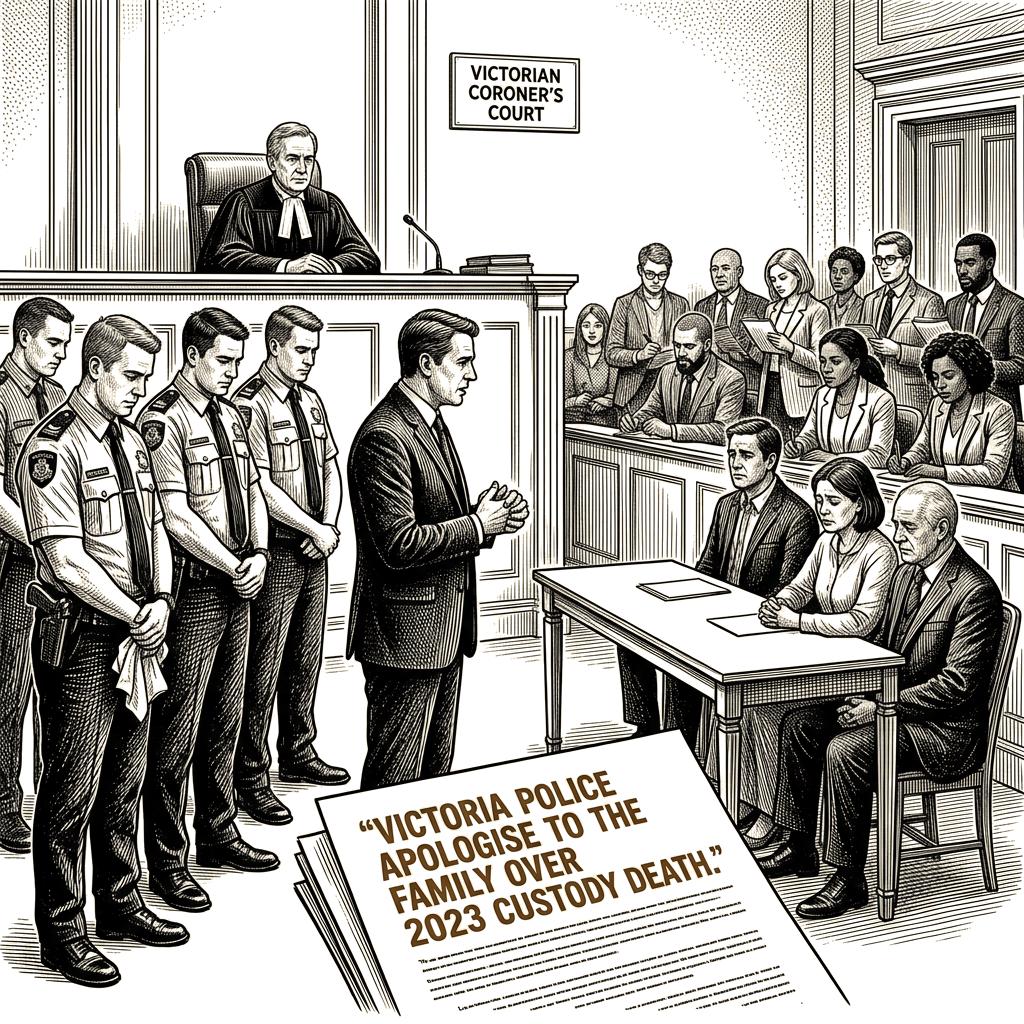
The chief commissioner’s lawyer, Andrew Imrie, apologized to Makai’s family and said his care “was not at the standard that … any member of the Victorian community is entitled to expect.” The apology matters. It does not settle responsibility.
The language of “failure” and “shortcomings” performs a familiar act of administrative concealment: it describes the breakdown without naming the people and institutions that controlled the decisions. The chief commissioner’s office benefits from that language because it converts custody, observation, inaccurate reporting, risk assessment, medical triage, and delayed escalation into a cloud called “the situation.” The cloud has no hands. It cannot be cross-examined. It cannot lose command authority.
But Mike Bush’s office is not merely observing this inquest from the public gallery. Its lawyer entered an apology on its behalf. The office commands the institution whose officers took Makai to the cells, failed to complete the medical checklist, failed to complete a risk assessment, failed to recognize his deteriorating condition, and failed to conduct adequate checks, according to the evidence summarized in court. Disciplinary action was taken “where a basis was available.” That phrasing tells its own story: accountability is made to sound like a technical opportunity rather than a duty owed to a man who was under police control.
The inquest will examine what treatment Makai might have received had he been taken directly to hospital. It will examine the cause and circumstances of his death, the dispatch failure, the custody practices, and the changes made after he died. Those questions must remain open until the evidence is heard. But uncertainty about the final medical counterfactual does not create uncertainty about the documented chain of custody.
Makai was visibly unable to stand. His head struck surfaces during the transfer. He was placed in a cell without producing a verbal response. He was described to ambulance dispatch as having a minor facial injury. Officers claimed responses that CCTV did not show. A later review disputed the claimed 15-minute checks. The first ambulance request did not result in dispatch. The second came after hours had passed.
The publication has previously reported on the release of body-camera footage in a custody death. The lesson here is not that one police force should be compared favorably with another. It is that footage is a counter-record. It makes the institution’s language answerable to the body, the room, the timestamp, and the act.
King’s late work insisted that a society cannot repair what it refuses to see. He made that argument most sharply when he moved from individual acts to the system that produced and protected them, in the years after the 1963 demonstrations and especially in his 1967 structural speeches. The point was never to replace one convenient culprit with another. It was to refuse the escape hatch in which every person is responsible for a fragment and no institution is responsible for the whole.
John Makai was not a fragment. He was a man in state custody. Victoria Police had the authority. Triple Zero Victoria had the dispatch function. The chief commissioner’s office has the command responsibility and the public duty to tell the truth about what its officers did.
An apology is not yet an answer. A policy review is not yet repair. A disciplinary file is not yet accountability. The record must name the custody decisions, the false observations, the missed checks, the broken dispatch chain, and the officials responsible for maintaining a system in which a man could be visibly unresponsive in a police cell while the language of “deep sleep” carried more authority than his body.
The inquest continues. So must the demand.
We name what happened. We name who held the power. We name who paid for its failure. And we refuse to let institutional regret become the final resting place of the truth.